


The increasing power density of artificial intelligence (AI) servers and high-performance computing (HPC) systems has accelerated the development of advanced liquid cooling technologies.
Within a liquid cooling system, components such as cold plates, manifolds, heat exchangers, mounting structures, and fluid channels must operate reliably under continuous thermal and mechanical conditions.
Material selection plays an important role in determining the performance, manufacturability, durability, and cost structure of these components.
Among the materials commonly considered for liquid cooling applications, aluminum, copper, and composite materials each offer different engineering characteristics.
Rather than identifying a single “best” material, engineers typically evaluate materials based on application requirements, including:
- Thermal performance
- Mechanical strength
- Weight
- Corrosion considerations
- Manufacturing requirements
- System integration
This article compares aluminum, copper, and composite materials for liquid cooling components used in AI infrastructure.
The Importance of Material Selection in Liquid Cooling Systems
A liquid cooling system contains multiple components with different functional requirements.
Examples include:
- Cold plates
- Manifolds
- Coolant channels
- Distribution plates
- Structural brackets
- Heat exchangers
- Mounting interfaces
Each component may have different priorities.
For example:
A cold plate may prioritize thermal transfer.
A manifold may prioritize:
- Fluid distribution
- Mechanical integration
- Manufacturing complexity
A support structure may prioritize:
- Lightweight design
- Mechanical stability
Therefore, material selection should be based on the role of each component within the system.
Aluminum for Liquid Cooling Components
Aluminum is widely used in industrial thermal management and mechanical systems.
Common aluminum applications include:
- Cold plates
- Manifolds
- Cooling brackets
- Structural supports
- Liquid cooling frames
Advantages of Aluminum
Lightweight Characteristics
One of aluminum’s major advantages is its relatively low density.
Compared with copper, aluminum components can significantly reduce structural weight.
Potential benefits include:
- Easier installation
- Reduced handling requirements
- Lower mechanical load on supporting structures
This can be valuable in large-scale AI infrastructure deployments.
Manufacturing Flexibility
Aluminum is compatible with many manufacturing processes.
Common methods include:
- CNC machining
- Aluminum extrusion
- Die casting
- Vacuum brazing
- Sheet fabrication
This flexibility allows engineers to develop customized cooling components for different system architectures.
Corrosion Considerations
Aluminum naturally forms an oxide layer that provides some surface protection.
However, liquid cooling applications require careful evaluation of:
- Coolant chemistry
- Operating conditions
- Contact with other metals
- Long-term maintenance requirements
Material compatibility remains an important consideration.
Weight-to-Performance Balance
In many infrastructure applications, engineers consider not only thermal conductivity but also the overall system balance.
Aluminum provides a combination of:
- Moderate thermal performance
- Low weight
- Good manufacturability
which makes it suitable for many cooling component designs.
Copper for Liquid Cooling Components
Copper has long been used in thermal management applications due to its excellent thermal conductivity.
Common applications include:
- High-performance cold plates
- Heat spreaders
- Thermal interfaces
Advantages of Copper
High Thermal Conductivity
Copper provides higher thermal conductivity compared with aluminum.
This characteristic can be valuable in applications where maximum heat transfer capability is a primary requirement.
Proven Thermal Technology
Copper has extensive application history in:
- Electronics cooling
- Industrial heat exchangers
- Power electronics
Its thermal properties are well established.
Challenges of Copper
Higher Density
Copper is significantly heavier than aluminum.
Potential considerations include:
- Increased component weight
- More demanding mechanical support
- Transportation impact
Manufacturing Considerations
Copper machining may involve different challenges compared with aluminum.
Factors include:
- Tool wear
- Machining conditions
- Production cost
Cost Considerations
Copper material costs and processing requirements may influence the overall component cost.
For large-scale infrastructure deployment, cost optimization can become an important factor.
Composite Materials for Liquid Cooling Applications
Composite materials represent another development direction for thermal management systems.
Depending on design, composites may combine different materials to achieve specific properties.
Potential applications include:
- Lightweight cooling structures
- Thermal interface components
- Hybrid cooling assemblies
Potential Advantages of Composites
Lightweight Design
Some composites may provide high stiffness-to-weight ratios.
This may support applications where weight reduction is important.
Tailored Properties
Composite materials can potentially be engineered for specific requirements, including:
- Thermal conductivity
- Mechanical strength
- Chemical resistance
Challenges of Composites
Manufacturing Complexity
Compared with conventional metals, composites may require more specialized processing.
Challenges may include:
- Production consistency
- Cost control
- Quality inspection
Long-Term Qualification
For critical infrastructure applications, materials often require extensive validation.
Important considerations include:
- Thermal cycling
- Mechanical durability
- Environmental stability
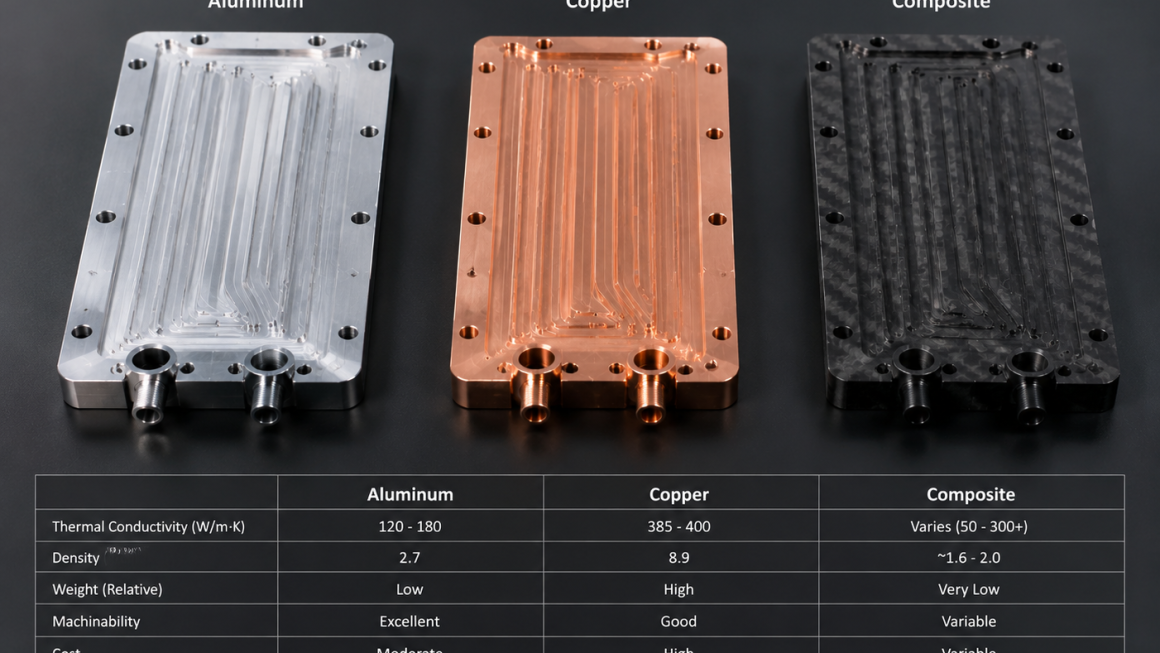
Aluminum vs Copper vs Composites Comparison
| Factor | Aluminum | Copper | Composites |
|---|---|---|---|
| Thermal Conductivity | Moderate | High | Depends on design |
| Weight | Low | High | Potentially low |
| Machinability | Excellent | Good but more demanding | Application dependent |
| Manufacturing Flexibility | High | High | Variable |
| Cost Consideration | Generally favorable | Higher material cost | Variable |
| Industrial Maturity | Very mature | Very mature | Developing |
| Structural Applications | Excellent | Moderate | Application specific |
Material Selection by Component Type
Cold Plates
Cold plates often prioritize:
- Thermal transfer
- Manufacturing precision
- Coolant compatibility
Copper may be considered where maximum thermal conductivity is required.
Aluminum may be selected where weight, manufacturing flexibility, and system integration are important.
Manifolds
Manifolds typically require:
- Reliable fluid distribution
- Mechanical integration
- Precision manufacturing
Aluminum is frequently considered because of:
- Machinability
- Lightweight characteristics
- Structural capability
Cooling Support Structures
For brackets, frames, and mounting systems:
Aluminum is often suitable due to:
- Low weight
- Easy fabrication
- Corrosion resistance characteristics
Heat Exchangers
Material selection depends on:
- Heat transfer requirements
- Fluid compatibility
- System design
Different applications may use different material combinations.
Hybrid Material Approaches
Modern liquid cooling systems may not rely on a single material.
Examples include:
- Copper thermal interfaces combined with aluminum structures
- Aluminum manifolds with polymer tubing
- Composite components integrated with metal assemblies
Hybrid designs allow engineers to optimize each component according to its function.
Key Engineering Considerations
Thermal Requirements
The required heat transfer capability should be evaluated based on:
- Component power density
- Cooling architecture
- Operating conditions
Mechanical Requirements
Engineers consider:
- Pressure resistance
- Mounting forces
- Vibration
- Thermal expansion
Manufacturing Requirements
Production considerations include:
- Volume
- Machining capability
- Assembly processes
- Quality control
Lifecycle Considerations
Long-term reliability depends on:
- Material compatibility
- Maintenance strategy
- Environmental conditions
Future Trends
Integrated Thermal-Mechanical Design
Future AI cooling systems may increasingly combine:
- Structural functions
- Thermal functions
- Fluid management
within integrated components.
Advanced Aluminum Solutions
Development areas may include:
- Improved aluminum alloys
- Optimized channel designs
- Advanced surface treatments
New Composite Technologies
Composite materials may continue developing for specialized applications requiring customized performance characteristics.
Material selection for liquid cooling components is a complex engineering decision involving thermal performance, mechanical requirements, manufacturing capability, and lifecycle considerations.
Copper provides excellent thermal conductivity and remains an important material for high-performance thermal applications.
Aluminum offers a balanced combination of lightweight design, manufacturing flexibility, and structural capability, making it suitable for many liquid cooling components in AI infrastructure.
Composite materials represent an emerging direction where customized properties may provide new opportunities.
In modern AI data centers, the most effective approach is often not choosing one universal material, but selecting the appropriate material for each component based on its specific function within the cooling system.