As AI data centers expand and GPU server systems become more complex, mechanical infrastructure must accommodate increasingly demanding requirements for structural support, equipment integration, thermal management, and maintenance access.
Aluminum framing is widely used in modular equipment structures because it offers a useful combination of low weight, corrosion resistance, machinability, and design flexibility. However, not every AI infrastructure project benefits from the same type of aluminum profile.
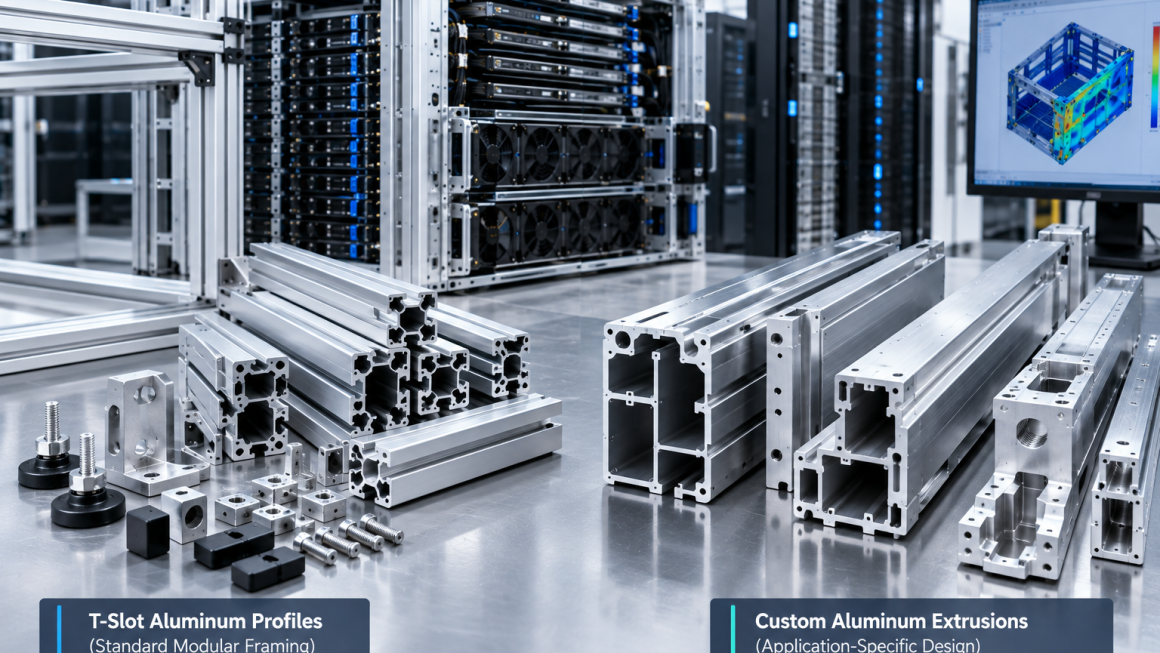
Standard T-slot aluminum profiles provide a convenient way to build adjustable frames and modular assemblies. Custom aluminum extrusions, by contrast, allow engineers to develop cross-sections tailored to specific structural loads, mounting interfaces, cable routing requirements, and cooling-related functions.
Understanding T-slot aluminum profiles vs. custom extrusion is therefore an important step in selecting the right manufacturing approach for AI server racks, equipment enclosures, cooling support structures, and other data center hardware.
The best choice depends on the application, production volume, structural requirements, assembly strategy, and expected product lifecycle.
1. What Are T-Slot Aluminum Profiles?
<AsyncImage query=”industrial silver T-slot aluminum extrusion profiles modular framing connectors assembly workbench realistic product photography” aspectRatio=”16:9″ width=”100%” />
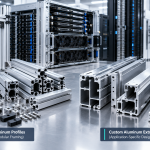
T-slot aluminum profiles are standardized extruded aluminum sections with longitudinal slots designed to accommodate compatible nuts, bolts, brackets, and connecting components.
Their main advantage is modularity. Engineers can assemble frames using standardized profiles and accessories without designing a unique cross-section for every project.
Typical applications include:
- Prototype AI server frames and equipment stands
- Modular test fixtures and laboratory equipment
- Adjustable mounting structures
- Cable management supports
- Auxiliary frames surrounding server or cooling equipment
- Engineering development platforms requiring frequent reconfiguration
Because the mounting slots extend along the profile, components can often be repositioned without machining new holes in the main structural member.
This flexibility makes T-slot profiles especially useful during early-stage development, equipment testing, and projects where the final layout may change.
However, standardization also introduces constraints. The profile geometry, slot dimensions, available accessories, and connection methods are limited by the selected product family.
For highly integrated production hardware, these limitations may justify a custom extrusion.
2. What Are Custom Aluminum Extrusions?
<AsyncImage query=”custom silver aluminum extrusion profiles with hollow cavities internal ribs mounting channels precision cut ends industrial manufacturing close up” aspectRatio=”16:9″ width=”100%” />
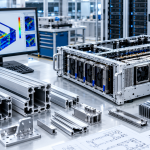
Custom aluminum extrusions are profiles designed around the functional requirements of a particular component or system.
Instead of selecting an existing standardized cross-section, engineers define the geometry required for structural performance, mounting, assembly, and manufacturing.
A custom AI infrastructure profile may integrate several features into one section, including:
- Structural walls and reinforcing ribs
- Hollow cavities for weight-efficient construction
- Dedicated mounting channels
- Panel-retention features
- Cable-routing passages
- Alignment features for adjacent components
- Surfaces intended for subsequent CNC machining
For example, a custom rack support profile could combine the primary load-bearing section with an integrated mounting channel and a panel-retention feature. This may reduce the number of separate brackets needed during assembly.
Custom extrusions also offer greater control over cross-sectional geometry, but they require engineering development and typically involve extrusion die costs, design reviews, and production qualification.
They are most attractive when a project requires repeated production of a defined component and the advantages of an optimized cross-section justify the initial investment.
3. T-Slot Aluminum Profiles vs. Custom Extrusion: Key Differences
The two approaches serve overlapping but distinct purposes.
| Evaluation factor | T-slot aluminum profiles | Custom aluminum extrusions |
|---|---|---|
| Initial development | Usually faster with standard components | Requires profile design and tooling preparation |
| Design flexibility | High at the assembly level | High at the cross-section level |
| Reconfiguration | Generally convenient | Depends on integrated interfaces and assembly design |
| Structural optimization | Limited to available standard geometries and connections | Cross-section can be tailored to the load case |
| Component integration | Often requires separate brackets and accessories | Multiple functions can be integrated into one profile |
| Tooling investment | Usually no new profile die for standard products | Custom extrusion die is generally required |
| Secondary machining | May be limited to selected mounting features | Can be planned around specific interfaces |
| Assembly complexity | Can increase with numerous connectors and brackets | May decrease when features are integrated |
| Best-fit applications | Prototypes, modular frames, adjustable equipment | Dedicated production hardware and specialized structures |
| Economic advantage | Often attractive for small quantities and changing designs | Can become attractive for repeated production and optimized assemblies |
These comparisons are general tendencies rather than universal rules. Actual results depend on profile size, alloy, connection design, supplier capability, machining requirements, order quantity, and the cost of assembly.
A custom extrusion is not automatically stronger or cheaper than a T-slot profile. Its advantage comes from the ability to optimize the geometry for a defined application.
4. Structural Rigidity and Load-Bearing Performance
Structural performance is one of the most important considerations when selecting aluminum profiles for AI infrastructure.
Server frames and auxiliary structures may need to support heavy equipment, maintain mounting alignment, and resist deformation during installation and operation.
T-slot profiles: modularity with connection-dependent performance
T-slot framing allows engineers to create structures quickly using standardized connectors. However, the stiffness of the completed assembly depends on more than the profile itself.
Connection brackets, fastener preload, joint geometry, unsupported spans, and load direction all influence the overall result.
For a lightly loaded equipment stand, this arrangement may be entirely adequate. For a structure supporting heavier modules or requiring precise alignment, the connection design deserves closer attention.
Custom extrusions: geometry designed around the load
A custom profile can place material where it contributes most effectively to stiffness and strength.
Depending on the loading conditions, engineers may use internal ribs, hollow sections, optimized wall distribution, or integrated mounting features to improve structural efficiency.
For example, a custom cross-member may be designed to resist bending in a particular direction while providing a dedicated interface for attaching a server tray.
Nevertheless, structural performance must be evaluated using the complete assembly, including joints, fasteners, mounting conditions, and the loads expected in service.
Practical recommendation: Use T-slot framing when modularity and rapid adjustment are the main priorities. Consider custom extrusion when the structural load paths, mounting geometry, or packaging constraints justify a dedicated profile.
5. Modularity vs. Integration
The fundamental difference between these approaches is the balance between modular assembly and functional integration.
When modular aluminum framing makes sense
T-slot profiles are useful when an engineering team needs to:
- Adjust component positions frequently
- Build several frame configurations from common components
- Develop prototypes before mechanical interfaces are finalized
- Assemble equipment with relatively simple tools
- Reuse existing profiles and accessories across multiple projects
This flexibility can reduce early-stage development effort and make design changes easier.
When integrated custom profiles make sense
Custom AI rack profiles may be preferable when the final hardware requires:
- A dedicated structural cross-section
- Integrated mounting and panel interfaces
- Reduced dependence on separate brackets
- A defined external envelope
- Repeatable production geometry
- Specific machining or finishing requirements
Integration can simplify the finished assembly, but it may also make later changes to the profile itself more expensive.
A useful design strategy is to keep frequently changed interfaces modular while optimizing permanent structural members through custom extrusion.
This hybrid approach can preserve flexibility without sacrificing the benefits of integrated geometry.
6. Weight Optimization and Material Efficiency
Weight reduction is often an important objective in AI server hardware, but it should be approached through structural engineering rather than material removal alone.
Standard T-slot profiles are available in various sizes and geometries. Engineers can select a suitable section for the intended loads, although the available choices may not perfectly match the application.
Custom extrusion allows more direct optimization of the cross-section.
Potential approaches include:
- Adjusting wall thickness according to structural demand
- Incorporating hollow cavities
- Adding reinforcing ribs where needed
- Removing redundant external features
- Integrating mounting functions into the main profile
A well-designed custom profile may reduce unnecessary material and the number of separate parts. However, the actual weight advantage must be verified against an equivalent functional assembly.
Comparisons should include brackets, fasteners, connectors, and other components required to complete the T-slot structure.
A profile that is heavier on its own may still produce a lighter assembly if it eliminates multiple additional components. Conversely, a custom section may add complexity without meaningful weight savings if the design does not justify the change.
Finite element analysis and physical testing can help evaluate these trade-offs when structural performance is critical.
7. Integration with Cooling Hardware and Cable Management
AI infrastructure increasingly requires coordinated packaging of structural frames, power distribution, networking, and cooling-related hardware.
The selected profile system can influence how efficiently these components fit together.
Cooling support structures
T-slot framing can provide adjustable mounting points for auxiliary manifolds, hose supports, equipment brackets, and test fixtures.
Custom extrusion may be more appropriate when a structural member needs to accommodate a specific cooling interface or maintain a defined clearance around hoses and fittings.
The distinction between a structural support and a coolant-containing component is important. A standard aluminum frame should not be treated as a pressure-bearing coolant channel unless it has been specifically designed and validated for that function.
Cable management
T-slot structures can accommodate add-on cable trays, clips, and brackets that can be repositioned as the layout changes.
Custom profiles can incorporate dedicated cable-routing channels or mounting features, potentially reducing the need for separate hardware.
The choice depends on cable density, bend-radius requirements, accessibility, and whether the cable layout is expected to change over the product lifecycle.
Thermal clearance
Both profile types can be designed around air-cooled or liquid-cooled equipment. Neither guarantees improved thermal performance by itself.
The mechanical structure must preserve the required airflow passages, coolant-line routing, component clearances, and service access defined by the system’s cooling architecture.
8. CNC Machining and Secondary Processing
Extrusion is only one stage of manufacturing an aluminum infrastructure component.
Depending on the design, the finished part may require cutting, drilling, tapping, milling, surface treatment, and dimensional inspection.
Standard T-slot profiles can often be cut to length and assembled using compatible accessories. This can reduce initial manufacturing preparation.
Custom extrusions can be designed with specific machining operations in mind. Engineers may define precision mounting holes, connector interfaces, end features, and other details according to the assembly requirements.
The best manufacturing strategy is not necessarily to integrate every feature into the extrusion. Some geometries are more economical to produce through secondary machining or separate components.
A design-for-manufacturing review should consider:
- Extrusion die complexity
- Profile straightness and dimensional requirements
- CNC machining access
- Material removal and cycle time
- Surface treatment and masking
- Assembly sequence
- Inspection and production consistency
For repeat orders, the combined cost of extrusion, machining, finishing, and assembly is more informative than the raw profile price alone.
9. Comparing Total Cost: Standard Profiles vs. Custom Extrusions
A meaningful cost comparison should include both upfront and recurring expenses.
T-slot profile cost structure
Typical cost elements include standard profile material, connectors, fasteners, cutting, any required machining, and assembly labor.
This approach can be economical for prototypes, small production runs, and applications where design changes are frequent.
However, a large assembly containing numerous brackets and connectors may accumulate substantial hardware and labor costs.
Custom extrusion cost structure
Custom profiles typically involve engineering preparation and die costs, followed by recurring expenses for extrusion, cutting, machining, finishing, inspection, and assembly.
The initial investment may be higher, but integration can reduce recurring part count or manufacturing effort.
The break-even point depends on the project. A simple comparison can be expressed as:
Total project cost = initial engineering and tooling + recurring unit cost × production quantity
For a fair comparison, both options must deliver equivalent structural performance, interfaces, finish, and serviceability.
The T-slot option should include all required connectors and assembly operations. The custom extrusion option should include tooling amortization and any secondary machining.
There is no universal production quantity at which custom extrusion becomes cheaper. The result depends on the actual design and supplier quotations.
10. Prototype, Pilot Production, and Mass Production
The preferred profile strategy can change as a project develops.
Prototype stage
T-slot framing is often useful when dimensions, equipment positions, or service procedures are still being evaluated.
It enables engineers to adjust the layout without immediately committing to a dedicated extrusion die.
Pilot production
During pilot production, the design becomes more stable. This is a useful stage to compare the standard modular assembly with a custom profile concept.
Engineers can measure assembly time, verify load performance, identify redundant components, and estimate the production economics of alternative designs.
Mass production
When the design is stable and demand is repeatable, custom extrusions may offer advantages through integrated interfaces, reduced part count, and consistent manufacturing geometry.
However, standard profiles can remain competitive in mass production when the assembly benefits from modularity or when custom tooling and machining do not provide sufficient added value.
The decision should be based on documented cost and performance comparisons rather than production volume alone.
11. Can T-Slot Profiles and Custom Extrusions Be Used Together?
Yes. In many AI infrastructure projects, a hybrid approach is more practical than choosing one profile system exclusively.
For example, a GPU equipment development platform may use standard T-slot profiles for its adjustable external frame while incorporating custom aluminum extrusions for specific mounting rails or enclosure interfaces.
A production server-support structure could use dedicated extruded members for its primary geometry while retaining modular brackets at locations where adjustment is useful.
This strategy separates stable, application-specific functions from interfaces likely to change.
Potential benefits include:
- Faster initial development
- Greater flexibility during testing
- Reduced dependence on custom tooling for every component
- Better integration of selected production features
- Easier replacement of modular accessories
- A clearer transition from prototype to production
The key is to define the interfaces between the standard and custom components early in the design process.
12. How to Choose the Right Profile for Your AI Infrastructure Project
Before requesting quotations, engineering and procurement teams should establish the following requirements.
1. Structural loads: Identify component weights, support conditions, load directions, and allowable deformation.
2. Geometry: Define the available installation envelope, mounting locations, and required clearances.
3. Modularity: Determine which interfaces need to remain adjustable and which can be fixed.
4. Production quantity: Estimate prototype, pilot, and expected repeat-order volumes.
5. Manufacturing requirements: Specify alloy and temper, cutting, CNC machining, surface treatment, tolerances, and inspection needs.
6. Lifecycle requirements: Consider maintenance access, replacement procedures, future hardware changes, and supply continuity.
7. Validation: Define the structural, dimensional, and environmental tests required before release.
For projects with uncertain geometry, standard T-slot profiles can provide a useful starting point. For stable designs with specialized structural or integration requirements, custom extrusion deserves a detailed engineering and cost review.
The comparison of T-slot aluminum profiles vs. custom extrusion is ultimately a decision between modular flexibility and application-specific integration.
T-slot profiles are well suited to prototypes, adjustable frames, equipment fixtures, and structures that need frequent reconfiguration. Custom aluminum extrusions can provide greater control over cross-sectional geometry, integrated mounting features, structural optimization, and repeatable production.
For AI infrastructure manufacturers, the most effective solution may combine both approaches: modular components where flexibility matters and custom profiles where dedicated geometry creates measurable value.
At Aluminum4AI, evaluating the application before selecting the manufacturing method is essential. By coordinating profile design, CNC machining, surface treatment, and assembly requirements, engineering teams can develop aluminum structures that are practical to manufacture and suited to the mechanical demands of AI infrastructure.