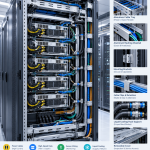
As artificial intelligence (AI) servers continue to increase in computing density and power consumption, liquid cooling systems have become an important part of many high-performance computing (HPC) platforms. These systems circulate coolant through cold plates, manifolds, tubing, and distribution units to remove heat from critical electronic components.
Because liquid cooling introduces fluid into electronic environments, mechanical reliability becomes an essential aspect of system design. One of the primary engineering objectives is minimizing the risk of coolant leakage through careful structural design, appropriate material selection, controlled manufacturing, and thorough system validation.
Leak prevention is not determined by a single component. It is the result of coordinated engineering across the entire cooling system, including mechanical interfaces, sealing methods, manufacturing tolerances, and maintenance procedures.
This article provides an overview of leak prevention design in liquid cooling mechanical structures and discusses engineering considerations that contribute to reliable cooling system integration.
Why Leak Prevention Matters
A liquid cooling system consists of numerous interconnected mechanical components.
Typical examples include:
- Cold plates
- Manifolds
- Distribution blocks
- Tubing
- Flexible hoses
- Quick disconnect couplings
- Valves
- Connectors
- Pump assemblies
Each interface represents a potential leakage location if the system is not properly designed, manufactured, assembled, or maintained.
The engineering objective is not to eliminate all theoretical risk, but to reduce risk through appropriate design practices and validation.
Understanding Potential Leak Locations
Before designing a cooling structure, engineers typically identify potential leakage paths.
Common locations include:
Mechanical Connections
Examples include:
- Threaded fittings
- Compression fittings
- Flanged interfaces
- Adapter connections
Reliable sealing depends on interface geometry, assembly quality, and operating conditions.
Sealing Interfaces
Seals may be located between:
- Cold plate covers
- Manifold sections
- Connector interfaces
- Service access points
Seal performance depends on material compatibility, compression, and environmental conditions.
Welded or Brazed Structures
Certain liquid cooling components are manufactured using:
- Vacuum brazing
- Laser welding
- TIG welding
Joint quality should be verified through appropriate inspection and testing procedures.
Tubing Connections
Flexible cooling lines experience movement during installation and maintenance.
Mechanical design should consider:
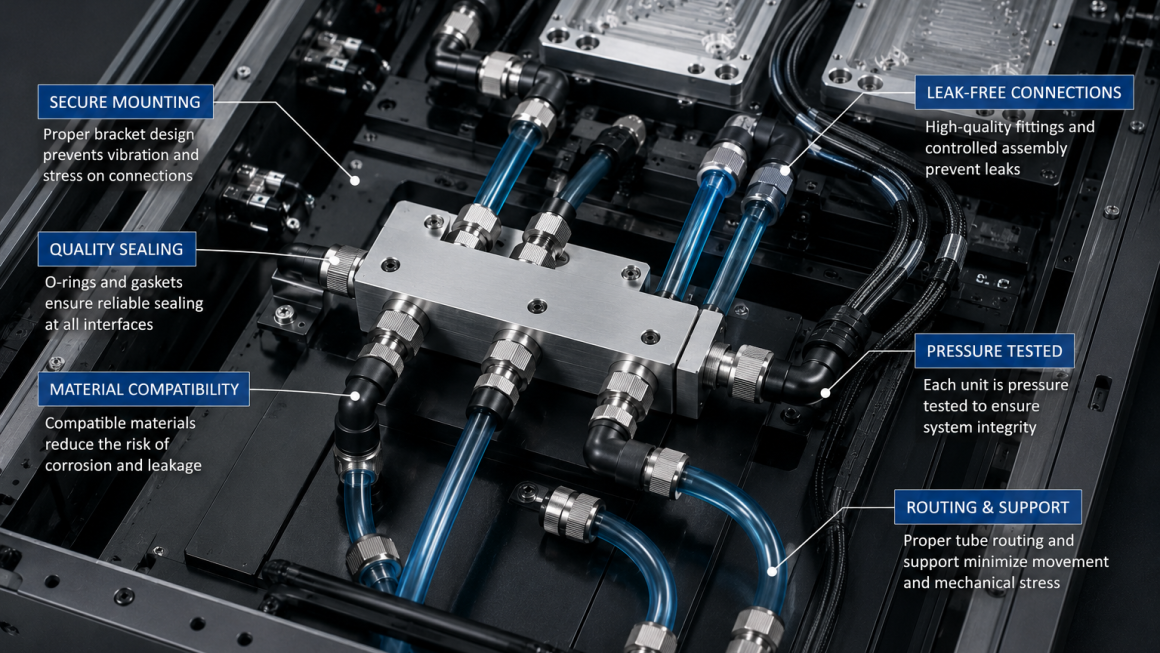
- Routing
- Bend radius
- Connection stability
- Service accessibility
Mechanical Design Principles
Minimize Unnecessary Interfaces
Every connection introduces an additional sealing interface.
Where practical, engineers may reduce the number of joints by:
- Integrating components
- Simplifying flow paths
- Using modular designs with fewer connection points
Reducing interface complexity may contribute to improved assembly consistency.
Proper Structural Support
Cooling components should not rely solely on tubing for mechanical support.
Structural brackets, mounting frames, and dedicated supports can reduce stress caused by:
- Vibration
- Handling
- Installation forces
- Thermal expansion
Well-supported components are less likely to experience excessive mechanical loading.
Controlled Fastening
Fasteners should provide consistent compression across sealing surfaces.
Engineering considerations include:
- Bolt pattern
- Tightening sequence
- Fastener selection
- Assembly procedures
Uneven loading may affect sealing performance.
Sealing Strategies
Various sealing methods are used in liquid cooling systems depending on operating conditions and product design.
Examples include:
- O-rings
- Flat gaskets
- Metal seals
- Compression seals
- Elastomer sealing systems
Selection depends on factors such as:
- Coolant compatibility
- Temperature range
- Pressure conditions
- Maintenance requirements
The most suitable sealing method should be evaluated during product development.
Material Compatibility
Material compatibility influences long-term sealing reliability.
Engineers commonly evaluate interactions between:
- Aluminum
- Copper
- Stainless steel
- Engineering polymers
- Elastomer seals
Coolant chemistry is also an important consideration.
Material selection should account for both mechanical and chemical compatibility throughout the intended service life.
Thermal Expansion Considerations
Cooling systems experience temperature changes during operation.
Different materials expand at different rates.
Mechanical design may therefore consider:
- Expansion clearance
- Flexible mounting
- Seal compression range
- Interface alignment
Accommodating thermal expansion can help reduce unnecessary mechanical stress.
Pressure Management
Liquid cooling components operate under defined pressure conditions established by the overall system.
Design considerations include:
- Internal pressure capability
- Pressure distribution
- Flow resistance
- Pressure fluctuations
System designers typically evaluate pressure conditions during development and validation.
Manufacturing Quality
Reliable leak prevention depends on manufacturing consistency.
Important production considerations include:
Precision Machining
Accurate machining helps achieve:
- Flat sealing surfaces
- Consistent dimensions
- Proper connector alignment
Surface Finish
Surface quality may influence sealing performance.
Depending on the application, engineers evaluate:
- Surface roughness
- Flatness
- Contact quality
Assembly Control
Production procedures may include:
- Defined assembly sequences
- Torque verification
- Visual inspection
- Process documentation
Consistent assembly helps improve repeatability.
Validation and Testing
Mechanical structures are typically evaluated before deployment.
Depending on project requirements, validation may include:
- Leak testing
- Pressure testing
- Thermal cycling
- Vibration testing
- Mechanical durability evaluation
Testing methods should be selected according to the intended application and applicable engineering standards.
Maintenance-Oriented Design
Leak prevention also depends on long-term serviceability.
Designs may consider:
Accessible Connections
Maintenance personnel should be able to inspect and service key interfaces without unnecessary disassembly.
Modular Replacement
Components such as manifolds, valves, or connectors may be designed for replacement without affecting unrelated parts of the system.
Visual Inspection
Providing clear access to critical joints can simplify routine inspection and maintenance.
Design for Manufacturability
Leak-resistant structures should also be practical to manufacture.
Engineers often balance:
- Manufacturing complexity
- Machining capability
- Assembly efficiency
- Inspection requirements
An effective design considers both engineering performance and production feasibility.
Future Development Trends
Several trends are influencing the design of liquid cooling mechanical structures.
Integrated Cooling Assemblies
Combining multiple functions into fewer components may reduce the number of sealing interfaces.
Advanced Sealing Materials
Ongoing developments in elastomers and engineered sealing materials continue to improve compatibility with modern coolants and operating environments.
Digital Engineering
Simulation tools such as finite element analysis (FEA) and computational fluid dynamics (CFD) are increasingly used to evaluate mechanical stress, thermal expansion, and coolant flow before physical prototypes are manufactured.
Smart Monitoring
Future liquid cooling systems may incorporate additional sensors for:
- Pressure monitoring
- Flow monitoring
- Temperature measurement
- Leak detection
These systems can assist maintenance teams by identifying abnormal operating conditions, but they complement rather than replace sound mechanical design.
Leak prevention in liquid cooling mechanical structures is a system-level engineering challenge involving component design, sealing methods, material compatibility, manufacturing quality, and operational maintenance.
Rather than relying on any single technology, reliable liquid cooling systems are achieved through coordinated engineering practices, careful validation, and attention to detail throughout the product lifecycle.
As AI servers and high-performance computing systems continue to evolve, robust mechanical design will remain an important factor in supporting reliable, maintainable, and scalable liquid cooling infrastructure.