
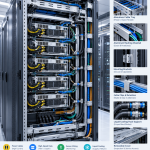
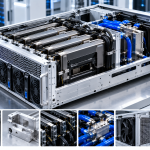
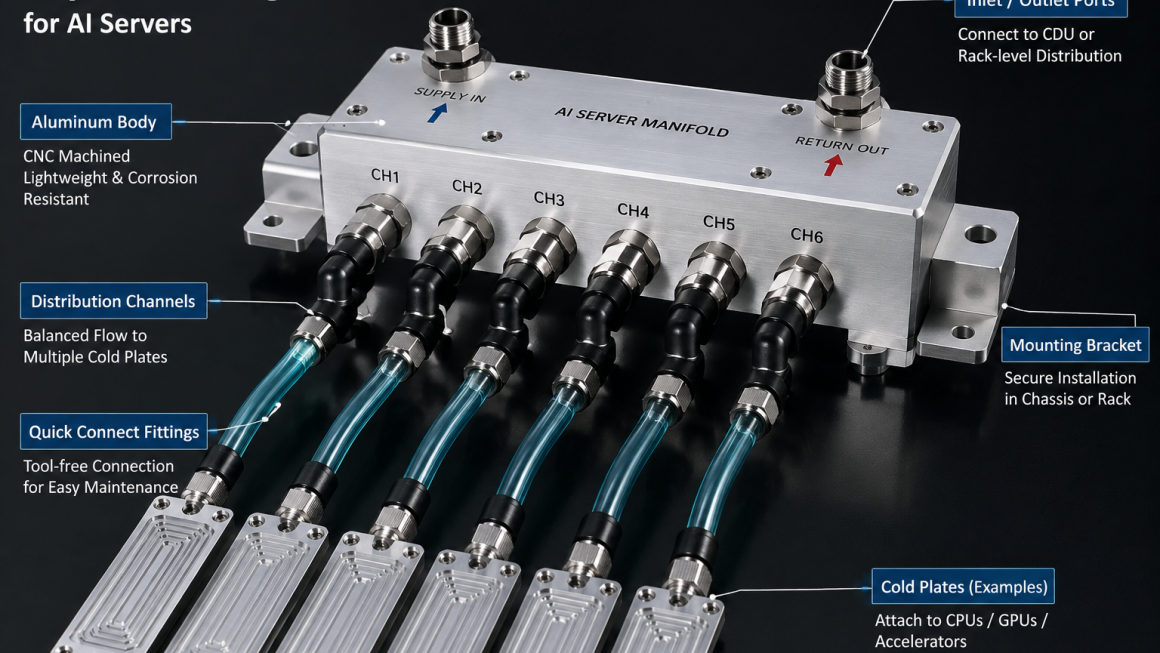
As artificial intelligence (AI) computing platforms continue to increase in computing density and power consumption, liquid cooling has become an important consideration in many high-performance server architectures. While components such as cold plates and cooling distribution units (CDUs) often receive significant attention, the manifold is another critical element within the liquid cooling system.
A manifold serves as the distribution interface between the coolant supply and multiple cooling loops inside a server or rack. It helps direct coolant to individual cold plates and returns heated coolant to the circulation system. Although its function appears straightforward, manifold design influences fluid distribution, mechanical integration, maintenance accessibility, and manufacturing complexity.
For AI server manufacturers and infrastructure suppliers, manifold design requires close coordination between thermal engineering, mechanical design, material selection, and manufacturing processes.
This article provides an overview of manifold design for liquid cooling distribution in AI servers and discusses key engineering considerations related to performance, manufacturability, and system integration.
What Is a Liquid Cooling Manifold?
A liquid cooling manifold is a fluid distribution component that divides coolant flow from a primary supply into multiple branches and collects the return flow after heat has been absorbed.
Depending on the cooling architecture, manifolds may be installed at different levels, including:
- Server level
- Chassis level
- Rack level
- Cooling cabinet level
The manifold forms part of the overall coolant distribution network and works together with:
- Cold plates
- Flexible tubing
- Quick disconnect couplings
- Pumps
- Cooling distribution units (CDUs)
- Sensors and monitoring devices
Its primary purpose is to provide a controlled path for coolant while supporting reliable mechanical connections throughout the cooling system.
The Role of Manifolds in AI Servers
Modern AI servers often contain multiple high-power devices operating simultaneously.
Examples include:
- GPUs
- CPUs
- AI accelerators
- Memory modules
- Power electronics
Many of these components may be cooled through independent cold plates connected to a common manifold.
Typical functions include:
- Supplying coolant to multiple cooling circuits
- Collecting return coolant
- Supporting balanced flow distribution
- Simplifying coolant routing
- Reducing unnecessary tubing complexity
- Improving service accessibility
A well-planned manifold layout contributes to a more organized and maintainable cooling system.
System Integration Considerations
A manifold does not operate independently. It must integrate with the complete mechanical and thermal architecture of the server.
Design engineers often evaluate compatibility with:
- Server chassis
- Rack structures
- Cooling loops
- Cable routing
- Maintenance access
- Structural supports
Mechanical integration becomes increasingly important as server density continues to increase.
Flow Distribution Principles
One of the main objectives of manifold design is to distribute coolant effectively among multiple cooling branches.
Engineering considerations may include:
Flow Uniformity
The manifold should support consistent coolant delivery across connected cooling circuits where required by the system design.
Design factors include:
- Internal passage geometry
- Branch arrangement
- Inlet and outlet positioning
- Flow path length
The desired flow distribution depends on the cooling requirements of each connected component.
Pressure Management
Pressure conditions influence coolant circulation throughout the system.
Engineers may evaluate:
- Pressure drop
- Flow resistance
- Connection geometry
- Internal channel dimensions
The objective is to achieve a balanced system while considering the operating characteristics of the overall cooling loop.
Internal Flow Path Design
Manifold geometry can influence coolant movement.
Examples of design approaches include:
- Straight distribution channels
- Symmetrical branching
- Layered flow passages
- Compact integrated layouts
The appropriate configuration depends on available installation space, manufacturing methods, and cooling architecture.
Mechanical Design Considerations
Compact Installation
AI servers typically have limited internal space.
Manifold designs should consider:
- Equipment clearance
- Cable routing
- Cold plate connections
- Service access
Compact layouts can help simplify assembly while supporting efficient use of available space.
Structural Stability
During operation, manifolds experience mechanical loads resulting from:
- Tubing connections
- Internal coolant pressure
- Installation forces
- Thermal expansion
Designers often evaluate structural rigidity to support reliable long-term operation.
Connection Interfaces
Reliable interfaces are important for system assembly and maintenance.
Typical interfaces may include:
- Threaded ports
- Compression fittings
- Quick disconnect couplings
- Sealing surfaces
Connection methods should be compatible with the selected cooling architecture.
Material Selection
Several materials may be considered depending on application requirements.
Aluminum
Aluminum is commonly evaluated because it offers:
- Lightweight construction
- Good machinability
- Manufacturing flexibility
- Corrosion resistance characteristics
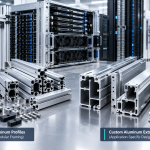
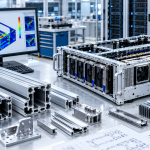
Precision CNC machining allows aluminum manifolds to incorporate complex internal passages and customized mounting features.
Stainless Steel
Certain applications may use stainless steel where mechanical strength or specific environmental considerations are prioritized.
Engineering Polymers
Some cooling systems incorporate polymer manifolds or hybrid designs depending on:
- Temperature requirements
- Pressure conditions
- Weight objectives
- Chemical compatibility
Material selection should be based on the requirements of the complete cooling system.
Manufacturing Methods
CNC Machining
Precision CNC machining is frequently used for customized manifold production.
Advantages include:
- Flexible geometry
- Prototype development
- Complex internal passages
- High dimensional accuracy
CNC machining is particularly suitable for engineering validation and lower-volume production.
Brazed Assemblies
Certain manifold configurations may be manufactured by joining multiple aluminum components.
This approach may support:
- Internal channel complexity
- Integrated structures
- Compact designs
The manufacturing method depends on the product design and production strategy.
Surface Treatment
Surface engineering may include:
- Anodizing
- Protective coatings
- Cleaning processes
Treatment selection should consider coolant compatibility, assembly requirements, and the intended operating environment.
Integration with Cold Plates
The manifold and cold plates function as a coordinated system.
Important considerations include:
Routing Efficiency
Coolant paths should be arranged to minimize unnecessary tubing while maintaining accessibility.
Mounting Accuracy
Mechanical alignment between the manifold and cold plates supports repeatable assembly.
Maintenance Accessibility
Server maintenance procedures should consider:
- Connector access
- Component replacement
- Inspection points
Good mechanical design can reduce service complexity.
Reliability Considerations
Long-term reliability is an important objective for liquid cooling systems.
Areas commonly evaluated include:
- Mechanical integrity
- Seal performance
- Material compatibility
- Assembly consistency
- Manufacturing quality
Depending on project requirements, qualification testing may include pressure verification, leak inspection, and environmental evaluation.
Challenges in AI Server Manifold Design
Increasing Power Density
As AI hardware continues to evolve, cooling systems may need to support more devices within limited installation space.
This increases the importance of compact and efficient manifold layouts.
Manufacturing Complexity
Internal flow channels and multiple connection points may increase manufacturing difficulty.
Designers often balance:
- Manufacturing feasibility
- Machining efficiency
- Assembly simplicity
- Product performance
Future Expandability
Some modular AI platforms are designed with future hardware upgrades in mind.
A modular manifold architecture may simplify future system modifications while maintaining compatibility with existing infrastructure.
Future Development Trends
Several trends are expected to influence manifold development for AI liquid cooling systems.
Integrated Cooling Modules
Future designs may integrate manifolds more closely with:
- Cold plates
- Structural frames
- Cooling distribution assemblies
to reduce assembly complexity.
Modular Cooling Architectures
Modular cooling systems may improve flexibility across different server configurations and deployment scales.
Advanced Manufacturing
Future developments may include:
- Improved CNC machining efficiency
- Automated inspection
- Enhanced manufacturing consistency
- Digital engineering workflows
Hybrid Material Solutions
Future manifolds may combine aluminum with:
- Stainless steel
- Engineering polymers
- Composite materials
depending on the functional requirements of different sections of the cooling system.
Manifolds play an essential role in liquid cooling distribution for AI servers by connecting multiple cooling circuits into an organized and maintainable fluid network. Their design requires careful consideration of fluid distribution, mechanical integration, material compatibility, manufacturing methods, and long-term reliability.
Aluminum remains an important material option for many manifold applications because of its lightweight characteristics, machining flexibility, and compatibility with customized mechanical designs. However, successful manifold performance depends on system-level engineering rather than material selection alone.
As AI infrastructure continues to advance, manifold design will remain an important aspect of liquid cooling systems, supporting scalable, serviceable, and well-integrated server architectures.