As artificial intelligence (AI), cloud computing, and high-performance computing (HPC) facilities continue to expand, data center infrastructure is becoming increasingly complex.
Modern AI data centers contain large amounts of:
- Power cables
- Network cables
- Fiber connections
- Cooling-related systems
- Mechanical support structures
Cable management infrastructure plays an important role in organizing and protecting these systems. However, as cable density increases, fire safety considerations have become an essential part of infrastructure design.
Material selection for cable trays, conduits, protective channels, and support structures must consider multiple factors, including:
- Fire performance
- Mechanical strength
- Thermal characteristics
- Environmental conditions
- Manufacturing requirements
This article discusses fire safety considerations in cable management infrastructure and explains how material selection influences the design of modern data center systems.
The Importance of Fire Safety in AI Data Centers
AI data centers operate with increasingly high power densities.
Compared with traditional server environments, AI facilities may involve:
- Higher electrical loads
- More power distribution equipment
- Greater cable concentration
- More complex cooling systems
Cable infrastructure must therefore be designed with attention to:
- Safe installation practices
- Proper cable organization
- Appropriate material selection
- Maintenance accessibility
Fire safety is not determined by a single component. It depends on the complete system, including electrical design, protection systems, facility engineering, and operational procedures.
Fire Risks Related to Cable Infrastructure
Cable management systems themselves are generally passive structures, but their design influences the overall safety environment.
Potential considerations include:
Cable Overloading
Improper cable selection or installation may contribute to:
- Excessive heating
- Insulation stress
- Reduced cable lifespan
Proper engineering evaluation is required to ensure cables operate within appropriate conditions.
Cable Accumulation
High-density cable environments may create challenges related to:
- Heat concentration
- Maintenance access
- Inspection difficulty
Organized routing helps improve visibility and system management.
Material Behavior Under Heat
Different materials respond differently under elevated temperatures.
Engineers may evaluate:
- Thermal stability
- Combustibility characteristics
- Smoke generation properties
- Structural integrity
according to application requirements.
Material Selection Considerations for Cable Management Systems
Cable management components may use different materials depending on the application.
Common materials include:
- Aluminum
- Steel
- Engineering polymers
- Composite materials
The appropriate choice depends on:
- Structural requirements
- Installation environment
- Weight considerations
- Fire safety requirements
Aluminum in Cable Management Infrastructure
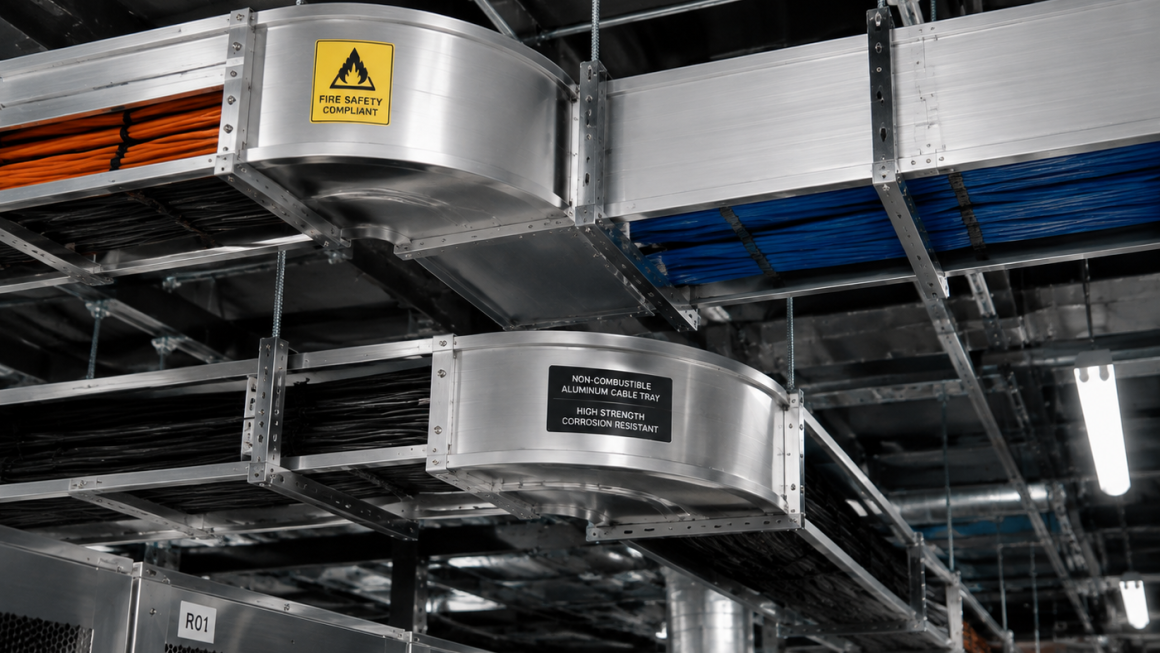
Aluminum is widely used in many infrastructure applications, including:
- Cable trays
- Cable channels
- Support brackets
- Rack accessories
Aluminum Thermal Characteristics
Aluminum has high thermal conductivity compared with many structural materials.
This characteristic can influence heat distribution within metal components.
However, the overall thermal behavior of a cable management system depends on:
- Component geometry
- Cable arrangement
- Ventilation
- Operating conditions
Aluminum and Fire Safety Considerations
Aluminum itself is a non-combustible metal commonly used in construction and industrial applications.
However, fire performance of a complete cable management system depends on:
- System design
- Cable materials
- Surrounding environment
- Applicable standards
Therefore, aluminum components should be evaluated as part of the complete infrastructure system.
Steel Cable Management Structures
Steel is another commonly used material for cable management applications.
Potential advantages include:
- High mechanical strength
- Established manufacturing processes
- Wide availability
Considerations may include:
- Weight
- Corrosion protection
- Installation requirements
Engineering Polymers and Fire Considerations
Polymers may be used for:
- Cable clips
- Protective covers
- Insulating components
- Cable guides
When polymers are used, engineers may evaluate:
- Flame resistance characteristics
- Temperature limits
- Smoke properties
- Application environment
Different polymer formulations provide different performance characteristics.
Composite Materials
Composite materials may be considered for specialized applications requiring:
- Lightweight structures
- Specific mechanical properties
- Electrical insulation
Their suitability depends on:
- Material formulation
- Certification requirements
- Environmental conditions
Fire Safety Design Principles for Cable Management
Proper Cable Separation
Cable routing design should consider separation between:
- Power cables
- Communication cables
- Sensitive signal cables
Appropriate organization can improve maintenance and reduce installation risks.
Ventilation and Heat Management
Cable management structures should avoid unnecessary heat accumulation.
Design considerations include:
- Open vs enclosed systems
- Cable density
- Air circulation
- Installation spacing
Mechanical Protection
Cable protection systems may help reduce risks associated with:
- Physical damage
- Abrasion
- Improper handling
Examples include:
- Protective channels
- Edge guards
- Cable covers
Aluminum Extrusion for Fire-Conscious Infrastructure Design
Aluminum extrusion is widely used for customized infrastructure components.
Potential applications include:
- Cable tray profiles
- Protective channels
- Structural supports
Advantages of Extruded Aluminum Profiles
Extrusion allows designers to develop customized geometries.
Possible design features include:
- Reinforcement ribs
- Mounting grooves
- Modular connection points
- Optimized material usage
Surface Treatment Considerations
Aluminum components may receive surface treatments such as:
- Anodizing
- Protective coatings
The selection depends on:
- Environmental requirements
- Appearance requirements
- Application conditions
Manufacturing and Quality Considerations
Reliable cable infrastructure requires consistent manufacturing processes.
Important factors include:
Dimensional Accuracy
Ensures:
- Correct assembly
- Compatibility between components
- Reliable installation
Material Control
Manufacturers should consider:
- Material specifications
- Process consistency
- Surface quality
Inspection and Verification
Depending on application requirements, inspection may include:
- Dimensional checks
- Surface inspection
- Mechanical evaluation
Integration With AI Data Center Infrastructure
Fire safety considerations must be integrated with other systems.
Cable management interacts with:
- Server racks
- Power distribution units
- Cooling systems
- Structural frames
A practical design approach considers the entire infrastructure environment.
Challenges in Future AI Infrastructure
Increasing Power Density
Future AI systems may require:
- More electrical capacity
- More complex cable networks
- Higher infrastructure density
This increases the importance of careful material and structural design.
Balancing Protection and Accessibility
Additional protection features must be balanced with:
- Maintenance requirements
- Installation efficiency
- System flexibility
Regulatory Requirements
Different regions and projects may follow different standards.
Material selection and system design should consider:
- Local regulations
- Customer specifications
- Project certification requirements
Future Development Trends
Integrated Cable Management Systems
Future infrastructure may combine:
- Cable routing
- Mechanical protection
- Thermal considerations
- Structural support
into more integrated solutions.
Lightweight Infrastructure Materials
Materials such as aluminum may continue to support lightweight and modular infrastructure designs.
Customized Manufacturing
AI infrastructure projects increasingly require:
- Custom aluminum profiles
- Precision components
- Project-specific solutions
Flexible manufacturing capabilities will become increasingly valuable.
Conclusion
Fire safety and material selection are important considerations in the design of cable management infrastructure for modern AI data centers.
The selection of aluminum, steel, polymers, or composite materials should be based on application requirements, environmental conditions, mechanical needs, and relevant safety standards.
A well-designed cable management system requires more than selecting a material. It requires coordination between structural engineering, thermal management, manufacturing processes, and overall facility design.
For suppliers supporting AI infrastructure development, opportunities exist in customized aluminum cable trays, protective structures, modular conduit systems, and precision mechanical components that contribute to safer and more scalable data center environments.