The rapid development of artificial intelligence (AI), high-performance computing (HPC), and cloud infrastructure is transforming the requirements for modern data centers.
Traditional data center design focused primarily on server installation, power distribution, and cooling management. However, AI infrastructure introduces new levels of complexity due to:
- Higher computing density
- Increased rack power requirements
- More advanced cooling systems
- Larger cable volumes
- More complex mechanical interfaces
As a result, mechanical design has become an increasingly important part of AI data center infrastructure.
Integrated mechanical design focuses on coordinating different physical systems, including:
- Rack structures
- Cable management
- Cooling support components
- Protective structures
- Mounting interfaces
The objective is to create infrastructure that is organized, maintainable, and adaptable to evolving computing requirements.
Why Mechanical Integration Matters in AI Infrastructure
AI computing systems require close coordination between multiple physical components.
A typical AI rack may include:
- GPU servers
- Power distribution systems
- Network connections
- Liquid cooling components
- Cable routing structures
- Mechanical support frames
When these systems are designed independently, challenges may occur during:
- Installation
- Maintenance
- Expansion
- Equipment upgrades
Integrated mechanical design considers the relationship between components from the beginning of the engineering process.
Key Elements of Integrated Mechanical Design
Rack Structural Systems
The rack structure provides the foundation for AI hardware installation.
Important design considerations include:
- Mechanical strength
- Equipment compatibility
- Mounting flexibility
- Service accessibility
Modern AI racks may require stronger and more adaptable structures due to increasing equipment density.
Potential components include:
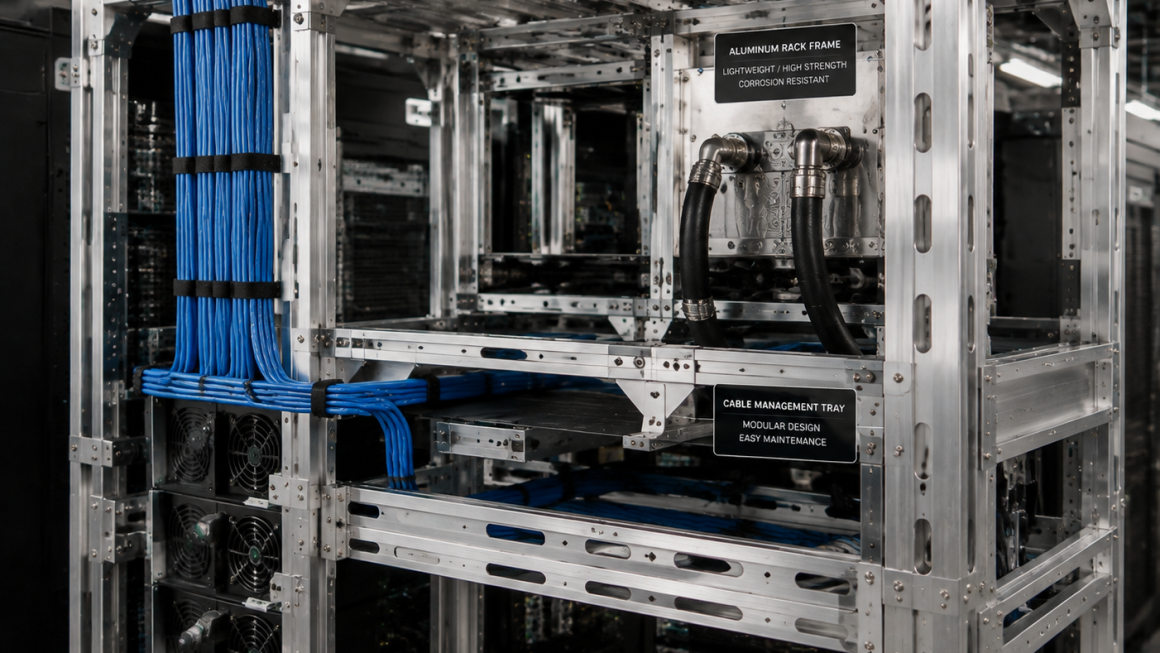
- Aluminum frames
- Structural profiles
- Mounting rails
- Support brackets
Cable Infrastructure Integration
Cable systems are a critical part of AI infrastructure.
A mechanical design approach considers:
- Cable routing paths
- Support structures
- Protection components
- Maintenance access
Integrated cable solutions may include:
- Aluminum cable trays
- Cable channels
- Modular conduits
- Protective covers
The objective is to organize complex cable networks while maintaining accessibility.
Liquid Cooling Mechanical Integration
AI systems increasingly adopt liquid cooling technologies to manage thermal requirements.
Liquid cooling introduces additional mechanical considerations, including:
- Coolant routing
- Manifold support
- Pipe positioning
- Quick-connect accessibility
Mechanical structures must coordinate between:
- Electrical systems
- Cooling components
- Rack assemblies
Proper integration helps simplify installation and maintenance processes.
Thermal and Mechanical Relationship
Mechanical design and thermal management are closely connected.
Infrastructure components may influence:
- Airflow pathways
- Cooling component placement
- Heat dissipation structures
Examples include:
- Aluminum heat sink structures
- Cold plate mounting systems
- Cooling support brackets
A complete design approach considers both mechanical stability and thermal requirements.
Aluminum in Integrated Mechanical Systems
Aluminum is widely used in many industrial infrastructure applications.
Potential applications in AI data centers include:
- Rack frames
- Cable management structures
- Mounting brackets
- Cooling components
- Protective covers
Advantages of Aluminum Structural Components
Lightweight Characteristics
Aluminum provides a high strength-to-weight ratio.
Potential benefits include:
- Easier handling
- Reduced installation effort
- Flexible structural design
Manufacturing Flexibility
Aluminum supports multiple manufacturing processes:
- Extrusion
- CNC machining
- Sheet fabrication
- Surface treatment
This enables customized mechanical solutions for different infrastructure requirements.
Custom Profile Development
Aluminum extrusion allows engineers to create application-specific profiles.
Possible features include:
- Integrated mounting channels
- Reinforcement structures
- Modular connection points
Integration Between Components
A major objective of integrated mechanical design is improving compatibility between different systems.
Examples include:
Rack and Cable Systems
Considerations:
- Cable tray attachment
- Routing space
- Service clearance
Rack and Cooling Systems
Considerations:
- Cooling component support
- Pipe routing
- Maintenance access
Structural and Protective Components
Considerations:
- Mechanical stability
- Equipment protection
- Installation efficiency
Design for Manufacturing (DFM)
Integrated mechanical design should consider manufacturing requirements from the beginning.
Important factors include:
Material Selection
Engineers evaluate:
- Mechanical requirements
- Environmental conditions
- Weight considerations
- Manufacturing feasibility
Production Processes
Possible manufacturing approaches include:
Aluminum Extrusion
Suitable for:
- Long structural profiles
- Cable channels
- Rack components
CNC Machining
Suitable for:
- Precision interfaces
- Connection parts
- Customized brackets
Surface Treatment
Common options include:
- Anodizing
- Protective coatings
depending on application requirements.
Modular Design Approach
AI infrastructure changes rapidly.
Modular mechanical systems can support:
- Easier installation
- Future modification
- Component replacement
Examples include:
- Modular rack structures
- Adjustable cable systems
- Replaceable mounting components
Challenges in Integrated Mechanical Design
Increasing System Complexity
AI infrastructure combines:
- Electrical systems
- Thermal systems
- Mechanical structures
Coordination becomes increasingly important.
Space Optimization
High-density racks require efficient use of available space.
Mechanical design must balance:
- Component density
- Accessibility
- Maintenance requirements
Customization Requirements
Different AI applications may have different:
- Rack configurations
- Cooling architectures
- Cable layouts
Flexible manufacturing is therefore important.
Future Trends
Integrated AI Infrastructure Platforms
Future designs may increasingly combine:
- Structural frames
- Cable systems
- Cooling support
- Protective components
into integrated mechanical platforms.
Lightweight Structural Solutions
Materials such as aluminum may continue to support:
- Modular infrastructure
- Customized structures
- Efficient installation
Digital Engineering and Manufacturing
Future development may involve:
- 3D CAD integration
- Simulation-driven design
- Digital manufacturing workflows
These approaches can support faster customization and improved production consistency.
Integrated mechanical design is becoming an important consideration in next-generation AI data center infrastructure.
As computing density increases, physical systems such as racks, cable management, cooling structures, and protective components must work together as a coordinated platform.
Aluminum structural systems, customized profiles, precision-machined components, and flexible manufacturing capabilities provide potential solutions for suppliers supporting AI infrastructure development.
Successful AI infrastructure design requires not only advanced computing hardware but also reliable mechanical foundations that support installation, maintenance, and future expansion.