As AI computing systems move toward higher power density, thermal management is becoming increasingly integrated with mechanical infrastructure.
Traditional AI cooling designs often treat the following as separate components:
- Structural frame
- Heat sink
- Cooling plate
- Coolant manifold
- Mounting bracket
- Cable and hose support
However, aluminum extrusion creates another possibility.
Instead of designing every function as a separate component, engineers can explore aluminum profiles that combine multiple functions into a single structural element.
A properly designed profile could potentially provide:
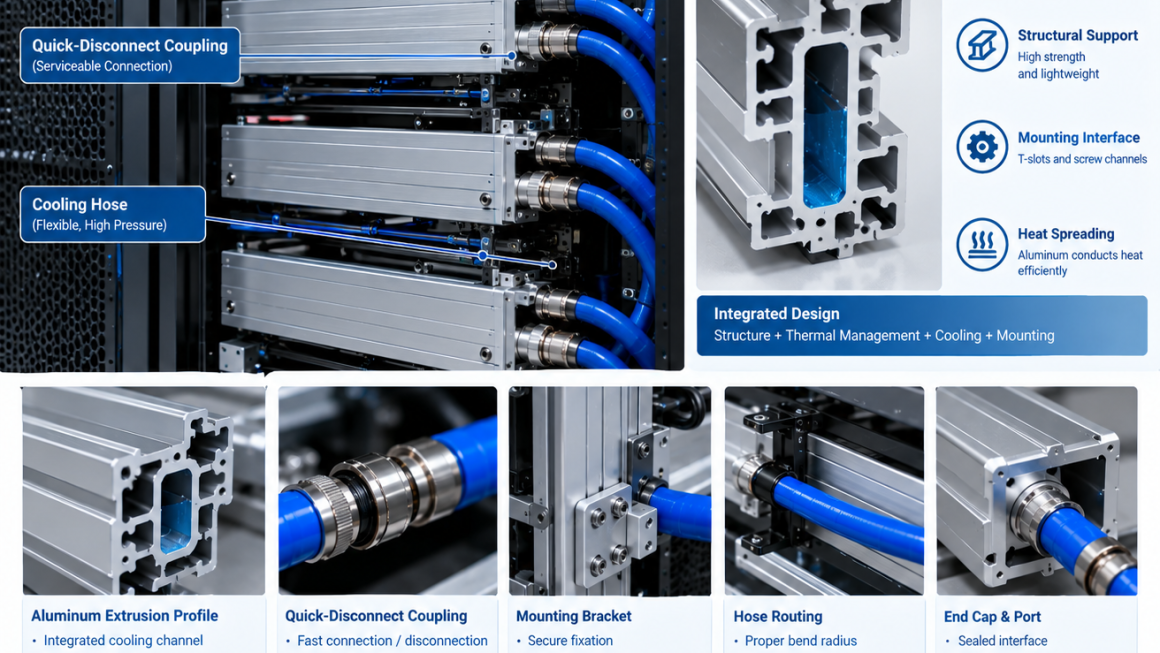
Structural Support + Thermal Management + Coolant Routing + Mounting Features
This concept creates new possibilities for an aluminum cooling channel for AI infrastructure.
The objective is not simply to put a hole inside an aluminum extrusion.
The objective is to design a multifunctional aluminum component in which the structural and thermal functions are engineered together.
1. What Is an Aluminum Cooling Channel for AI Infrastructure?
An aluminum cooling channel is a component or profile containing a defined thermal or fluid path that helps transfer heat away from high-power equipment.
Depending on the system architecture, the channel may be used for:
- Coolant circulation
- Heat spreading
- Thermal conduction
- Cold plate support
- Manifold distribution
- Heat exchanger structures
The channel can be manufactured using several approaches, including:
- Aluminum extrusion
- CNC machining
- Drilling
- Port machining
- Joining or sealing operations
- Hybrid manufacturing
The most interesting opportunity for AI infrastructure is the extruded cooling channel.
Extrusion can create complex cross-sectional geometries continuously, making it possible to integrate structural ribs, mounting channels, cavities, and thermal features into one profile.
2. Why Combine Structural and Thermal Functions?
In conventional mechanical design, a structural member primarily carries load.
A cooling component primarily transfers heat.
This separation is straightforward, but it can also create:
- More components
- More interfaces
- More fasteners
- More assembly operations
- More weight
- More installation space
A multifunctional aluminum profile can potentially reduce this complexity.
For example, a single profile could include:
Outer Structural Wall
→ carries mechanical load
Internal Cooling Channel
→ transports coolant or provides a thermal path
External Ribs
→ increase stiffness and surface area
Mounting Channel
→ supports adjacent components
This creates a more integrated AI cooling structure.
3. The Basic Architecture of an Extruded Cooling Channel
A simplified aluminum cooling profile could include several functional zones.
Structural Zone
Provides:
- Bending stiffness
- Load capacity
- Mounting support
Thermal Zone
Provides:
- Heat conduction
- Heat spreading
- Increased surface area
Cooling Zone
Provides:
- Coolant passage
- Flow distribution
Interface Zone
Provides:
- Fastener locations
- Mounting channels
- Connection points
The cross-section should be designed around all four requirements.
This is one of the main advantages of extrusion.
Instead of starting with a simple rectangular tube, engineers can design the profile around the required load path and thermal path simultaneously.
4. Aluminum Extrusion as a Cooling Structure
Aluminum extrusion is particularly attractive for this type of application.
During extrusion, heated aluminum is forced through a customized die to create a continuous cross-section.
This allows engineers to produce profiles with:
- Internal cavities
- Thin walls
- Ribs
- Channels
- Mounting slots
- Multiple chambers
For AI infrastructure, the extrusion can be optimized around both mechanical and thermal requirements.
A profile may therefore function as more than a conventional structural beam.
It can become a thermal-mechanical platform.
5. Designing the Internal Cooling Channel
The internal channel is one of the most important design elements.
Engineers need to balance:
- Flow area
- Pressure drop
- Heat-transfer area
- Wall thickness
- Structural stiffness
- Manufacturability
A larger channel may reduce pressure drop.
However, simply increasing channel size does not necessarily improve thermal performance.
The actual design should consider:
Coolant Flow → Channel Geometry → Heat Transfer → Structural Constraints
6. Straight Channels vs Multi-Channel Profiles
A basic aluminum liquid cooling channel may use one large passage.
However, multiple smaller channels can provide a larger surface-area-to-volume ratio.
Possible configurations include:
- Single channel
- Parallel channels
- Multi-port channels
- Serpentine paths
- Integrated manifold channels
Each configuration has different hydraulic and manufacturing characteristics.
For example:
Single Large Channel
Potential advantages:
- Lower flow resistance
- Simple geometry
- Easier cleaning
Multiple Small Channels
Potential advantages:
- Larger wetted surface area
- Potentially improved heat transfer
But smaller channels may increase:
- Pressure drop
- Manufacturing sensitivity
- Contamination risk
Therefore, channel geometry must be optimized rather than selected based on thermal performance alone.
7. Wall Thickness and Structural Performance
An aluminum cooling channel has to perform two jobs.
It must contain the cooling path while also maintaining mechanical integrity.
Wall thickness therefore influences:
- Pressure resistance
- Structural stiffness
- Thermal conduction
- Extrusion feasibility
- Weight
Too thin:
- May reduce structural margin.
- May increase deformation.
- May complicate manufacturing.
Too thick:
- Adds weight.
- Increases thermal resistance from the channel to the external surface.
- May reduce extrusion efficiency.
The optimal wall thickness is therefore a system-level design parameter.
8. Structural Ribs Can Serve Two Functions
One of the interesting possibilities of aluminum extrusion is that ribs can perform both mechanical and thermal functions.
A rib can:
- Increase bending stiffness
- Reduce structural deformation
- Increase surface area
- Improve heat spreading
This means the geometry can be optimized simultaneously for:
Mechanical Stiffness
and
Thermal Performance
Instead of adding separate reinforcement after the thermal design is complete, the extrusion profile itself can become the reinforcement.
9. Heat Spreading Through the Aluminum Profile
Aluminum has useful thermal conductivity and relatively low density.
When a hot component is connected to an aluminum cooling structure, heat can spread through the material before being transferred to the cooling path.
A simplified thermal path can be represented as:
AI Processor
→ Thermal Interface
→ Aluminum Heat-Spreading Region
→ Cooling Channel Wall
→ Coolant
The performance of this path depends on:
- Contact resistance
- Aluminum alloy
- Wall thickness
- Channel position
- Temperature distribution
- Coolant conditions
Therefore, channel placement is critical.
10. Channel Position Relative to the Heat Source
The cooling channel should be positioned according to the actual thermal path.
A channel that is too far away from the heat source may increase thermal resistance.
A channel that is too close to a heavily loaded structural region may affect mechanical performance.
Engineers should evaluate:
- Heat source location
- Contact area
- Channel distance
- Structural load path
- Local temperature gradients
This is where thermal simulation and mechanical FEA can work together.
11. Integrating Cooling Channels With AI Rack Structures
An advanced aluminum cooling structure could potentially serve as part of the rack itself.
For example:
Vertical Aluminum Profile
could provide:
- Structural load path
- Cooling channel
- Cable management
- Mounting locations
A horizontal profile could provide:
- Rack cross support
- Thermal spreading
- Hose/manifold integration
- Equipment mounting
This approach reduces the conceptual separation between:
Rack Structure
and
Cooling Infrastructure
The result can be a more integrated AI infrastructure platform.
12. Aluminum Cooling Channels Around AI Server Chassis
Another application is integrating cooling structures directly into server chassis components.
A chassis profile could combine:
- Mechanical frame
- GPU support
- Thermal structure
- Cooling channel
This can potentially reduce:
- Brackets
- Separate heat spreaders
- Assembly interfaces
However, the design must maintain sufficient serviceability.
A highly integrated component is only useful if technicians can still access:
- Cooling connections
- Electrical components
- Fasteners
- Replaceable modules
13. Extruded Cooling Channel and Manufacturing
The design of an aluminum cooling channel must be compatible with extrusion manufacturing.
Important considerations include:
- Profile size
- Wall thickness
- Hollow geometry
- Die complexity
- Extrusion ratio
- Alloy selection
- Dimensional tolerances
The profile should be designed with the extrusion process in mind from the beginning.
A theoretical cross-section that is extremely difficult to extrude may not provide a commercially attractive solution.
This is where design-for-manufacturing becomes important.
14. Alloy Selection for Aluminum Cooling Channels
Different aluminum alloys provide different combinations of:
- Strength
- Thermal conductivity
- Extrudability
- Machinability
- Corrosion resistance
For example, 6063 is widely associated with extrusion and architectural profiles, while 6061 is often selected where higher structural strength and machining performance are important.
However, alloy selection for a coolant-contact channel involves additional considerations.
Engineers should evaluate:
- Coolant compatibility
- Corrosion behavior
- Pressure requirements
- Extrusion performance
- Thermal requirements
- Surface treatment
The best alloy is therefore determined by the complete application rather than thermal conductivity alone.
15. Coolant Compatibility Is Critical
An aluminum liquid cooling channel is directly exposed to the coolant.
This makes material compatibility particularly important.
Engineers should evaluate:
- Coolant chemistry
- pH
- Conductivity
- Corrosion inhibitors
- Dissolved oxygen
- Operating temperature
- Material combinations
This is especially important when the cooling loop also contains:
- Copper
- Brass
- Stainless steel
- Nickel-plated components
The coolant should be selected based on the complete material system.
16. Galvanic Corrosion in Aluminum Cooling Channels
When aluminum and copper are present in the same cooling loop, galvanic corrosion requires careful consideration.
Potential conditions include:
- Electrical contact
- Conductive coolant
- Dissimilar metals
- Long-term exposure
Possible strategies include:
- Compatible coolant chemistry
- Material isolation
- Surface treatments
- Appropriate component selection
- Corrosion monitoring
The cooling channel should therefore be evaluated as part of the entire liquid cooling loop rather than as an isolated aluminum component.
17. Internal Surface Treatment
Surface treatment can be more complicated for internal cooling channels than for external structural surfaces.
Potential approaches depend on:
- Channel geometry
- Coolant chemistry
- Manufacturing process
- Required corrosion resistance
The engineer must also consider whether a coating or treatment could:
- Reduce channel area
- Affect dimensional tolerance
- Influence surface roughness
- Affect thermal transfer
- Interact with coolant chemistry
Internal surface treatment should therefore be validated for the specific application.
18. Sealing the Cooling Channel
A cooling channel is only useful if it remains reliably sealed.
Possible connection methods include:
- Machined ports
- O-ring interfaces
- Gaskets
- Threaded fittings
- Brazed or joined components
- End caps
The selection depends on:
- Pressure
- Temperature
- Maintenance requirements
- Production volume
- Serviceability
The sealing system should be designed together with the aluminum profile.
19. End Caps and Port Design
Extruded profiles create a continuous channel.
The ends must therefore be closed or connected to the rest of the cooling loop.
This may involve:
- Machined end caps
- Manifolds
- Plugs
- Welded components
- Mechanical sealing
Ports may be machined after extrusion.
CNC machining can create:
- Inlet ports
- Outlet ports
- Mounting holes
- O-ring grooves
- Connector interfaces
This creates a powerful combination:
Extrusion → Continuous Geometry
CNC → Precision Interfaces
20. Integrating Quick-Disconnect Couplings
QD connectors can be integrated into an aluminum cooling channel or manifold.
However, the connector should have adequate mechanical support.
The structure needs to accommodate:
- Connection force
- Disconnection force
- Hose bending
- Vibration
- Thermal expansion
A QD should not rely on the hose to maintain alignment.
Instead:
QD → Bracket → Aluminum Structure
should provide a controlled mechanical path.
21. Cooling Channel Pressure and Structural Design
A coolant channel experiences internal pressure.
The pressure creates forces on the channel walls and end closures.
Therefore, structural analysis should consider:
- Internal pressure
- Wall thickness
- Port geometry
- End-cap design
- Stress concentration
- Fatigue
Sharp internal transitions or abrupt geometry changes may create local stress concentrations.
A good extrusion design seeks smooth transitions where practical.
22. Pressure Drop and Hydraulic Design
Thermal performance alone is not enough.
A cooling channel must also deliver acceptable hydraulic performance.
Important variables include:
- Channel cross-sectional area
- Length
- Surface roughness
- Flow rate
- Coolant viscosity
- Number of bends
- Port geometry
A simplified system relationship is:
Pump Capacity → Flow Rate → Pressure Drop → Heat Removal
A highly restrictive channel may provide good local heat transfer but increase pump requirements.
Therefore, thermal and hydraulic optimization must happen together.
23. Thermal Expansion of Aluminum Cooling Structures
Aluminum expands as temperature increases.
This matters when a cooling channel is integrated into a larger structure containing:
- Steel
- Copper
- Stainless steel
- Composite materials
Different materials expand at different rates.
Engineers should therefore consider:
- Fixed mounting points
- Floating mounting points
- Expansion direction
- Flexible hose connections
This is particularly important for long aluminum profiles.
24. Combining Cooling Channels With Cable Management
An AI infrastructure profile may also carry cables.
This creates another opportunity for multifunctional design.
For example, a profile could contain:
Internal Cooling Channel
and
External Cable Management Channel
This can reduce rack complexity.
However, thermal separation should be considered.
High-temperature areas should not unnecessarily transfer heat into sensitive cable regions.
Mechanical and thermal zoning should therefore be incorporated into the profile geometry.
25. Cooling Channels and Serviceability
Highly integrated cooling structures should not sacrifice maintenance.
Engineers should provide access to:
- QD connectors
- Manifolds
- Seals
- Drain points
- Inspection areas
A permanently integrated cooling channel may be efficient during initial assembly but difficult to repair later.
The better approach is modular integration.
For example:
Permanent Structural Profile
Replaceable Connector Module
Serviceable Seal
can provide a better lifecycle balance.
26. Leak Prevention in Extruded Cooling Channels
Leak prevention must be considered throughout the design.
Potential risk points include:
- End closures
- Ports
- O-ring grooves
- Threaded interfaces
- Machined transitions
- Joined sections
The extrusion body itself may be relatively simple.
The interfaces often create the greater reliability challenge.
Therefore:
Interface Design > Profile Geometry Alone
when considering long-term leak prevention.
27. Testing an Aluminum Liquid Cooling Channel
A prototype cooling channel should undergo appropriate validation before production.
Potential tests include:
Dimensional Inspection
Verify:
- Channel dimensions
- Wall thickness
- Port positions
- Flatness
Pressure Testing
Evaluate structural integrity.
Leak Testing
Verify sealing performance.
Thermal Testing
Measure:
- Temperature distribution
- Heat transfer
- Coolant temperature rise
Flow Testing
Measure:
- Flow rate
- Pressure drop
Thermal Cycling
Evaluate long-term interface behavior.
28. Thermal Simulation and Structural FEA
A multifunctional aluminum profile benefits from simulation because thermal and structural requirements interact.
Thermal simulation can evaluate:
- Temperature distribution
- Heat spreading
- Channel performance
- Hot spots
Structural FEA can evaluate:
- Bending
- Deflection
- Stress
- Pressure loading
- Mounting loads
The most useful approach may be a coupled design process:
Thermal Model
→ identifies required channel location
↓
Structural Model
→ checks profile stiffness
↓
Geometry Optimization
→ balances thermal and mechanical performance
↓
Prototype Validation
→ verifies the real component
29. Prototype-to-Production Development
A practical development process for an aluminum cooling channel can follow:
Application Definition
↓
Thermal Requirements
↓
Cooling Architecture
↓
Profile Concept
↓
Extrusion Feasibility Review
↓
Tooling / Prototype
↓
CNC Port Machining
↓
Pressure & Leak Testing
↓
Thermal Validation
↓
Design Optimization
↓
Production
This approach reduces the risk of discovering manufacturing limitations after the profile design has already been finalized.
30. Where Aluminum Cooling Channels Can Be Used
Potential AI infrastructure applications include:
AI Server Frames
Integrated thermal and structural profiles.
GPU Cooling Structures
Heat-spreading and cooling support.
Rack-Level Manifolds
Coolant distribution combined with structural mounting.
Cooling Rails
Horizontal structures supporting multiple cooling interfaces.
Edge AI Enclosures
Compact thermal structures for outdoor or distributed computing.
Modular AI Infrastructure
Profiles combining structural, thermal, and mounting functions.
31. When an Integrated Cooling Channel Makes Sense
An integrated profile can be particularly attractive when:
- The geometry is repeated
- Production volume is sufficient
- Space is limited
- Weight reduction matters
- Multiple functions must be integrated
- The cooling architecture is stable
For low-volume prototypes, conventional machined components may sometimes be more economical.
For larger production volumes, extrusion can become increasingly attractive.
This is why production planning should be considered early.
32. When a Separate Cooling Component Is Better
Integration is not always the right answer.
A separate cold plate or manifold may be preferable when:
- Thermal loads are extremely concentrated
- Complex internal channels are required
- Frequent design changes are expected
- Production volume is low
- Specialized materials are required
The best design may therefore be hybrid:
Extruded Aluminum Structure
Machined Cooling Component
Copper Thermal Interface
QD Connection
This allows each material and manufacturing process to perform the function where it is most effective.
33. Aluminum Cooling Channels and the Future of AI Infrastructure
As AI infrastructure becomes denser, engineers will increasingly look for ways to reduce the number of independent components.
The future may involve more multifunctional structures combining:
- Mechanical support
- Thermal management
- Fluid distribution
- Cable routing
- Mounting interfaces
This is particularly attractive for:
- High-density GPU racks
- Liquid-cooled AI servers
- Edge AI systems
- Modular computing infrastructure
The aluminum extrusion may evolve from a simple structural profile into a multifunctional infrastructure component.
34. A Practical Design Philosophy
The most important question is not:
“Can we put a cooling channel inside an aluminum profile?”
The better question is:
“Which functions can be safely and economically integrated into one aluminum component?”
The answer may include:
Structural Load Path
Thermal Path
Coolant Path
Mounting Interface
Cable/Hose Management
When these functions are intentionally designed together, the result can be lighter, more compact, and easier to assemble.
But integration should never compromise:
- Cooling reliability
- Pressure resistance
- Leak prevention
- Serviceability
- Manufacturability
Designing Aluminum as a Thermal-Mechanical Platform
The concept of an aluminum cooling channel for AI represents an important evolution in AI infrastructure design.
Instead of treating aluminum only as a structural material, engineers can explore its role as a multifunctional platform combining:
- Structural support
- Heat spreading
- Coolant routing
- Mounting
- Cable and hose management
An aluminum liquid cooling channel can potentially reduce component count and create a more integrated AI cooling structure.
The key is to balance:
Thermal Performance
Hydraulic Performance
Structural Strength
Manufacturability
Sealing Reliability
Serviceability
Extrusion provides the geometric foundation, while CNC machining, surface engineering, sealing technologies, and validation complete the system.
The future opportunity is not simply to manufacture another aluminum profile.
It is to engineer an aluminum profile that performs several infrastructure functions at the same time.
Structure + Thermal Management + Cooling + Integration
This is where aluminum extrusion can become a strategic building block for next-generation AI infrastructure.