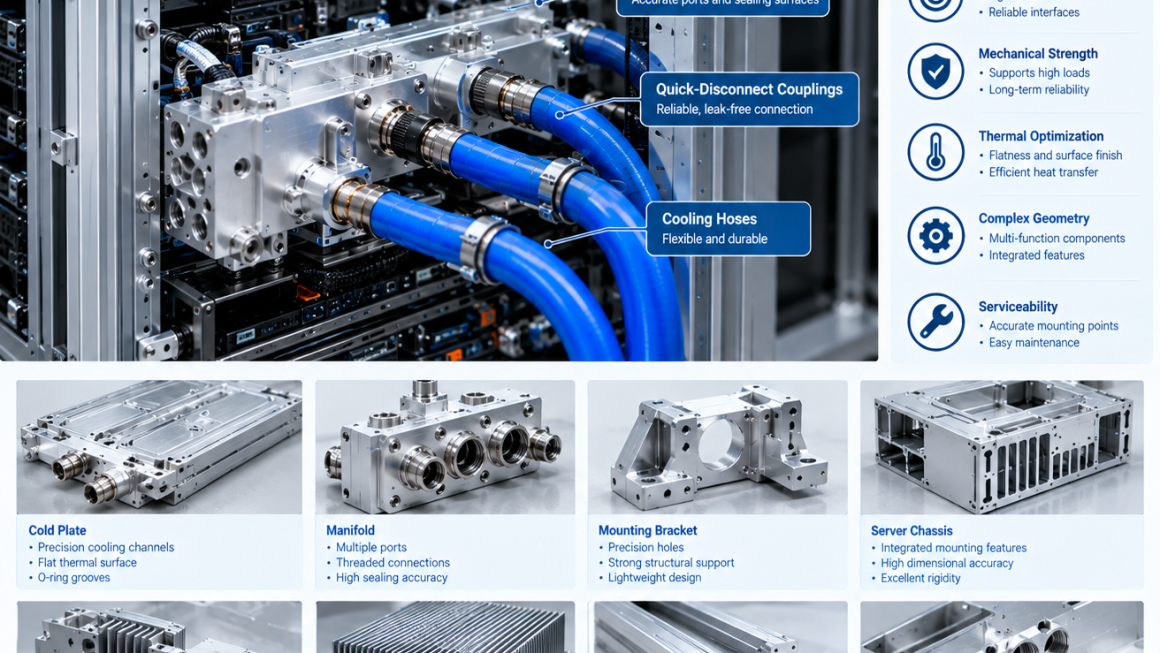
As AI servers become more powerful and rack-level power density continues to increase, aluminum components are being asked to perform more than one function. A single component may need to provide structural support, thermal conduction, sealing, mounting, and precise mechanical alignment.
This is where CNC machining becomes particularly important.
While aluminum extrusion is highly efficient for producing long structural profiles and repeated cross-sections, many AI infrastructure components require features that cannot be produced economically or accurately through extrusion alone. Manifolds, cold plates, brackets, chassis components, mounting interfaces, and precision cooling structures often require secondary CNC machining to achieve the required geometry and dimensional control.
For CNC aluminum parts for AI infrastructure, the manufacturing process is therefore not simply about removing material. It is about translating an engineering design into a component that can reliably fit, seal, conduct heat, carry loads, and integrate with the rest of the system.
Why CNC Machining Matters in AI Infrastructure
AI infrastructure contains many interfaces where small dimensional errors can create larger system-level problems.
Examples include:
- Cooling manifold connections
- Cold plate mounting surfaces
- Quick-disconnect interfaces
- Threaded ports
- O-ring grooves
- Server chassis mounting points
- GPU and accelerator brackets
- Structural connection points
- Cable and hose routing interfaces
- Heat spreader surfaces
- Precision alignment features
These components often have multiple functional surfaces that must work together.
A bracket that is slightly misaligned may create installation problems. A cold plate with excessive surface variation may increase thermal interface resistance. An incorrectly machined sealing groove may increase leakage risk. A manifold with poorly positioned ports may make hose installation difficult.
CNC machining provides the dimensional control needed for these interfaces.
CNC Machining vs. Aluminum Extrusion
Extrusion remains one of the most efficient manufacturing processes for AI infrastructure components with a constant cross-section.
It is particularly suitable for:
- Structural beams
- Rack profiles
- Frame members
- Cable trays
- Cooling channels
- Mounting rails
- Heat sink profiles
- Long structural components
However, many finished components require additional features.
An extruded aluminum profile may subsequently require:
- Drilling
- Tapping
- Milling
- Pocketing
- End machining
- Slot machining
- Surface facing
- Threaded holes
- Precision mounting surfaces
- Connector openings
This creates a practical manufacturing model:
Extrusion → CNC machining → surface treatment → inspection → assembly
For many AI infrastructure products, this combination provides a better balance between material efficiency, structural performance, dimensional precision, and production cost than machining an entire component from a solid aluminum block.
CNC Machined Aluminum AI Server Parts
AI servers contain numerous aluminum components that benefit from CNC machining.
These can include chassis structures, GPU mounting brackets, cooling plates, structural adapters, drive brackets, connector plates, and custom mechanical interfaces.
1. AI Server Chassis Components
A server chassis must maintain dimensional stability while supporting heavy computing hardware and cooling equipment.
CNC machining can create:
- Mounting holes
- Threaded inserts
- Precision slots
- Connector openings
- Bracket interfaces
- Alignment features
- Structural pockets
- Ventilation openings
For modular AI systems, repeatable hole locations and mounting interfaces are particularly important.
A chassis may need to accommodate GPUs, accelerator cards, power modules, cooling components, cables, and service-access mechanisms within a limited space.
CNC machining allows these interfaces to be incorporated directly into the aluminum structure.
CNC Machining for AI Cooling Components
Thermal management is one of the most demanding applications for precision aluminum machining.
AI processors can generate substantial heat within relatively small areas. The cooling component therefore needs to maintain reliable contact with the heat source while providing an efficient path for heat transfer.
CNC machining is widely applicable to:
- Cold plates
- Heat spreaders
- Liquid cooling blocks
- Cooling manifolds
- Thermal interface structures
- Heat sink bases
- Cooling channel components
The important point is that machining accuracy alone does not guarantee thermal performance.
The complete thermal path must be considered:
GPU → TIM → cold plate → coolant → heat rejection system
CNC machining primarily controls the geometry and surface characteristics of the aluminum component within this chain.
CNC Machining of Aluminum Cold Plates
Cold plates are a particularly important example.
Depending on the design, a cold plate may contain:
- Internal cooling channels
- Inlet and outlet ports
- Machined sealing surfaces
- O-ring grooves
- Mounting holes
- Flat heat-transfer surfaces
- Internal fins or pins
- Manifold interfaces
The challenge is to maintain the required thermal geometry while also satisfying pressure, sealing, mechanical, and assembly requirements.
For example, the heat-transfer surface may require controlled flatness so that the thermal interface material can maintain consistent contact.
At the same time, the cooling channels need sufficient wall thickness to withstand the operating conditions.
This means cold plate machining requires more than simply achieving a target dimension. Engineers must balance:
thermal performance + mechanical strength + manufacturability + sealing + serviceability
CNC Machined Aluminum Manifolds
Liquid cooling manifolds are another important application.
A manifold distributes coolant between multiple cooling branches and therefore contains several interfaces in a relatively compact volume.
A machined aluminum manifold may include:
- Multiple coolant ports
- Internal flow passages
- Threaded connections
- O-ring grooves
- Mounting holes
- Pressure-test ports
- Sensor interfaces
- Quick-disconnect interfaces
Port position becomes particularly important when the manifold must connect to multiple hoses or cooling modules.
A few millimeters of positional error may create unnecessary hose bending or installation difficulty.
For this reason, CNC machining can be valuable for maintaining the positional relationship between multiple interfaces.
Precision Aluminum Machining for Mechanical Interfaces
Not every CNC-machined component in AI infrastructure is a cooling component.
Many are mechanical interfaces.
Examples include:
- Rack-to-frame connections
- Server mounting brackets
- Cold plate supports
- GPU structural brackets
- Cable management interfaces
- Cooling manifold supports
- Enclosure mounting plates
- Door and panel interfaces
- Sensor mounting structures
These parts often connect components manufactured through different processes.
For example:
Extruded aluminum frame + CNC-machined bracket + steel fastener + cooling component
The CNC-machined bracket acts as the interface between them.
This makes dimensional control particularly important.
Surface Flatness and Thermal Interfaces
Flatness becomes critical when an aluminum component contacts another precision surface.
This is especially relevant to:
- Cold plates
- Heat spreaders
- Heat sink bases
- Thermal mounting plates
- Processor cooling interfaces
If two surfaces do not contact consistently, the thermal interface material may need to compensate for larger gaps.
This can increase thermal resistance.
Therefore, engineers should define the required flatness based on the complete thermal interface rather than simply specifying an unnecessarily tight machining tolerance.
A useful engineering principle is:
Specify the tolerance required by the function—not the smallest tolerance the machine can produce.
This can significantly improve manufacturability and cost control.
Threaded Holes and Fastener Interfaces
AI infrastructure contains many threaded connections.
CNC machining can produce:
- Metric threads
- Imperial threads
- Blind holes
- Through holes
- Counterbores
- Countersinks
- Precision dowel holes
Thread design should consider aluminum’s mechanical characteristics.
For highly loaded joints, engineers may need to evaluate:
- Thread engagement length
- Fastener material
- Torque
- Repeated assembly
- Pull-out resistance
- Galvanic compatibility
- Thread wear
For frequently serviced AI infrastructure, threaded interfaces should also be designed with maintenance in mind.
A component that is assembled and disassembled repeatedly may require a different fastening strategy from a component intended for permanent installation.
CNC Machining and Liquid Cooling Sealing
Sealing surfaces are another area where machining quality matters.
Liquid cooling systems may use:
- O-rings
- Gaskets
- Sealing plates
- Threaded fittings
- Compression interfaces
An O-ring groove, for example, needs appropriate dimensional control and surface characteristics to provide reliable sealing.
The groove geometry depends on:
- O-ring material
- Cross-section
- Compression
- Pressure
- Temperature
- Fluid compatibility
- Static or dynamic application
Therefore, sealing geometry should be designed together with the selected sealing system rather than added after the mechanical design is completed.
Choosing the Right Aluminum Alloy
CNC performance depends partly on the aluminum alloy being machined.
Common alloys for infrastructure components include 6061 and 6063, although the appropriate alloy depends on the application.
6061 Aluminum
6061 is frequently considered when the component requires a combination of:
- Higher mechanical strength
- Machinability
- Structural performance
- Corrosion resistance
- General engineering versatility
It can be suitable for brackets, structural components, machined blocks, cold plate bases, and other mechanically loaded parts.
6063 Aluminum
6063 is widely used for extrusion because of its favorable extrusion characteristics and surface finish.
It is particularly useful for:
- Structural profiles
- Frames
- Rails
- Channels
- Heat sink profiles
- Long extruded components
When CNC machining is added after extrusion, the alloy selection should consider both the extrusion process and the final machining requirements.
CNC Machining After Aluminum Extrusion
One of the most practical manufacturing approaches for AI infrastructure is to combine extrusion with CNC machining.
Consider a liquid-cooling structural channel.
The extrusion can efficiently create:
- Main channel geometry
- Structural ribs
- Mounting surfaces
- Longitudinal cooling passages
CNC machining can then add:
- Port openings
- Threaded holes
- End interfaces
- Mounting holes
- Connector pockets
- Sealing grooves
This approach reduces machining volume while maintaining the precision needed at critical interfaces.
It is particularly attractive for medium- and high-volume production.
CNC Machining Methods for AI Components
Different components require different machining strategies.
3-Axis CNC Machining
Suitable for many:
- Brackets
- Plates
- Blocks
- Mounting components
- Simple cooling structures
4-Axis and 5-Axis Machining
More complex geometries may benefit from additional axes.
Applications can include:
- Complex cooling structures
- Multi-angle interfaces
- Integrated manifolds
- Complex chassis components
- Advanced thermal components
The objective is not to select the most sophisticated machine automatically.
The objective is to select a manufacturing process that can produce the required geometry consistently and economically.
Designing Aluminum Components for CNC Manufacturing
A good CNC component begins with a manufacturable design.
Several factors should be considered during the design stage.
Tool Access
Deep pockets, narrow channels, and internal corners can create machining difficulties.
Tool diameter and tool reach should therefore be considered early.
Internal Corner Radius
A standard milling tool naturally produces a radius rather than a perfectly sharp internal corner.
Designing appropriate corner radii can reduce machining time and tool requirements.
Wall Thickness
Very thin walls may deform during machining, particularly when large amounts of material are removed.
Machining Depth
Deep pockets increase tool reach requirements and may reduce machining stability.
Datum Design
Critical surfaces should be referenced from appropriate datums so that dimensional relationships remain controlled throughout manufacturing.
These principles are especially important for precision aluminum parts used in AI cooling systems.
CNC Machining Tolerances: More Is Not Always Better
One common mistake is specifying extremely tight tolerances for every feature.
This can increase:
- Machining time
- Tool wear
- Inspection requirements
- Scrap risk
- Production cost
Instead, tolerances should be divided into functional categories.
Critical Features
Examples:
- Sealing surfaces
- Cooling interfaces
- Precision mounting holes
- Alignment features
These may require tighter control.
Standard Features
Examples:
- General mounting holes
- Non-critical pockets
- Cosmetic surfaces
These may use more conventional machining tolerances.
Non-Critical Features
These should avoid unnecessary precision requirements.
This functional approach makes precision aluminum machining more practical for commercial production.
Surface Treatment After CNC Machining
CNC machining is often followed by surface treatment.
Possible processes include:
- Anodizing
- Powder coating
- Conversion coating
- Specialized protective coatings
- Mechanical finishing
Surface treatment may provide:
- Corrosion protection
- Surface hardness
- Electrical insulation
- Appearance control
- Environmental resistance
However, coating thickness can affect dimensions.
For precision interfaces, engineers should consider the dimensional effect of the surface treatment before final machining and assembly.
This is particularly important for:
- Threaded holes
- Bearing interfaces
- Sealing surfaces
- Precision mounting areas
- Sliding interfaces
Aluminum, Copper, and Galvanic Compatibility
AI liquid cooling systems may combine aluminum with copper, stainless steel, brass, and other metals.
This creates a potential galvanic corrosion issue.
CNC machining does not solve material compatibility by itself.
The complete system should consider:
- Coolant chemistry
- Metal combinations
- Surface treatment
- Electrical isolation
- Fastener materials
- Sealing materials
- Operating temperature
- Long-term fluid exposure
For aluminum cooling components, material compatibility should therefore be addressed during system design rather than after machining.
Quality Control for CNC Aluminum Parts
Precision machining requires a clear inspection strategy.
Depending on the component, inspection may include:
- Dimensional inspection
- Flatness measurement
- Hole position verification
- Thread inspection
- Surface roughness measurement
- Visual inspection
- CMM measurement
- Pressure testing
- Leak testing
- Thermal testing
For liquid cooling components, pressure and leak testing can be particularly important.
For structural components, dimensional inspection and load validation may be more relevant.
The inspection plan should follow the component’s actual functional requirements.
Prototype to Production
CNC machining is especially valuable during the early stages of AI infrastructure development.
A typical development sequence may look like:
Concept → CAD → CNC prototype → Functional testing → Design refinement → Pilot production → Mass production
CNC machining allows engineering teams to validate:
- Mechanical fit
- Cooling interfaces
- Assembly sequence
- Service access
- Hose routing
- Thermal performance
- Sealing
- Structural behavior
before committing to larger production volumes.
This is particularly useful for custom AI infrastructure, where designs may evolve as GPU platforms, cooling architectures, and rack configurations change.
CNC Machining for Low-Volume and Custom AI Hardware
AI infrastructure is not always a high-volume manufacturing market.
Many applications involve:
- Prototype racks
- Customized cooling systems
- Research computing platforms
- Edge AI equipment
- Special-purpose servers
- Pilot data centers
- Custom liquid cooling assemblies
CNC machining is well suited to these applications because it does not require a dedicated extrusion die for every geometry.
This allows manufacturers to produce customized aluminum components in relatively small quantities while maintaining engineering-grade dimensional control.
Common CNC Design Mistakes in AI Infrastructure
Several problems appear repeatedly during development.
1. Designing for CNC Without Considering Assembly
A component may be machinable but difficult to assemble.
2. Over-Specifying Tolerances
Unnecessary precision can increase cost without improving system performance.
3. Ignoring Tool Access
Deep or narrow features may be difficult to manufacture.
4. Treating Surface Finish as Cosmetic Only
Surface characteristics can affect sealing, thermal interfaces, and corrosion resistance.
5. Machining Everything From Solid
Large structural components may be more efficiently produced by extrusion followed by CNC machining.
6. Designing Cooling and Mechanical Interfaces Separately
Cooling ports, mounting points, brackets, and hoses must often work together as one mechanical system.
7. Waiting Until Production to Define Inspection
Critical dimensions should be identified during the engineering stage.
A Practical CNC Manufacturing Workflow
For custom AI infrastructure components, a practical workflow can be structured as follows:
Step 1 — Define the Function
Identify whether the component is primarily:
- Structural
- Thermal
- Cooling
- Sealing
- Mounting
- Enclosure
- Interface
Step 2 — Select the Manufacturing Route
Evaluate:
- CNC machining
- Aluminum extrusion + CNC
- Die casting + CNC
- Sheet metal + CNC
- Hybrid manufacturing
Step 3 — Select the Alloy
Consider:
- Strength
- Thermal conductivity
- Extrudability
- Machinability
- Corrosion resistance
- Surface treatment
Step 4 — Define Critical Dimensions
Identify the surfaces and interfaces that actually require precision.
Step 5 — Design for Manufacturing
Review:
- Tool access
- Corner radii
- Wall thickness
- Machining depth
- Datum structure
- Fasteners
- Assembly
Step 6 — Prototype
Produce the first components and verify physical fit and performance.
Step 7 — Validate
Depending on the application:
- Dimensional inspection
- Thermal testing
- Pressure testing
- Leak testing
- Structural testing
- Environmental testing
Step 8 — Optimize for Production
Once the design is validated, optimize the process for:
- Cycle time
- Material utilization
- Tool life
- Inspection
- Surface treatment
- Assembly
- Repeatability
CNC Machined Aluminum Components Across AI Infrastructure
| Component | CNC Function | Key Considerations |
|---|---|---|
| Cold plate | Channels, ports, sealing surfaces | Flatness, thermal path, pressure |
| Manifold | Ports, passages, mounting | Port alignment, sealing, flow |
| Server chassis | Mounting and structural features | Dimensional accuracy, stiffness |
| GPU bracket | Precision mounting | Alignment, load distribution |
| Heat spreader | Precision thermal surface | Flatness, interface resistance |
| Cooling bracket | Structural support | Position, vibration, serviceability |
| Aluminum enclosure | Openings and interfaces | Protection, assembly, thermal design |
| Cable interface | Holes, slots, routing features | Clearance, accessibility |
CNC Machining as Part of an Integrated Aluminum Manufacturing System
For AI infrastructure, CNC machining should not be considered an isolated manufacturing service.
The strongest results often come from integrating:
Material selection → extrusion → CNC machining → surface treatment → inspection → assembly → validation
This allows the manufacturing process to be considered together with the engineering requirements.
For example, an aluminum cooling structure may begin as an extruded profile because extrusion efficiently creates the main geometry. CNC machining then adds precision ports and mounting interfaces. Surface treatment provides the required environmental protection. Finally, dimensional and pressure testing verify the finished component.
This integrated approach can reduce unnecessary machining while preserving the precision required where it matters.
When Should You Choose CNC Machining?
CNC machining is particularly suitable when an AI infrastructure component requires:
- Complex geometry
- Precision mounting interfaces
- Controlled flatness
- Multiple threaded ports
- Sealing grooves
- Low-to-medium production volumes
- Rapid prototyping
- Customized cooling structures
- Tight positional relationships
For long, constant-section components, extrusion may be more efficient.
For thin sheet components, fabrication processes may be more appropriate.
For complex high-volume parts, casting or other near-net-shape processes may become attractive.
The right manufacturing process depends on geometry, volume, tolerance, material, and functional requirements.
From Precision Aluminum Machining to AI Infrastructure
As AI hardware becomes denser, the mechanical components surrounding processors, cooling systems, power systems, and cabling become increasingly important.
CNC machining provides the precision required to connect these systems together.
The goal is not simply to produce highly accurate aluminum parts.
The goal is to create components that function reliably within a larger infrastructure:
Structure → Cooling → Interface → Assembly → Serviceability
For CNC aluminum parts for AI infrastructure, the most effective approach is therefore to combine precision machining with appropriate aluminum alloys, extrusion, thermal design, surface treatment, quality control, and application-specific validation.
At the component level, precision matters.
At the system level, integration matters even more.
For AI infrastructure manufacturers and engineering teams, this is where CNC machining becomes a valuable bridge between digital design and reliable physical hardware.
AI infrastructure design → aluminum material → extrusion or CNC → precision interfaces → validation → production
The closer these stages are integrated, the easier it becomes to develop aluminum components that are not only manufacturable, but also thermally effective, mechanically reliable, serviceable, and ready for production.