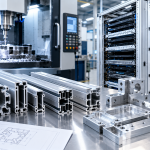
AI hardware is becoming increasingly complex.
Modern AI servers and infrastructure systems may combine high-power processors, liquid cooling, structural frames, cable management, power distribution, sensors, and serviceable enclosures within a compact mechanical architecture.
As a result, aluminum components often need to perform several functions simultaneously. They may need to provide structural stiffness, thermal conduction, cooling channels, mounting interfaces, and protection for sensitive hardware.
Choosing the right manufacturing process therefore becomes an important part of engineering design.
For many AI infrastructure components, the question is not whether to use aluminum extrusion or CNC machining.
The better question is:
Which features should be produced by extrusion, and which features require CNC machining?
A well-designed combination of aluminum extrusion and CNC machining can reduce material waste, simplify manufacturing, improve dimensional control, and provide an efficient path from prototype to production.
Why Manufacturing Strategy Matters for AI Hardware
AI hardware is different from many conventional mechanical products.
A single component may need to satisfy several requirements at the same time:
- Structural strength
- Thermal performance
- Dimensional accuracy
- Cooling integration
- Low weight
- Corrosion resistance
- Serviceability
- Assembly compatibility
- Production scalability
These requirements can conflict with each other.
For example, machining an entire structural component from a solid aluminum block may provide excellent geometric flexibility, but it can also create substantial material waste and machining time.
On the other hand, an extruded profile is highly efficient for constant cross-sections but cannot directly produce every precision feature required for a finished AI component.
This is where a hybrid manufacturing strategy becomes valuable.
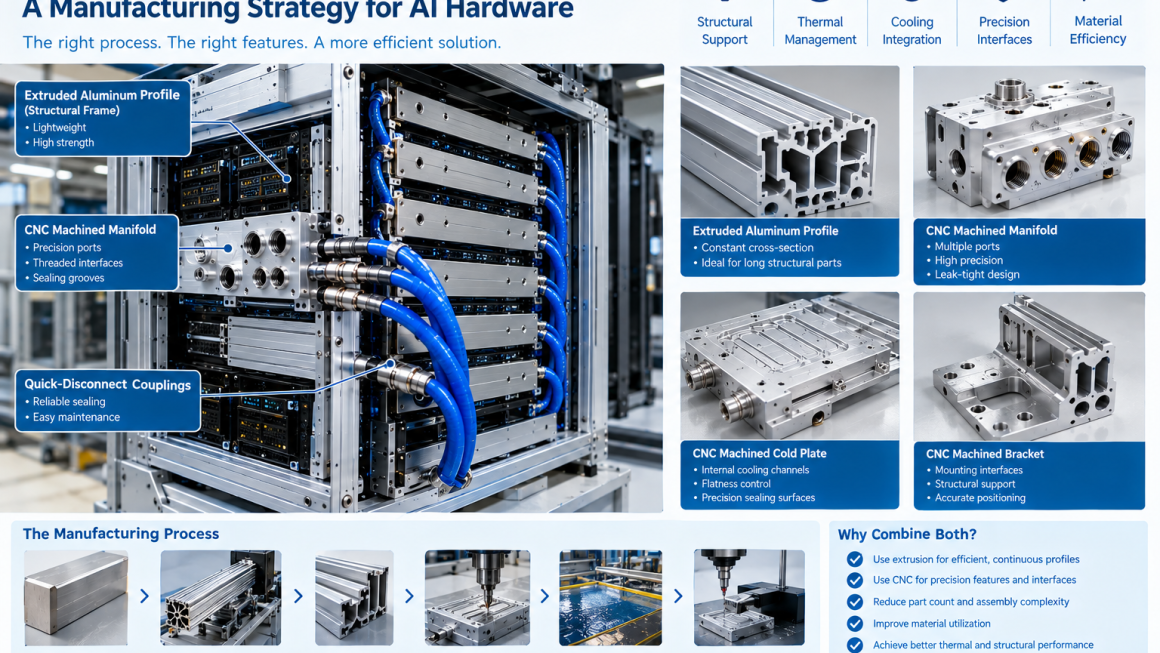
Extrusion creates the main geometry. CNC machining creates the critical interfaces.
What Is Aluminum Extrusion?
Aluminum extrusion is a manufacturing process in which heated aluminum billet is pushed through a die to create a continuous profile with a defined cross-section.
The process is particularly efficient when the desired geometry remains relatively constant along the length of the component.
Typical AI infrastructure applications include:
- Structural profiles
- Rack frame members
- Cooling channels
- Heat sink profiles
- Mounting rails
- Cable management structures
- Chassis frames
- Equipment supports
- Lightweight enclosure sections
The major advantage is that a complex cross-section can be produced continuously.
Instead of machining the entire shape from a solid block, the extrusion process forms much of the final geometry directly.
When Is Aluminum Extrusion Preferable?
Extrusion is generally attractive when a component has a relatively constant cross-section and needs to be produced in repeated lengths.
Several characteristics make extrusion particularly useful.
1. Long Components
Extrusion is well suited to:
- Rack beams
- Frame rails
- Structural channels
- Cooling profiles
- Cable trays
These components may be hundreds or thousands of millimeters long.
Machining them entirely from solid material would often be inefficient.
2. Repeated Geometry
If the same cross-section is repeated along the length of a component, extrusion can provide a highly efficient manufacturing route.
3. Integrated Functions
An extrusion die can incorporate multiple functions into a single profile.
For example, one aluminum profile could contain:
- Structural ribs
- Cooling channels
- Mounting slots
- Fastener channels
- Cable routing spaces
This can reduce the number of separate components required.
4. Material Efficiency
Because the near-net cross-section is produced directly, extrusion can reduce the amount of material that would otherwise be removed during machining.
5. Production Scalability
Once the extrusion die is developed and qualified, repeated production can be highly efficient.
This becomes increasingly valuable as production volumes increase.
What Are the Limitations of Aluminum Extrusion?
Extrusion is not suitable for every geometry.
The main limitation is that the profile is fundamentally based on a continuous cross-section.
This makes some features difficult or impossible to produce directly.
Examples include:
- Complex localized pockets
- Precision end interfaces
- Multiple intersecting ports
- Complex mounting patterns
- Localized sealing grooves
- Precision connector interfaces
- Deep blind holes
- Non-continuous geometries
These features often require secondary machining.
This is where CNC enters the manufacturing process.
What Does CNC Machining Add?
CNC machining removes material from an existing aluminum component to create precise features.
It can be applied to:
- Extruded profiles
- Aluminum plates
- Forged components
- Cast components
- Solid billets
For AI infrastructure, CNC machining is particularly useful for creating:
- Precision mounting holes
- Threaded holes
- Cooling ports
- O-ring grooves
- Flat sealing surfaces
- Connector interfaces
- End features
- Structural pockets
- Alignment features
- Custom openings
Instead of asking CNC machining to create the entire component, engineers can use it selectively where precision and geometric flexibility are actually required.
Aluminum Extrusion + CNC Machining
The hybrid process can be summarized simply:
Extrusion creates the profile.
CNC machining creates the precision features.
Surface treatment protects the finished component.
Inspection verifies the final geometry.
A typical manufacturing sequence may look like:
Aluminum billet → extrusion → cutting → CNC machining → deburring → surface treatment → inspection → assembly
This approach is particularly useful for custom aluminum components used in AI servers and cooling infrastructure.
Example: AI Rack Structural Profile
Consider a structural aluminum profile used in an AI server rack.
The extrusion could produce:
- Main structural body
- Internal ribs
- Mounting channels
- Cable routing space
- Lightweight hollow sections
After extrusion, CNC machining could create:
- End mounting holes
- Precision connector surfaces
- Bracket interfaces
- Threaded holes
- Alignment holes
The result is a component that combines the efficiency of extrusion with the precision of machining.
Trying to CNC-machine the entire component from a solid block would generally be unnecessary.
Example: Liquid Cooling Structural Channel
A liquid cooling profile provides another useful example.
The extrusion can create the primary cooling architecture:
- Coolant channel
- Structural walls
- Reinforcement ribs
- Mounting features
- Heat-spre sections
CNC machining can then add:
- Inlet ports
- Outlet ports
- Threaded connections
- O-ring grooves
- Quick-disconnect interfaces
- Mounting holes
- End closures
This allows thermal and structural functions to be integrated into a single aluminum component.
The manufacturing strategy therefore follows the engineering architecture.
Example: Aluminum Cold Plate
Cold plates can also benefit from a hybrid approach.
Depending on the design, an aluminum extrusion may provide the basic thermal structure or channel geometry.
CNC machining can then provide:
- Precision mounting surfaces
- Port connections
- Sealing grooves
- End interfaces
- Threaded holes
- Localized cooling features
However, not every cold plate should be extruded.
For highly complex internal channel geometries or low-volume development projects, machining from plate or billet may be more appropriate.
The correct choice depends on:
- Channel geometry
- Component dimensions
- Production volume
- Thermal requirements
- Pressure requirements
- Tolerance requirements
- Tooling investment
Example: AI Server Chassis
An AI server chassis may contain a combination of long structural elements and localized precision features.
Extrusion can provide:
- Side rails
- Frame members
- Structural channels
- Heat-dissipating sections
CNC machining can provide:
- GPU mounting interfaces
- Connector openings
- Precision holes
- Bracket locations
- Panel interfaces
- Cable access openings
This modular manufacturing strategy can simplify both engineering and production.
Why Not CNC-Machine Everything?
CNC machining offers excellent flexibility, but using it for every feature is not always the most efficient approach.
Machining a large aluminum component from a solid block can increase:
- Material consumption
- Machining time
- Tool wear
- Production cost
- Chip generation
- Fixture requirements
The larger and more geometrically repetitive the component becomes, the more important material utilization and machining efficiency become.
Extrusion can remove much of this unnecessary machining volume.
The CNC machine then focuses on the features that actually require precision.
Why Not Extrude Everything?
The opposite approach also has limitations.
Extrusion cannot efficiently replace every localized precision feature.
For example, a cooling manifold may require multiple ports in different directions.
A server bracket may require a specific three-dimensional mounting geometry.
A cold plate may require localized sealing and interface features.
These components may need CNC machining even when extrusion provides part of the basic geometry.
Therefore:
Extrusion optimizes repeated geometry.
CNC optimizes localized precision.
Designing for Aluminum Extrusion Machining
When developing custom aluminum components, the manufacturing strategy should be considered during CAD design rather than after the design is completed.
A good design process asks:
Which geometry is continuous?
This geometry may be suitable for extrusion.
Which features are localized?
These may be better produced by CNC.
Which surfaces require precision?
These should be identified as critical machining surfaces.
Which features are structural?
They may be integrated into the extrusion profile.
Which features are thermal?
Cooling channels, heat-spreading sections, and thermal interfaces should be evaluated together.
Which features are for assembly?
Mounting holes, threads, and connector interfaces may be added through CNC machining.
This approach is often called design for manufacturing, or DFM.
Profile Design Before CNC
The extrusion profile itself has a major influence on the total manufacturing cost.
A well-designed profile can reduce the amount of CNC work required later.
For example, an extrusion can incorporate:
- Mounting channels
- Reinforcement ribs
- Cable paths
- Cooling channels
- Fastener channels
- Weight-reduction cavities
This means that the extrusion die effectively becomes part of the manufacturing toolset.
The more functional geometry that can be produced directly through extrusion, the less material needs to be removed later.
However, the profile should not become unnecessarily complicated simply to avoid machining.
Die complexity, extrusion feasibility, dimensional control, and tooling cost must also be considered.
CNC Features Should Be Function-Driven
After extrusion, CNC machining should focus on the features that provide measurable functional value.
Typical examples include:
Structural Interfaces
Where another component must attach accurately.
Thermal Interfaces
Where flatness and surface condition affect heat transfer.
Sealing Interfaces
Where grooves and surfaces must meet the requirements of the sealing system.
Fluid Interfaces
Where ports and connectors must align correctly.
Assembly Interfaces
Where hole position and thread geometry determine assembly quality.
This approach helps prevent over-machining.
Aluminum Extrusion and CNC Tolerances
Extrusion and CNC machining have different dimensional characteristics.
Extrusion dimensions are influenced by:
- Die design
- Alloy
- Temperature
- Extrusion speed
- Profile geometry
- Cooling
- Straightening
- Cut length
CNC machining can provide tighter control over selected features.
Therefore, a practical design should distinguish between:
Extruded dimensions
and
CNC-controlled dimensions
Critical interfaces should generally be associated with the appropriate manufacturing process.
For example, a long structural dimension may be controlled through extrusion, while a precision mounting hole pattern can be controlled through CNC machining.
Surface Treatment and Manufacturing Sequence
Surface treatment should also be considered as part of the manufacturing strategy.
Typical processes include:
- Anodizing
- Powder coating
- Conversion coating
- Protective coatings
The sequence may vary depending on the required function.
For precision components, engineers should consider whether critical machining should occur:
- Before surface treatment
- After surface treatment
- Partially before and partially after treatment
For example, coating thickness can affect:
- Thread fit
- Hole diameter
- Sealing interfaces
- Sliding surfaces
- Connector dimensions
Manufacturing drawings should therefore identify critical surfaces clearly.
Aluminum Alloy Selection
The manufacturing strategy also influences alloy selection.
6063 aluminum is widely used for extrusion because of its favorable extrusion characteristics and surface finish.
6061 aluminum is often considered where higher mechanical performance and machinability are important.
The final choice depends on the component’s requirements.
For AI infrastructure, engineers may need to balance:
- Structural strength
- Thermal conductivity
- Extrusion performance
- CNC machinability
- Corrosion resistance
- Surface treatment
- Availability
- Cost
There is no universal aluminum alloy for every AI application.
Production Volume Changes the Answer
Production volume is one of the most important factors when selecting between extrusion, CNC machining, and hybrid manufacturing.
Prototype Stage
For a small number of parts, CNC machining directly from plate or billet may be practical.
The objective is often:
speed + flexibility + validation
rather than minimum unit cost.
Pilot Production
A hybrid approach may become attractive.
An extruded profile can provide the basic geometry, while CNC machining creates the required interfaces.
Higher Production Volume
The value of extrusion generally increases when the same profile is produced repeatedly.
The tooling investment can then be distributed across a larger number of components.
This creates an important manufacturing principle:
Production volume changes the economics of the manufacturing process.
Prototype-to-Production Strategy
A common mistake is to use the same manufacturing strategy throughout the entire product lifecycle.
The most efficient process for one prototype may not be the most efficient process for 10,000 units.
A practical development path may look like:
Phase 1 — Engineering Prototype
CNC machining provides maximum flexibility.
Phase 2 — Functional Prototype
Hybrid extrusion + CNC may be introduced to validate the production architecture.
Phase 3 — Pilot Production
Manufacturing processes, fixtures, inspection, and surface treatment are optimized.
Phase 4 — Production
Extrusion tooling and optimized CNC operations are used to improve repeatability and cost.
This staged approach allows the manufacturing process to evolve together with the product.
Reducing Manufacturing Complexity
One of the most important advantages of combining extrusion and CNC machining is that it can reduce unnecessary complexity.
Instead of creating multiple small components, engineers may be able to integrate functions into a single extruded profile and machine only the required interfaces.
For example, a single aluminum structural profile could potentially combine:
- Structural support
- Cable routing
- Cooling channels
- Mounting channels
- Heat spreading
- Fastener access
This can reduce:
- Part count
- Assembly steps
- Fasteners
- Alignment operations
- Supplier interfaces
However, integration should be used carefully.
A component should not become so complex that manufacturing, inspection, repair, or replacement becomes difficult.
Custom Aluminum Components for AI Infrastructure
AI infrastructure is increasingly customized.
Different applications may require different:
- Rack dimensions
- GPU configurations
- Cooling architectures
- Power layouts
- Cable routing
- Environmental protection
- Service-access requirements
Custom aluminum extrusion combined with CNC machining provides a flexible manufacturing platform for these requirements.
Instead of developing an entirely new manufacturing process for every component, engineers can often modify:
Profile geometry + machining features + assembly interfaces
This can shorten development cycles while preserving a repeatable manufacturing foundation.
Quality Control for Hybrid Manufacturing
Quality control should cover both extrusion and CNC operations.
For extruded profiles, inspection may include:
- Cross-section dimensions
- Straightness
- Twist
- Surface condition
- Cut length
- Alloy and temper
For CNC-machined features, inspection may include:
- Hole position
- Thread dimensions
- Flatness
- Parallelism
- Perpendicularity
- Surface roughness
- Critical interface dimensions
For finished cooling components, additional testing may include:
- Pressure testing
- Leak testing
- Flow testing
- Thermal testing
The inspection strategy should focus on the characteristics that influence actual system performance.
Common Manufacturing Mistakes
1. CNC-Machining an Entire Extrudable Geometry
This can increase machining time and material waste.
2. Trying to Extrude Highly Localized Features
Complex localized geometry may be better produced through CNC.
3. Ignoring Production Volume
A prototype process may not be suitable for production quantities.
4. Designing the Profile Without CNC Access
The extrusion may technically be producible but difficult to machine afterward.
5. Over-Integrating the Component
Reducing part count is not always beneficial if it creates difficult assembly or maintenance.
6. Ignoring Surface Treatment Effects
Coatings and anodizing can affect critical dimensions.
7. Defining Tolerances Without Considering the Process
Extrusion and CNC have different manufacturing capabilities and cost structures.
A Practical Decision Framework
When selecting a manufacturing route for an aluminum AI component, engineers can ask several questions.
| Requirement | Extrusion | CNC Machining | Hybrid |
|---|---|---|---|
| Long constant profile | Excellent | Poor | Excellent |
| Complex localized geometry | Limited | Excellent | Excellent |
| High production volume | Excellent | Variable | Excellent |
| Rapid prototype | Moderate | Excellent | Excellent |
| Precision holes | Limited | Excellent | Excellent |
| Cooling channels | Excellent for suitable profiles | Excellent | Excellent |
| Sealing grooves | Limited | Excellent | Excellent |
| Material efficiency | Excellent | Variable | Excellent |
| Custom interfaces | Limited | Excellent | Excellent |
| Structural integration | Excellent | Excellent | Excellent |
The table is not a universal rule. Actual process selection depends on component geometry, alloy, tolerance, quantity, tooling investment, and functional requirements.
Aluminum Extrusion + CNC Machining for AI Server Manufacturing
The combination becomes particularly powerful when designing complete AI infrastructure systems.
A typical system may contain:
Extruded structural profiles
↓
CNC-machined interfaces
↓
Thermal components
↓
Cooling manifolds
↓
Mounting brackets
↓
Server chassis
↓
Surface treatment
↓
Inspection and validation
This allows the manufacturing strategy to follow the architecture of the AI system.
The same supplier or manufacturing partner can potentially coordinate material selection, extrusion, machining, finishing, inspection, and assembly.
That can simplify supplier management and reduce communication gaps between engineering and manufacturing.
From Aluminum Profile to Finished AI Hardware
The real value of aluminum extrusion CNC machining for AI infrastructure is not simply that two manufacturing processes can be combined.
The value is that each process can be used where it is most effective.
Extrusion is efficient at creating continuous, lightweight, structurally optimized geometry.
CNC machining is effective at creating precision interfaces, localized features, and complex three-dimensional geometry.
Together, they provide a practical manufacturing route for:
- AI server frames
- GPU mounting structures
- Liquid cooling channels
- Cold plate components
- Cooling manifolds
- Heat sinks
- Cable management structures
- Aluminum chassis
- Edge AI enclosures
- Custom mechanical interfaces
For companies developing custom aluminum components for AI infrastructure, this combination can provide a useful balance between engineering flexibility and production efficiency.
The key is to decide early which geometry belongs to extrusion and which geometry belongs to CNC.
AI hardware requires more than high-performance processors and cooling systems. The mechanical infrastructure around those systems must also be engineered for strength, thermal management, precision, assembly, and long-term serviceability.
Aluminum extrusion and CNC machining address different parts of this challenge.
Extrusion is highly effective for continuous profiles, structural sections, integrated cooling channels, and repeated geometries.
CNC machining becomes important when the component requires precision holes, threaded interfaces, sealing surfaces, cooling ports, complex localized geometry, or controlled dimensional relationships.
The most practical solution is often neither process alone.
It is a carefully designed combination:
Extrusion for efficient base geometry.
CNC machining for precision features.
Surface treatment for environmental performance.
Inspection and validation for production reliability.
For AI server manufacturing, this hybrid strategy can reduce unnecessary machining, improve material utilization, simplify component architecture, and provide a scalable path from prototype to production.
The manufacturing question should therefore not be:
“Extrusion or CNC?”
It should be:
“Which features should be extruded, which features should be machined, and how can both processes work together as one manufacturing system?”
That is the foundation of efficient aluminum extrusion machining for AI infrastructure.