The rapid expansion of artificial intelligence (AI), cloud computing, and high-performance computing (HPC) has created new challenges for data center physical infrastructure.
Modern AI data centers contain significantly higher densities of:
- Power cables
- Network cables
- Fiber connections
- Liquid cooling-related lines
- Monitoring and control wiring
As rack power levels increase and computing equipment becomes more compact, cable management systems must evolve beyond simple support structures.
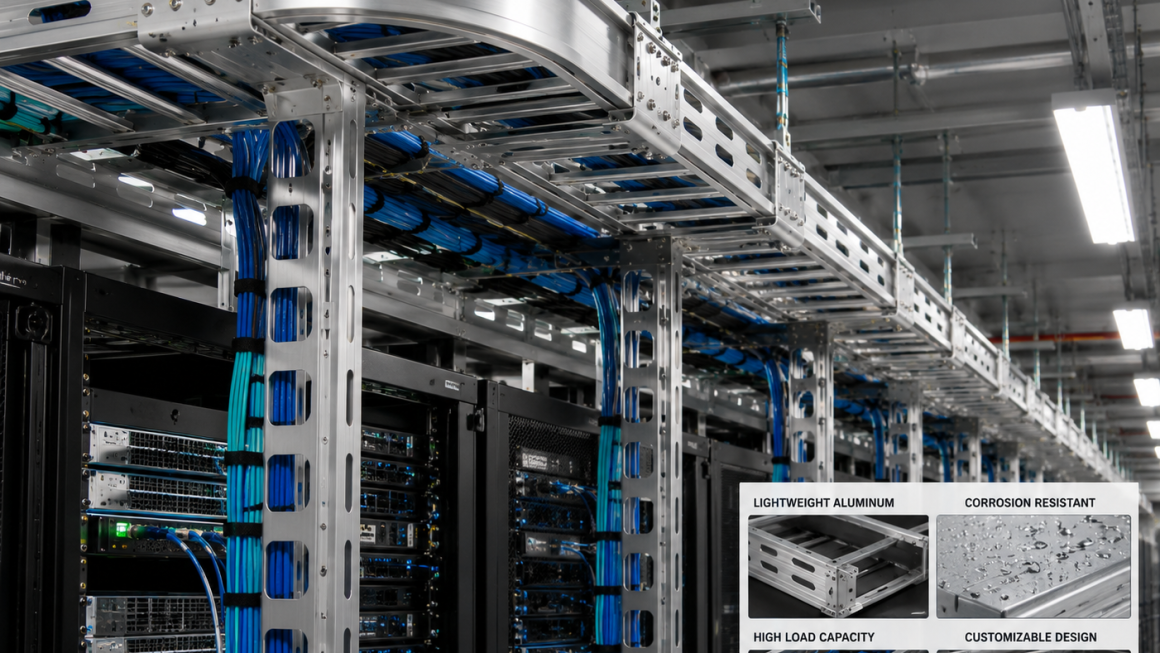
Aluminum cable trays are becoming an important consideration for high-density computing environments due to their combination of lightweight characteristics, manufacturing flexibility, corrosion resistance, and adaptability for customized infrastructure designs.
This article explores the role of aluminum cable trays in AI data centers, including structural requirements, material considerations, manufacturing approaches, and integration challenges.
The Growing Importance of Cable Infrastructure in AI Data Centers
Traditional data centers were primarily designed around server installation, power distribution, and airflow management.
However, AI infrastructure introduces additional complexity.
High-performance AI clusters require:
- More electrical connections
- Higher network bandwidth
- More complex rack configurations
- Additional cooling infrastructure
Cable systems must support reliable operation while maintaining:
- Accessibility
- Organization
- Mechanical protection
- Future scalability
Therefore, cable tray design has become an important part of AI infrastructure engineering.
What Are Aluminum Cable Trays?
An aluminum cable tray is a structural support system designed to route and organize cables throughout a facility.
Typical applications include:
- Overhead cable routing
- Rack-to-rack connections
- Power distribution pathways
- Network infrastructure support
Common cable tray designs include:
Ladder-Type Cable Trays
Features:
- Open structure
- High ventilation capability
- Easy cable access
Often used for:
- Large cable bundles
- Power distribution systems
Perforated Cable Trays
Features:
- Continuous support surface
- Additional cable protection
Applications may include:
- Network cables
- Sensitive communication wiring
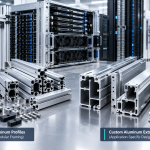
Custom Aluminum Profiles
For specialized AI infrastructure, custom extrusion profiles may be developed to meet:
- Specific load requirements
- Installation constraints
- Rack integration needs
Why Aluminum Is Considered for Cable Tray Applications
Material selection depends on project requirements.
Aluminum provides several characteristics that make it suitable for many infrastructure applications.
Lightweight Structural Design
One of the main advantages of aluminum is its low density.
Compared with traditional steel structures, aluminum components may offer:
- Reduced installation weight
- Easier handling
- Lower structural load requirements
This can be valuable in large-scale data center environments where extensive cable routing systems are required.
Corrosion Resistance Considerations
Data centers may operate in different environmental conditions.
Potential concerns include:
- Humidity
- Cooling system exposure
- Industrial environments
Aluminum naturally forms an oxide layer that provides surface protection.
Additional treatments such as:
- Anodizing
- Protective coatings
may be considered depending on environmental requirements.
Manufacturing Flexibility
Aluminum cable trays can be manufactured through several processes.
Aluminum Extrusion
Extrusion is commonly used for long structural profiles.
Advantages include:
- Consistent cross-sectional design
- Efficient production
- Custom profile development
Custom extrusion allows engineers to design profiles with:
- Reinforcement ribs
- Mounting channels
- Weight optimization features
CNC Machining
CNC machining may be used for:
- Connection brackets
- Custom mounting interfaces
- Precision components
Sheet Fabrication
Aluminum sheet processing may be suitable for:
- Covers
- Panels
- Protective structures
Structural Requirements for High-Density Computing
Load Capacity
AI data centers often contain large cable volumes.
Cable tray systems should consider:
- Cable weight
- Support spacing
- Installation loads
- Safety margins
Structural design may involve evaluating:
- Profile geometry
- Material thickness
- Connection methods
Mechanical Stability
Cable trays must maintain stability under operating conditions.
Considerations include:
- Vibration
- Thermal expansion
- Installation forces
- Long-term loading
Proper support structures help maintain system reliability.
Cable Separation and Organization
High-density computing environments contain multiple cable categories.
A well-designed tray system may help organize:
Power Cables
Requirements may include:
- Appropriate spacing
- Heat management considerations
- Mechanical support
Network and Fiber Cables
Considerations include:
- Bend radius protection
- Reduced mechanical stress
- Easy maintenance access
Cooling-Related Lines
In liquid-cooled AI environments, cable systems may need to coordinate with:
- Coolant piping
- Manifolds
- Rack structures
The physical layout should avoid interference between different infrastructure systems.
Integration With AI Server Infrastructure
Rack-Level Integration
Cable trays should coordinate with:
- Server racks
- Power distribution systems
- Cooling infrastructure
Modular Installation
Modular aluminum cable systems may provide advantages such as:
- Faster deployment
- Easier expansion
- Simplified maintenance
Customized Designs
AI data center projects often have different requirements.
Customization may involve:
- Tray dimensions
- Mounting locations
- Profile geometry
- Surface treatment
Aluminum vs Steel Cable Tray Considerations
Both aluminum and steel are widely used engineering materials.
Aluminum
Potential advantages:
- Lightweight
- Good corrosion resistance
- Easy fabrication
- Flexible customization
Steel
Potential advantages:
- High mechanical strength
- Established infrastructure applications
- Cost efficiency in some projects
Engineering Selection
The optimal material depends on:
- Installation environment
- Load requirements
- Project scale
- Maintenance strategy
Material selection should be application-driven rather than based on one universal solution.
Surface Treatment Options
Surface finishing can improve performance and appearance.
Anodizing
Common for aluminum components.
Potential benefits include:
- Surface durability
- Corrosion resistance improvement
- Consistent appearance
Powder Coating
May be considered where:
- Color identification is needed
- Additional surface protection is required
Industrial Finishing
Depending on requirements, additional treatments may be evaluated for:
- Environmental durability
- Electrical considerations
- Long-term appearance
Manufacturing Quality Considerations
Reliable cable tray systems require consistent manufacturing control.
Important areas include:
Dimensional Accuracy
Ensuring:
- Correct installation fit
- Compatible connection interfaces
- Repeatable assembly
Structural Inspection
Evaluation may include:
- Profile dimensions
- Mechanical integrity
- Surface quality
Assembly Verification
Installation systems should consider:
- Connection strength
- Fastener compatibility
- Maintenance accessibility
Design Challenges in Future AI Infrastructure
Increasing Cable Density
Future AI systems may require:
- More power delivery
- Higher bandwidth networking
- More complex cooling integration
Cable management structures will need improved space utilization.
Integration With Liquid Cooling
Future racks may contain both:
- Electrical infrastructure
- Liquid cooling systems
Cable trays may need to coexist with:
- Cooling pipes
- Quick-connect interfaces
- Service access zones
Flexible Manufacturing Requirements
Because AI infrastructure designs continue evolving, suppliers may need capabilities in:
- Custom aluminum extrusion
- CNC machining
- Small-batch validation
- Production scaling
Future Development Trends
Lightweight Data Center Structures
The demand for efficient installation may increase interest in lightweight structural materials.
Integrated Infrastructure Systems
Future designs may combine:
- Cable management
- Rack structures
- Cooling support
- Mechanical interfaces
into more integrated solutions.
Digital Manufacturing
Advanced manufacturing approaches may include:
- CAD-driven customization
- Automated inspection
- Digital production tracking
Conclusion
Aluminum cable trays are becoming an important structural component in high-density computing environments, especially as AI data centers require more complex physical infrastructure.
Their combination of lightweight characteristics, manufacturing flexibility, and customization potential makes them suitable for many cable management applications.
However, successful implementation requires careful consideration of load requirements, installation environment, material selection, manufacturing quality, and integration with other data center systems.
As AI infrastructure continues to expand, customized aluminum cable tray systems and related structural components will play an important role in creating organized, scalable, and maintainable computing environments.