Artificial intelligence (AI) infrastructure is driving significant changes in modern data center design. As GPU clusters become denser and rack power levels continue to increase, the physical organization of cables has become an important engineering consideration rather than simply an installation task.
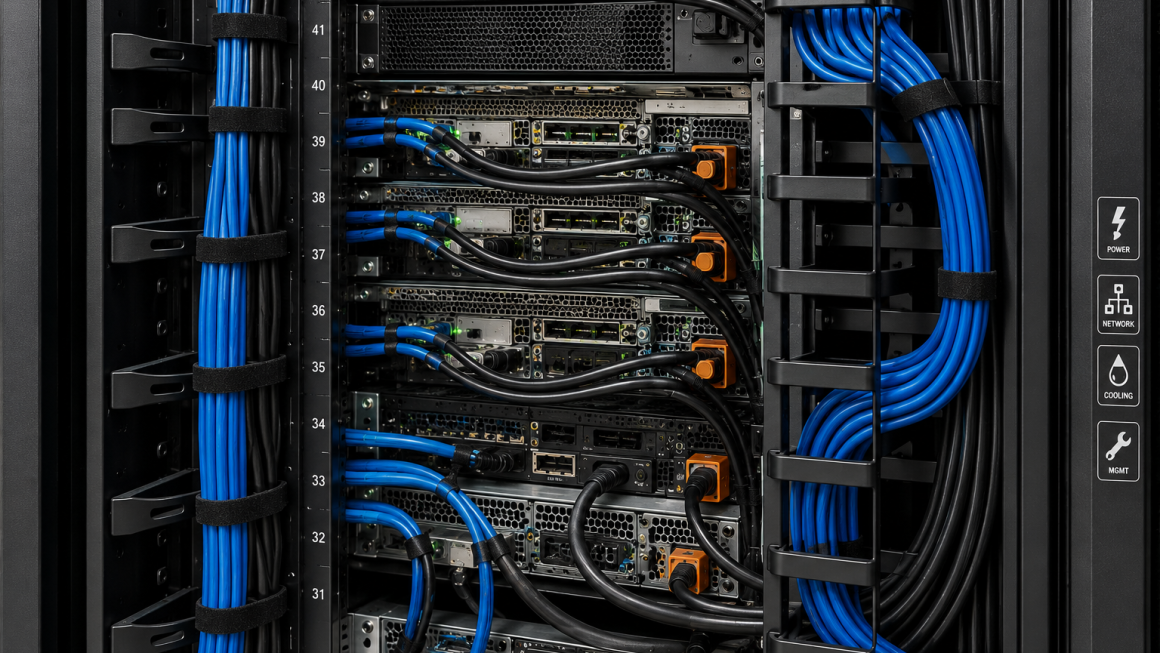
A typical AI server rack may contain power cables, high-speed Ethernet or InfiniBand connections, fiber optic links, management wiring, and, in many deployments, liquid cooling pipes. The growing number of mechanical and electrical interfaces requires cable routing strategies that support reliable operation, efficient maintenance, and future scalability.
Cable routing optimization focuses on arranging these connections in a structured manner that supports installation efficiency, mechanical protection, airflow or liquid cooling integration, and long-term serviceability.
This article explores the engineering principles behind cable routing optimization in AI server racks and discusses structural considerations, material selection, and manufacturing approaches for modern data center infrastructure.
Why Cable Routing Matters in AI Infrastructure
Compared with conventional enterprise servers, AI computing platforms typically require:
- Higher rack power density
- Larger numbers of GPU accelerators
- Higher network bandwidth
- More power distribution connections
- Additional cooling infrastructure
As cable density increases, routing decisions can influence:
- Equipment accessibility
- Connector reliability
- Maintenance efficiency
- Cooling system integration
- Mechanical protection
Well-organized cable routing contributes to a cleaner and more manageable infrastructure throughout the equipment lifecycle.
Types of Cables Inside AI Server Racks
Modern AI racks often contain multiple cable categories, each with different routing requirements.
Power Cables
Power cables deliver electricity from power distribution units (PDUs) to servers and supporting equipment.
Design considerations may include:
- Separation from signal cables
- Bend radius
- Mechanical support
- Service accessibility
Network Cables
AI clusters depend on high-speed communication between computing nodes.
Typical connections may include:
- Ethernet
- InfiniBand
- Optical fiber
Routing systems should help protect connectors while maintaining organized pathways.
Management and Control Wiring
Additional wiring may support:
- Environmental monitoring
- Rack management
- Sensor integration
- Security systems
These cables often require clear identification and organized routing.
Liquid Cooling Connections
For direct-to-chip liquid cooling systems, routing design must also consider:
- Flexible coolant hoses
- Manifolds
- Quick-connect interfaces
Electrical cables and cooling pipes should be arranged to minimize interference and simplify maintenance.
Engineering Objectives of Cable Routing Optimization
Effective cable routing is based on multiple engineering objectives rather than a single design target.
Mechanical Protection
Cables should be protected from:
- Abrasion
- Excessive bending
- Compression
- Accidental impact
Support structures and routing accessories can help reduce unnecessary mechanical stress.
Accessibility
Routine maintenance is an important consideration throughout the service life of an AI data center.
Cable routing should allow technicians to:
- Access servers
- Replace components
- Inspect connectors
- Perform upgrades
without unnecessary removal of unrelated cable assemblies.
Scalability
AI infrastructure often evolves over time.
Cable routing systems should allow additional equipment and cables to be integrated without extensive structural modifications.
Structural Design Considerations
Cable routing systems should be designed as part of the overall rack structure rather than added as an afterthought.
Important structural elements include:
- Cable trays
- Vertical cable managers
- Horizontal guides
- Support brackets
- Mounting rails
- Protective covers
These components help organize cables while supporting mechanical stability.
Maintaining Proper Bend Radius
Many cable types have recommended minimum bend radii.
Excessive bending may increase mechanical stress and potentially affect long-term reliability.
Cable routing designs often include:
- Rounded guide surfaces
- Smooth transitions
- Dedicated routing channels
to support appropriate cable handling during installation and maintenance.
Separation of Cable Categories
Different cable types may have different installation requirements.
Many rack layouts separate:
- High-voltage power cables
- Network cables
- Fiber optic cables
- Management wiring
- Cooling-related tubing
This organized approach can simplify maintenance and reduce congestion.
Integration With Liquid Cooling Systems
Many AI platforms are transitioning toward liquid cooling technologies.
Cable routing should be coordinated with:
- Cold plates
- Manifolds
- Coolant supply lines
- Quick-connect couplings
Adequate spacing between cables and cooling hardware can improve service access and reduce installation complexity.
Material Selection for Cable Routing Structures
Structural components used for cable routing should provide sufficient mechanical support while remaining practical to manufacture.
Aluminum
Aluminum is widely considered for cable routing structures because it offers:
- Lightweight construction
- Good corrosion resistance
- Excellent extrusion capability
- High manufacturing flexibility
Typical applications include:
- Cable trays
- Mounting brackets
- Rack accessories
- Custom structural profiles
Steel
Steel continues to be used in many infrastructure projects where higher structural load capacity is required.
Selection between aluminum and steel depends on project-specific factors such as load requirements, installation environment, and maintenance strategy.
Engineering Polymers
Certain cable management accessories may incorporate engineering polymers for:
- Electrical insulation
- Edge protection
- Cable retention
- Wear resistance
These materials are often used alongside metal structural components.
Manufacturing Considerations
Cable routing hardware can be produced using several manufacturing methods depending on the design.
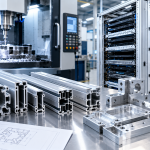
Aluminum Extrusion
Extrusion is commonly used for long structural profiles with consistent cross-sections.
It supports:
- Custom profile development
- Lightweight structures
- Efficient production
CNC Machining
Precision machining may be used for:
- Connection plates
- Mounting interfaces
- Specialized brackets
This approach is suitable for customized designs and lower-volume production.
Sheet Metal Fabrication
Sheet fabrication may be used for:
- Cable covers
- Enclosures
- Protective panels
depending on the structural requirements.
Design for Installation and Maintenance
Optimized cable routing should simplify installation while supporting future maintenance.
Key considerations include:
- Clear cable identification
- Accessible mounting points
- Replaceable support components
- Modular cable guides
These features can help reduce service time and improve operational efficiency.
Supporting High-Density AI Deployments
As AI server racks continue to increase in density, cable routing systems must accommodate:
- More computing nodes
- Higher cable counts
- Increased power delivery
- More liquid cooling hardware
Flexible routing solutions help infrastructure adapt to changing deployment requirements without extensive redesign.
Future Development Trends
Several trends are expected to influence cable routing systems for AI infrastructure.
Integrated Rack Architectures
Future rack systems may combine:
- Structural frames
- Cable management
- Cooling support
- Equipment mounting
into integrated mechanical platforms.
Lightweight Structural Components
Lightweight materials such as aluminum may continue to support easier installation and modular infrastructure expansion.
Digital Design and Manufacturing
Three-dimensional CAD modeling, digital simulation, and automated manufacturing processes can assist engineers in developing customized cable routing solutions with improved consistency and repeatability.
Cable routing optimization has become an important part of AI server rack design as computing density, power delivery, and liquid cooling infrastructure continue to evolve.
Rather than focusing only on cable organization, modern routing systems support mechanical protection, maintenance accessibility, scalability, and integration with other rack subsystems.
Through appropriate structural design, material selection, and manufacturing methods, cable routing solutions can contribute to more organized and maintainable AI infrastructure while supporting the long-term operational requirements of high-density computing environments.