



The continuous growth of artificial intelligence (AI), high-performance computing (HPC), and accelerated computing has created increasing demand for advanced thermal management solutions. Modern processors, GPUs, and AI accelerators generate significant heat during operation, requiring efficient and reliable methods to maintain appropriate operating conditions.
Liquid cooling has become an important thermal management approach for high-density computing systems, and cold plates are among the key components within many liquid cooling architectures.
Aluminum cold plates are widely considered for certain high-performance computing applications because they combine lightweight construction, good manufacturability, corrosion resistance, and compatibility with complex cooling system designs.
This article discusses the role of aluminum cold plates in HPC systems, including their design principles, manufacturing processes, material considerations, and integration challenges.
The Role of Cold Plates in HPC Thermal Management
A cold plate is a heat transfer component that creates a thermal pathway between high-power electronic devices and a liquid cooling system.
In many direct-to-chip cooling architectures, a cold plate is positioned directly above heat-generating components such as:
- GPUs
- CPUs
- AI accelerators
- Power modules
Its main functions include:
- Receiving heat from electronic components
- Transferring heat into circulating coolant
- Supporting stable operating conditions
- Providing a reliable mechanical interface
The overall thermal performance depends on the complete cooling system, including:
- Cold plate design
- Coolant properties
- Flow conditions
- Thermal interface materials
- System integration
Why Aluminum Is Used for Cold Plates
Material selection for cold plates depends on many engineering factors, including thermal requirements, weight, corrosion considerations, manufacturing methods, and cost objectives.
Aluminum alloys are commonly evaluated for cold plate applications because of several characteristics.
Lightweight Design
One of the primary advantages of aluminum is its relatively low density.
Compared with heavier metals, aluminum components may contribute to:
- Reduced system weight
- Easier handling
- Simplified mechanical integration
This can be beneficial in applications where multiple cooling components are installed within dense computing systems.
Manufacturing Flexibility
Aluminum provides excellent compatibility with manufacturing processes such as:
- CNC machining
- Vacuum brazing
- Extrusion
- Friction welding
- Precision fabrication
These processes allow engineers to develop cold plates with different:
- Channel structures
- Mounting interfaces
- Mechanical geometries
Corrosion Considerations
Liquid cooling systems require careful evaluation of material compatibility.
Aluminum naturally forms a protective oxide layer, but the long-term reliability of a cooling system depends on:
- Coolant chemistry
- Operating temperature
- Material combinations
- System maintenance
Proper engineering evaluation is required when aluminum interacts with other metals such as copper.
Aluminum Cold Plate Design Principles
Internal Channel Design
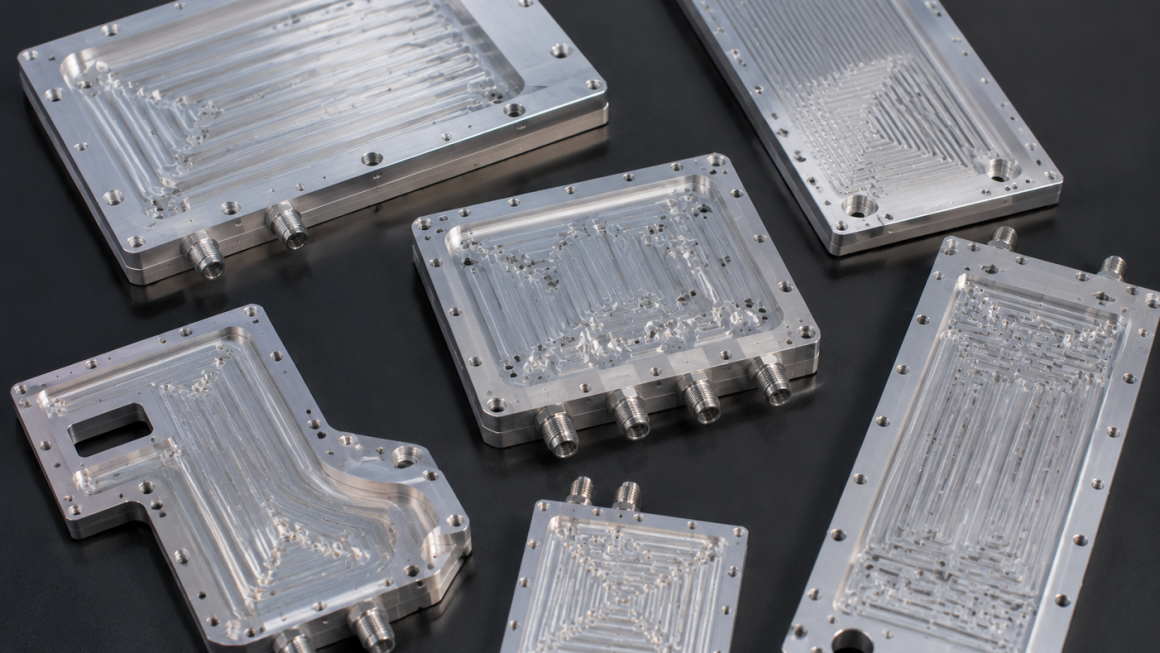
The internal coolant channels are one of the most important aspects of cold plate design.
Design factors may include:
- Channel geometry
- Flow distribution
- Pressure requirements
- Manufacturing feasibility
Different designs may use:
- Parallel channels
- Serpentine channels
- Micro-channel structures
The optimal design depends on application requirements.
Surface Flatness and Contact Quality
Cold plates require reliable contact with heat-generating components.
Important mechanical considerations include:
- Surface flatness
- Machining quality
- Mounting pressure
- Interface material compatibility
Precision manufacturing helps achieve consistent assembly conditions.
Structural Integrity
Cold plates must withstand:
- Internal coolant pressure
- Mechanical mounting forces
- Thermal cycling
Design engineers consider:
- Material thickness
- Channel depth
- Sealing methods
- Mechanical reinforcement
Manufacturing Methods for Aluminum Cold Plates
CNC Machining
CNC machining is commonly used for customized aluminum cold plates.
Advantages include:
- Flexible design modification
- Complex channel fabrication
- Precision interface machining
Applications include:
- Prototype development
- Small-batch production
- Specialized computing systems
Vacuum Brazing
Vacuum brazing can be used to join aluminum components while maintaining internal cooling structures.
Potential advantages include:
- Complex internal pathways
- Integrated structures
- Reduced assembly complexity
Extrusion-Based Manufacturing
Aluminum extrusion may be considered for certain cold plate designs.
Benefits include:
- Efficient production
- Repeatable profiles
- Scalable manufacturing
Aluminum Cold Plates in AI Hardware Applications
GPU Computing Systems
AI training and inference platforms increasingly use high-performance GPUs.
Cold plates may support cooling of:
- GPU modules
- Accelerator cards
- High-power computing boards
Data Center Servers
Server-level liquid cooling systems may incorporate aluminum cold plates together with:
- Pumps
- Manifolds
- Distribution units
- Cooling loops
Power Electronics
In addition to processors, power components may require thermal management.
Applications may include:
- Power conversion modules
- Energy management systems
- Industrial computing equipment
Integration Challenges
Material Compatibility
Liquid cooling systems often contain multiple materials.
Engineers must consider interactions between:
- Aluminum
- Copper
- Stainless steel
- Polymers
- Coolants
Material compatibility is an important factor in long-term reliability.
Manufacturing Consistency
For production applications, manufacturers need to control:
- Machining accuracy
- Surface quality
- Leakage testing
- Assembly consistency
Maintenance Considerations
Cooling systems require practical maintenance strategies.
Important considerations include:
- Access to components
- Connector reliability
- Inspection procedures
- Replacement methods
Aluminum Cold Plates and System-Level Design
A cold plate does not operate independently.
Its performance depends on integration with:
Thermal Interface Materials
The interface between the cold plate and electronic components influences heat transfer efficiency.
Mechanical Structures
Mounting systems must maintain:
- Alignment
- Contact pressure
- Structural stability
Cooling Distribution Systems
Cold plates must connect effectively with:
- Manifolds
- Tubing
- Pumps
- Cooling distribution units
Future Trends
Higher Heat Flux Applications
As AI processors continue to increase in performance, thermal management systems may require further development in:
- Cooling architecture
- Materials
- Manufacturing processes
Advanced Aluminum Manufacturing
Future manufacturing improvements may include:
- More precise machining
- Improved channel designs
- Automated inspection
Hybrid Thermal Structures
Future cooling solutions may combine aluminum with:
- Copper
- Composite materials
- Carbon-based thermal materials
depending on application requirements.
Aluminum cold plates are an important component in liquid cooling systems for high-performance computing and AI infrastructure. Their combination of lightweight characteristics, manufacturing flexibility, and structural capability makes them suitable for various cooling applications.
However, cold plate performance depends on more than material selection alone. Successful implementation requires coordinated consideration of thermal design, mechanical engineering, manufacturing processes, coolant compatibility, and system integration.
As AI computing systems continue to evolve toward higher power density, aluminum cold plates and other advanced thermal management components will remain important areas of engineering development.