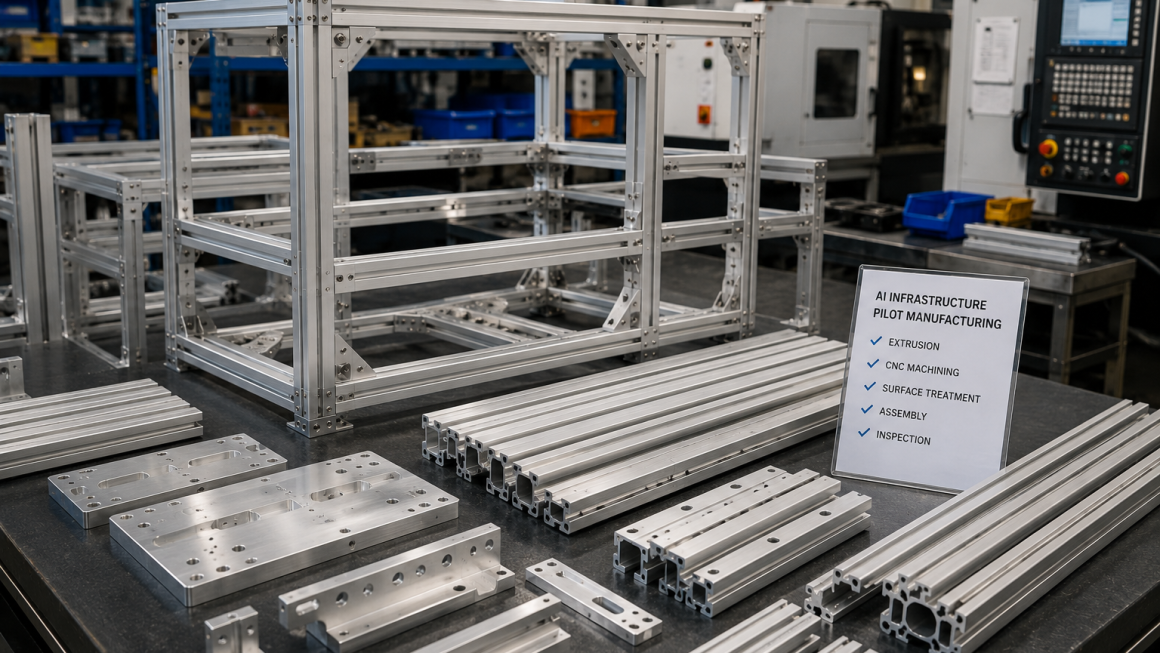
The rapid development of artificial intelligence (AI), high-performance computing (HPC), and high-density data centers is creating increasingly demanding requirements for physical infrastructure.
AI servers and data center systems require a wide range of mechanical components, including:
- Rack frames
- Aluminum structural profiles
- Mounting brackets
- Cable management components
- Cooling support structures
- Server chassis components
- Protective covers
- Precision-machined interfaces
Many of these components are not necessarily standard off-the-shelf products. Their dimensions, interfaces, mechanical requirements, and installation conditions may vary according to the specific hardware architecture.
For this reason, manufacturing development often begins with prototype and pilot production before moving to larger-scale manufacturing.
Pilot manufacturing provides an intermediate stage between engineering design and full production. It allows manufacturers and customers to evaluate whether a proposed aluminum structural component can be produced consistently and assembled effectively under realistic manufacturing conditions.
The objective is not simply to produce a small quantity of parts. A well-designed pilot manufacturing process should help identify potential issues related to:
- Material selection
- Profile geometry
- Machining
- Surface treatment
- Dimensional tolerances
- Assembly
- Packaging
- Production repeatability
For AI infrastructure projects, this stage can be particularly valuable because structural components often need to interact with multiple systems simultaneously.
What Is Pilot Manufacturing?
Pilot manufacturing refers to a controlled production stage used to validate a product and its manufacturing process before larger-scale production.
It generally sits between:
Engineering Design → Prototype → Pilot Production → Production Ramp-Up → Mass Production
The exact process varies according to the project.
For a customized aluminum component, pilot manufacturing may involve:
- Reviewing the engineering drawings
- Confirming material specifications
- Producing initial profiles or components
- Performing machining and finishing
- Assembling the components
- Checking dimensions and interfaces
- Evaluating manufacturing consistency
- Identifying required design or process modifications
Pilot production should therefore be considered part of the engineering development process rather than simply a smaller version of mass production.
Why Pilot Manufacturing Matters for AI Infrastructure
AI infrastructure projects often involve customized mechanical systems.
A component may need to interface with:
- Server chassis
- Rack structures
- Liquid cooling systems
- Cable management systems
- Electrical components
- Protective structures
Even when a component appears simple, the actual manufacturing requirements can be relatively complex.
For example, an aluminum support bracket may need to satisfy several requirements simultaneously:
- Correct mounting-hole positions
- Adequate mechanical strength
- Controlled dimensions
- Compatible surface treatment
- Sufficient clearance
- Repeatable assembly
Pilot manufacturing provides an opportunity to verify these requirements before committing to larger production quantities.
From Engineering Drawing to Physical Component
A successful pilot manufacturing process begins with a clear definition of the product.
Typical engineering information may include:
- 2D drawings
- 3D CAD models
- Material specifications
- Dimensional tolerances
- Surface treatment requirements
- Assembly requirements
- Inspection criteria
For customized aluminum structural components, it is important to distinguish between:
Design Requirements
and
Manufacturing Requirements
A design may be technically functional but difficult or expensive to manufacture.
Pilot manufacturing helps identify this difference.
Aluminum Material Selection
Material selection should be based on the intended function of the component.
Common aluminum alloys used in structural and industrial applications include:
- 6061
- 6063
- Other application-specific aluminum alloys
The appropriate alloy depends on:
- Required strength
- Extrusion characteristics
- Machinability
- Surface treatment
- Thermal requirements
- Project specifications
There is no universal aluminum alloy that is optimal for every AI infrastructure component.
Aluminum Extrusion in Pilot Manufacturing
Aluminum extrusion is particularly useful for structural components with continuous cross-sections.
Potential applications include:
- Rack profiles
- Support rails
- Cable channels
- Structural beams
- Cooling support profiles
A custom extrusion process normally requires a dedicated die.
For a new product, the development process may therefore involve:
Profile Design → Die Development → Trial Extrusion → Dimensional Inspection → Profile Optimization
This makes pilot production particularly useful before committing to larger production quantities.
Custom Profile Development
A customized aluminum extrusion profile can integrate multiple functions into a single component.
For example, a profile may include:
- Mounting grooves
- Fastener channels
- Reinforcement ribs
- Cable routing spaces
- Interface surfaces
However, adding features to a profile can also increase:
- Die complexity
- Manufacturing requirements
- Dimensional control requirements
The profile should therefore be optimized according to both engineering and manufacturing considerations.
CNC Machining After Extrusion
Extrusion does not necessarily produce the final component.
Many AI infrastructure components require additional machining, such as:
- Drilling
- Milling
- Tapping
- Slot machining
- End-face machining
- Precision interface machining
A typical manufacturing sequence may be:
Aluminum Extrusion → Cutting → CNC Machining → Surface Treatment → Inspection → Assembly
Pilot manufacturing helps verify whether this sequence is suitable for the actual component.
Precision CNC Machining
Some AI hardware components require tighter dimensional control than a standard extruded profile can provide.
CNC machining may therefore be used for:
- Server mounting interfaces
- Cooling component supports
- Precision brackets
- Structural connectors
- Cold plate mounting components
During pilot production, manufacturers can evaluate:
- Dimensional accuracy
- Machining time
- Tool selection
- Fixturing
- Repeatability
This information can be useful when preparing for larger production volumes.
Surface Treatment
Surface treatment is another important part of aluminum component manufacturing.
Common options include:
- Anodizing
- Powder coating
- Other protective finishes
The appropriate treatment depends on:
- Environmental conditions
- Appearance requirements
- Corrosion considerations
- Electrical requirements
- Dimensional tolerances
Surface treatment should be defined early because it can influence both appearance and certain dimensional interfaces.
Assembly Validation
A component can meet its individual drawing requirements and still create problems during assembly.
Pilot manufacturing therefore provides an opportunity to evaluate the complete assembly.
Important questions include:
- Do components fit correctly?
- Are mounting holes aligned?
- Are fasteners accessible?
- Is there sufficient clearance?
- Can components be removed for maintenance?
- Do cable and cooling interfaces remain accessible?
These questions become particularly important when several customized components are integrated into the same AI infrastructure system.
Pilot Manufacturing for Liquid Cooling Structures
Liquid cooling adds another layer of mechanical complexity.
Aluminum structural components may be used to support:
- Cold plates
- Manifolds
- Tubing
- Quick-connect interfaces
- Cooling modules
Pilot production can verify:
- Mounting geometry
- Hose clearance
- Connector accessibility
- Structural support
- Assembly sequence
The structural component itself does not necessarily form part of the coolant circuit. Its function may instead be to provide mechanical support around the cooling hardware.
This distinction is important when defining material and manufacturing requirements.
Pilot Manufacturing for Cable Infrastructure
Customized aluminum components may also be used in:
- Cable trays
- Cable channels
- Conduit systems
- Cable support brackets
- Protective structures
Pilot production can help evaluate:
- Cable routing capacity
- Installation access
- Mounting compatibility
- Edge conditions
- Connection between modules
For high-density computing environments, cable infrastructure often needs to coexist with cooling and structural systems.
Dimensional Inspection
Dimensional inspection is one of the most important parts of pilot manufacturing.
Depending on the component, inspection may include:
- Overall dimensions
- Hole positions
- Profile dimensions
- Flatness
- Surface condition
- Interface dimensions
Inspection methods may include:
- Calipers
- Micrometers
- Height gauges
- Coordinate measuring machines
- Optical inspection systems
The appropriate inspection method depends on the required accuracy and component geometry.
Manufacturing Repeatability
One prototype can demonstrate that a part can be produced.
A pilot batch provides more information about whether it can be produced consistently.
This distinction is important.
For example, a single machined component may meet the drawing requirements, while a larger pilot batch may reveal:
- Dimensional variation
- Fixture-related issues
- Surface inconsistencies
- Machining process variation
Pilot manufacturing therefore provides information that cannot always be obtained from a single prototype.
Design for Manufacturing
Pilot manufacturing is also an opportunity to improve the original design.
Engineers may identify:
- Unnecessary machining operations
- Difficult-to-manufacture features
- Excessive tolerances
- Complicated assembly steps
- Material utilization issues
The design can then potentially be modified before larger-scale production.
This approach is commonly referred to as Design for Manufacturing (DFM).
Balancing Tolerances and Manufacturing Cost
Not every dimension needs extremely tight tolerance.
Overly strict tolerances can increase:
- Machining time
- Inspection requirements
- Tooling complexity
- Production cost
On the other hand, insufficient dimensional control may create assembly problems.
Pilot manufacturing helps determine which dimensions are truly critical.
A practical approach is to distinguish between:
Critical Dimensions
and
General Dimensions
This allows manufacturing resources to focus on the interfaces that actually influence system performance and assembly.
Pilot Batch Size
There is no universal pilot batch size.
The appropriate quantity depends on:
- Product complexity
- Tooling requirements
- Customer requirements
- Manufacturing process
- Future production volume
For some projects, a small number of prototypes may be sufficient for initial mechanical verification.
For others, a larger pilot batch may be necessary to evaluate manufacturing repeatability.
The purpose of the pilot should determine the quantity rather than selecting an arbitrary number.
Supply Chain Coordination
Customized aluminum structural components may involve multiple manufacturing stages.
A typical supply chain can include:
Aluminum Billet
↓
Extrusion
↓
Cutting
↓
CNC Machining
↓
Surface Treatment
↓
Inspection
↓
Assembly
↓
Packaging
Each stage can influence the final product.
Pilot manufacturing provides an opportunity to evaluate whether these suppliers and processes can work together effectively.
Packaging and Transportation
Structural components may be relatively large compared with their weight.
Packaging should therefore consider:
- Surface protection
- Profile deformation
- Machined interface protection
- Moisture exposure
- Transportation handling
For finished aluminum components with precision surfaces, appropriate packaging can help prevent damage before assembly.
Quality Control During Pilot Manufacturing
Quality control should not be limited to final inspection.
A practical pilot manufacturing program may include:
Incoming Material Inspection
Checking:
- Alloy
- Material certification
- Surface condition
Process Inspection
Checking:
- Dimensions
- Machining features
- Surface treatment
Final Inspection
Checking:
- Overall dimensions
- Assembly interfaces
- Appearance
- Functional requirements
The inspection plan should be adapted to the component and customer requirements.
Prototype vs Pilot Production vs Mass Production
These stages serve different purposes.
| Stage | Main Objective |
|---|---|
| Prototype | Verify basic design |
| Pilot Production | Validate manufacturing and assembly |
| Production Ramp-Up | Improve process stability |
| Mass Production | Achieve established production targets |
Confusing these stages can lead to unrealistic expectations.
A prototype is not necessarily representative of mass-production cost or manufacturing consistency.
Similarly, a successful pilot does not automatically guarantee that a product will meet every future production requirement.
When Pilot Manufacturing Is Particularly Valuable
Pilot manufacturing can be useful when:
- The product is customized
- A new extrusion profile is required
- Multiple manufacturing processes are combined
- Several materials are integrated
- Assembly interfaces are complex
- The future production volume is uncertain
It can also be valuable when customers want to validate a new AI infrastructure design before making a larger procurement commitment.
Scaling From Pilot to Production
After pilot manufacturing, the next step is usually a structured production review.
This may involve:
- Design revision
- Process optimization
- Tooling modification
- Supplier confirmation
- Inspection-plan refinement
- Cost evaluation
Only after these factors are sufficiently understood should larger-scale production be considered.
Pilot Manufacturing and Flexible Production
AI infrastructure projects do not always follow a single standard product configuration.
Different customers may require different:
- Rack dimensions
- Mounting patterns
- Cable routes
- Cooling configurations
- Structural interfaces
Flexible manufacturing can therefore be useful for customized AI infrastructure components.
A supplier with extrusion, machining, finishing, and assembly capabilities can potentially support a broader range of customized requirements.
Limitations and Engineering Boundaries
Pilot manufacturing should not be treated as a substitute for engineering validation.
Depending on the application, additional testing may be required for:
- Structural loads
- Thermal performance
- Vibration
- Environmental durability
- Corrosion
- Safety requirements
The appropriate validation program depends on the intended application and applicable standards.
A pilot batch can provide manufacturing information, but it does not automatically establish complete product certification or system-level performance.
Future Development of Aluminum Infrastructure Components
As AI hardware evolves, demand may continue to develop for customized physical infrastructure.
Potential areas include:
- Aluminum rack structures
- Cooling support components
- Cable management profiles
- Server chassis parts
- Lightweight structural frames
- Precision CNC components
The manufacturing challenge will increasingly involve not only producing individual components but also coordinating different manufacturing processes into a reliable supply chain.
Pilot manufacturing is an important stage in the development of customized aluminum structural components for AI infrastructure.
It provides a practical bridge between engineering design and larger-scale production, allowing manufacturers and customers to evaluate:
- Material selection
- Profile design
- Machining processes
- Surface treatment
- Dimensional control
- Assembly
- Manufacturing repeatability
For AI data center applications, this process can be particularly valuable because structural components increasingly interact with cooling systems, cable infrastructure, server hardware, and other mechanical systems.
Aluminum extrusion, CNC machining, surface treatment, and flexible assembly capabilities can provide a practical manufacturing platform for customized components.
However, pilot manufacturing should be understood as a validation and learning stage, not as a guarantee of mass-production performance.
A disciplined transition from prototype to pilot production and then to scaled manufacturing can help reduce avoidable manufacturing risks while providing customers with a clearer understanding of the technical and production requirements of their customized AI infrastructure components.