The rapid development of artificial intelligence (AI) and high-performance computing (HPC) is creating increasingly demanding requirements for server hardware and data center infrastructure.
Modern AI servers can generate substantial amounts of heat within a relatively compact physical volume. To manage these thermal loads, infrastructure may incorporate advanced cooling technologies, including high-performance air cooling and liquid cooling.
However, thermal management is not only a question of removing heat. Changes in temperature can also influence the mechanical behavior of structural components, interfaces, fasteners, and cooling hardware.
This interaction between temperature and mechanical behavior is commonly described as thermal-mechanical coupling.
For AI server structural systems, thermal-mechanical considerations can become particularly relevant when multiple materials, high-density hardware, precision interfaces, and liquid cooling components are integrated into a compact assembly.
A practical design approach therefore considers both thermal and mechanical requirements rather than treating them as completely independent engineering problems.
What Is Thermal-Mechanical Coupling?
Thermal-mechanical coupling refers to the interaction between temperature changes and mechanical behavior.
When a material experiences a change in temperature, it generally undergoes some degree of thermal expansion or contraction.
The basic relationship can be represented as:
Thermal deformation ≈ coefficient of thermal expansion × temperature change × original dimension
In a simple unconstrained component, thermal expansion may occur without generating significant mechanical stress.
However, when the component is constrained by:
- Fasteners
- Adjacent structures
- Cooling components
- Electronic hardware
- Different materials
thermal expansion can generate additional mechanical stresses.
This is why temperature variation needs to be considered when designing precision AI server structures.
Why Thermal-Mechanical Effects Matter in AI Servers
AI servers combine several systems within limited physical space.
A typical high-density server may include:
- GPUs or other accelerators
- CPUs
- Memory modules
- Power delivery components
- Cold plates
- Heat sinks
- Network hardware
- Structural frames
- Cable management systems
These components may operate at different temperatures and may use different materials.
As a result, thermal expansion is not necessarily uniform throughout the assembly.
The engineering challenge is therefore not simply determining how much a material expands, but understanding how different components interact when their temperatures change.
Aluminum and Thermal Expansion
Aluminum is widely used in AI infrastructure because of its combination of relatively low density, manufacturability, corrosion resistance, and thermal conductivity.
However, aluminum also has a relatively high coefficient of thermal expansion compared with some other engineering materials.
This characteristic is important in precision mechanical assemblies.
For example, an aluminum structural member may expand more than a steel component over the same temperature change.
If the two components are rigidly connected, the difference in thermal expansion can introduce mechanical loads at the interface.
Therefore, aluminum selection should be accompanied by appropriate joint and interface design.
Thermal Expansion in AI Server Frames
AI server frames may experience temperature gradients during operation.
Different sections of a structure may be exposed to:
- Heat-generating components
- Cooling airflow
- Liquid cooling hardware
- Ambient conditions
This can result in non-uniform temperature distribution.
Potential design considerations include:
- Structural dimensions
- Mounting points
- Fastener locations
- Clearance
- Thermal gradients
The goal is not necessarily to eliminate thermal deformation, which is generally unrealistic, but to control its influence on the overall assembly.
Liquid Cooling and Thermal-Mechanical Interaction
Liquid cooling introduces additional thermal and mechanical considerations.
A liquid-cooled AI server may contain:
- Cold plates
- Manifolds
- Coolant tubing
- Quick-connect fittings
- Mounting brackets
- Structural supports
The cooling system may operate at temperatures different from surrounding structural components.
This creates thermal gradients between:
- Cooling hardware
- Server boards
- Structural frames
- Mounting components
The mechanical design should account for these differences where they can affect interfaces or serviceability.
Cold Plate Mounting
Cold plate installation is a good example of thermal-mechanical coupling.
A cold plate must maintain appropriate contact with the heat-generating component.
Mechanical design may involve:
- Fastener preload
- Contact pressure
- Surface flatness
- Thermal interface materials
- Structural stiffness
As temperatures change, different components may expand or contract.
If the assembly is overly constrained, thermal deformation can potentially influence contact conditions.
Therefore, cold plate mounting structures should be designed according to the specific component geometry and operating conditions.
Material Compatibility
AI server structures often combine multiple materials.
Common combinations may include:
- Aluminum
- Copper
- Steel
- Stainless steel
- Engineering polymers
- Composite materials
Each material has its own:
- Thermal expansion behavior
- Thermal conductivity
- Elastic properties
- Strength characteristics
The greater the difference between materials, the more carefully the interfaces may need to be considered.
Aluminum and Copper Interfaces
Aluminum and copper are both relevant to thermal management systems.
Copper is frequently used where high thermal conductivity is important, while aluminum may be attractive for structural components and selected cooling applications.
When the two materials are mechanically connected, designers should consider:
- Differential thermal expansion
- Joint geometry
- Contact pressure
- Corrosion compatibility
The correct solution depends on the specific operating environment and cooling architecture.
Fasteners and Thermal Cycling
Fasteners are an important part of structural systems.
Temperature changes can influence:
- Bolt preload
- Joint stiffness
- Contact pressure
Repeated thermal cycling may therefore need to be considered for assemblies that experience substantial temperature changes during operation.
Possible design approaches include:
- Appropriate fastener selection
- Controlled tightening procedures
- Joint geometry optimization
- Allowance for thermal movement
Actual requirements should be determined through engineering analysis and testing.
Thermal Gradients Within Structural Components
Temperature is not always uniform throughout an AI server structure.
For example, a structural component located close to a high-power processor may experience a different temperature than a component positioned farther away.
This creates a thermal gradient.
Thermal gradients can cause:
- Differential expansion
- Local deformation
- Interface movement
For precision components, these effects may become more important than uniform temperature changes.
Mechanical Stiffness and Thermal Behavior
Structural stiffness is another important consideration.
A structure that is mechanically stiff may better resist deformation under external loads.
However, excessive constraint can sometimes increase stresses caused by thermal expansion.
Therefore, the objective is not simply to maximize stiffness.
Engineers may instead seek an appropriate balance between:
- Structural stiffness
- Thermal movement
- Interface requirements
- Assembly constraints
Aluminum Extrusion and Thermal-Mechanical Design
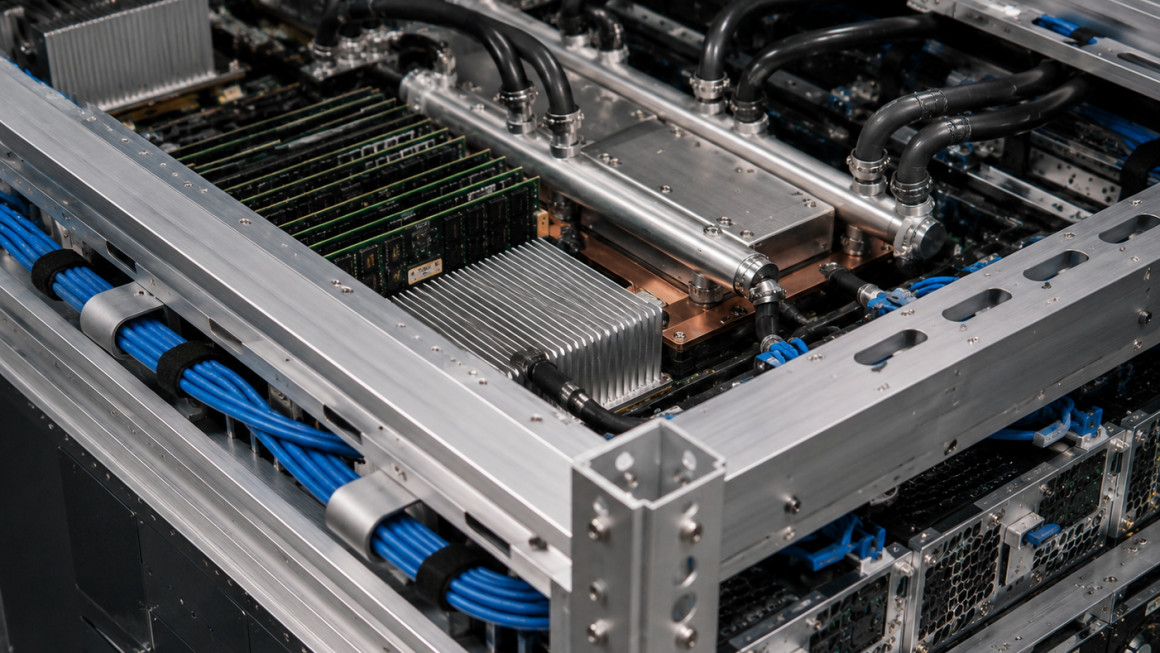
Aluminum extrusion is particularly useful for AI infrastructure because profiles can be customized according to structural and installation requirements.
Possible applications include:
- Server rack frames
- Cooling support profiles
- Cross-members
- Mounting rails
- Cable management channels
Extruded profiles can incorporate features that help control mechanical behavior, such as:
- Reinforcement ribs
- Controlled wall thickness
- Mounting channels
- Expansion interfaces
Profile geometry can therefore be considered as part of the thermal-mechanical design process.
Design of Mechanical Interfaces
Interfaces are often the most important areas in a multi-component system.
Examples include:
- Rack-to-server interfaces
- Cold plate-to-processor interfaces
- Manifold-to-frame interfaces
- Cable tray-to-rack interfaces
Each interface may need to accommodate:
- Mechanical loads
- Thermal movement
- Assembly tolerances
- Maintenance requirements
A well-designed interface does not necessarily mean eliminating movement. Instead, controlled movement can sometimes be preferable to excessive mechanical constraint.
Thermal Expansion and Cable Management
Cable management structures can also be affected by temperature changes.
AI racks may contain:
- Power cables
- Network cables
- Fiber optic connections
- Cooling hoses
Rigid routing structures should allow appropriate clearance for cables and connected components.
Flexible elements may be useful where movement needs to be accommodated.
The design should also respect the minimum bend radius and installation requirements of the cable type.
Thermal-Mechanical Considerations for Manifold Supports
Liquid cooling manifolds may be mounted directly or indirectly to rack structures.
A manifold support should consider:
- Manifold weight
- Connection loads
- Thermal expansion
- Hose forces
- Maintenance access
If coolant temperatures vary significantly during operation, differential expansion between the manifold and supporting frame may need to be evaluated.
This is particularly relevant when the manifold and structural support use different materials.
Composite and Polymer Components
Polymers and composites can also participate in thermal-mechanical systems.
For example:
- Polymer cable guides
- Insulating brackets
- Composite panels
- Protective covers
These materials may have different thermal expansion characteristics from aluminum.
In a multi-material assembly, designers should therefore consider the movement of each component rather than evaluating materials individually.
Environmental Conditions
Thermal-mechanical behavior is influenced not only by component temperatures but also by the surrounding environment.
Relevant factors may include:
- Ambient temperature
- Humidity
- Cooling system operating conditions
- Installation location
- Temperature cycling
Data center environments are generally controlled, but actual operating conditions vary between facilities and applications.
Design assumptions should therefore be based on project-specific requirements.
Finite Element Analysis and Simulation
For more complex structures, simulation tools can help engineers evaluate thermal-mechanical behavior.
Potential analysis methods include:
- Thermal simulation
- Structural finite element analysis
- Coupled thermal-structural analysis
These approaches can help investigate:
- Thermal deformation
- Stress concentration
- Joint behavior
- Structural displacement
Simulation results should be supported by appropriate material data and, where necessary, physical testing.
Prototype Validation
Prototype testing can provide practical information that is difficult to obtain from material data alone.
A prototype may be evaluated for:
- Dimensional stability
- Assembly fit
- Thermal deformation
- Fastener behavior
- Cooling interface stability
Small-batch manufacturing can also help identify issues before larger-scale production.
This is particularly useful for customized aluminum structures developed for specific AI hardware configurations.
Manufacturing Considerations
Thermal-mechanical design should be considered during manufacturing planning.
Important factors include:
Dimensional Tolerances
Precision interfaces may require controlled tolerances.
Machining Accuracy
CNC machining may be used for:
- Mounting surfaces
- Connection interfaces
- Cold plate features
- Precision brackets
Surface Treatment
Aluminum components may receive:
- Anodizing
- Protective coatings
- Other surface treatments
The effect of surface treatment on dimensional tolerances and interface requirements should be considered where relevant.
Design for Assembly and Maintenance
Thermal-mechanical design should not compromise practical maintenance.
AI infrastructure may require frequent access to:
- Server modules
- Cooling connections
- Cable systems
- Power components
Mechanical interfaces should therefore allow components to be removed and replaced without unnecessary structural disassembly.
Common Design Mistakes
Treating Thermal and Mechanical Design Separately
A component may meet mechanical requirements at room temperature but behave differently under operating conditions.
Ignoring Differential Expansion
Using multiple materials without considering their different thermal expansion characteristics can introduce unwanted interface loads.
Over-Constraining Components
Rigidly fixing every component may limit natural thermal movement and increase stress.
Relying Only on Material Data
Material properties provide important information, but system-level behavior also depends on:
- Geometry
- Interfaces
- Assembly
- Operating conditions
Future Development of AI Structural Systems
As AI hardware becomes denser and cooling systems become more integrated, thermal-mechanical design is likely to become increasingly important.
Future structural systems may combine:
- Aluminum extrusion frames
- Precision-machined interfaces
- Liquid cooling supports
- Polymer isolation components
- Composite panels
within modular mechanical architectures.
Digital design and simulation may also allow engineers to evaluate thermal and mechanical behavior earlier in the development process.
Thermal-mechanical coupling is an important consideration in the design of AI server structural systems.
As AI hardware generates more heat and incorporates increasingly complex cooling architectures, temperature changes can interact with mechanical structures, fasteners, interfaces, and multi-material assemblies.
Aluminum remains a useful material for many AI infrastructure applications because of its combination of low density, manufacturability, and thermal characteristics. However, its thermal expansion behavior must be considered when it is integrated with other materials and precision components.
Effective thermal-mechanical design therefore requires a system-level approach that considers:
- Material selection
- Structural geometry
- Thermal gradients
- Mechanical constraints
- Interface design
- Manufacturing tolerances
- Prototype validation
The objective is not to eliminate thermal deformation entirely, but to understand and manage its influence within the intended operating environment.
For AI infrastructure suppliers, this creates opportunities for customized aluminum structural components, precision-machined interfaces, cooling supports, and multi-material assemblies designed around specific hardware requirements.