
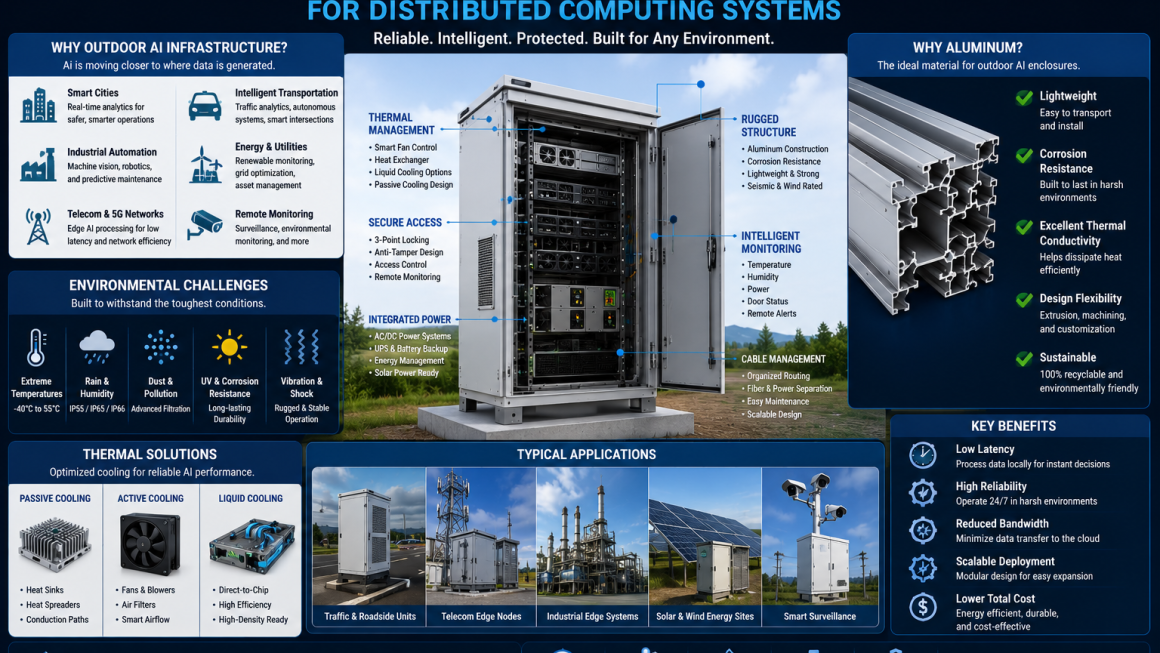
AI Is Moving Outside the Data Center
Artificial intelligence is no longer confined to hyperscale data centers.
Today, AI workloads are increasingly being deployed across:
- Smart cities
- Telecommunications networks
- Industrial facilities
- Transportation infrastructure
- Renewable energy systems
- Remote monitoring stations
This shift toward distributed computing creates a new challenge:
👉 How can AI hardware operate reliably in outdoor environments?
Unlike traditional data centers, outdoor deployments must withstand:
- Rain
- Dust
- Humidity
- Temperature extremes
- UV exposure
- Mechanical vibration
As a result, outdoor AI enclosures are becoming a critical part of modern distributed computing infrastructure.
1. What Is an Outdoor AI Enclosure?
An outdoor AI enclosure is a protective housing designed to support AI computing equipment outside conventional data center environments.
These enclosures may contain:
- Edge AI servers
- GPU systems
- Networking equipment
- Power systems
- Battery backup units
- Cooling hardware
Their primary purpose is to create a controlled operating environment for sensitive electronic systems.
👉 In many distributed deployments, the enclosure effectively becomes a miniature data center.
2. Why Distributed AI Requires Outdoor Infrastructure
The growth of Edge AI is being driven by applications that require local processing.
Examples include:
Smart Transportation
- Traffic analytics
- Autonomous vehicle support
- Intelligent intersections
Industrial Automation
- Machine vision
- Predictive maintenance
- Robotics control
Telecommunications
- 5G AI processing
- Network optimization
- Edge computing nodes
Renewable Energy
- Solar farm monitoring
- Wind turbine analytics
- Energy management systems
Processing data locally reduces:
- Network latency
- Bandwidth consumption
- Cloud dependency
👉 This makes outdoor AI infrastructure increasingly important.
3. Environmental Challenges for Outdoor AI Systems
Outdoor deployments face conditions rarely encountered in traditional data centers.
Temperature Extremes
Systems may experience:
- High summer temperatures
- Freezing winter conditions
- Rapid temperature fluctuations
These conditions create thermal stress on:
- Processors
- Power electronics
- Batteries
- Cooling systems
Dust and Contaminants
Industrial and roadside environments often expose equipment to:
- Dust
- Sand
- Pollutants
- Airborne debris
Without adequate protection, contamination can reduce reliability and cooling performance.
Moisture and Humidity
Outdoor equipment must resist:
- Rain
- Condensation
- Humid climates
Water ingress remains one of the most significant threats to electronic infrastructure.
👉 Environmental protection is one of the primary functions of outdoor AI enclosures.
4. Thermal Management Is Critical
Modern AI hardware generates significant heat.
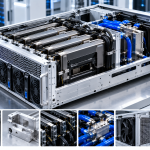
Even compact edge servers may contain:
- High-performance CPUs
- AI accelerators
- GPUs
- Power conversion systems
Without effective cooling:
- Performance may decrease
- Hardware lifespan may shorten
- Reliability may suffer
Passive Cooling
Many outdoor systems use:
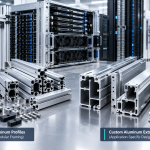
- Aluminum heat sinks
- Conductive chassis designs
- Heat spreaders
Benefits include:
- No moving parts
- Low maintenance
- High reliability
Active Cooling
Higher-performance systems may require:
- Fans
- Blowers
- Heat exchangers
These systems provide increased cooling capacity but introduce additional complexity.
Liquid Cooling
As edge AI becomes more powerful, liquid cooling may become increasingly common for:
- Telecom AI nodes
- Industrial AI systems
- High-density edge computing platforms
👉 Thermal management often determines the maximum performance of outdoor AI systems.
5. Why Aluminum Is Widely Used in Outdoor AI Enclosures
Material selection is critical for outdoor deployments.
Aluminum offers several advantages.
Lightweight Construction
Compared with steel, aluminum significantly reduces enclosure weight.
Benefits include:
- Easier transportation
- Faster installation
- Reduced structural loading
Corrosion Resistance
Outdoor environments expose equipment to:
- Humidity
- Rain
- Salt air
- Industrial pollutants
Aluminum naturally forms a protective oxide layer that helps improve durability.
Thermal Conductivity
Aluminum can contribute to heat dissipation through:
- Structural heat spreading
- Passive cooling designs
- Integrated thermal architectures
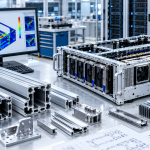
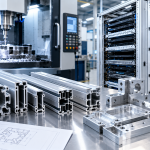
Manufacturing Flexibility
Aluminum supports:
- Extrusion
- CNC machining
- Sheet metal fabrication
This enables scalable and customizable enclosure designs.
👉 Aluminum is becoming one of the most important materials in outdoor AI infrastructure.
6. Mechanical Design Considerations
Outdoor AI enclosures must balance protection with accessibility.
Design priorities include:
Structural Strength
Supporting computing hardware and cooling equipment.
Serviceability
Allowing maintenance without extensive downtime.
Cable Management
Providing organized routing for:
- Power cables
- Fiber optics
- Sensor connections
Vibration Resistance
Particularly important for:
- Roadside deployments
- Rail infrastructure
- Industrial facilities
👉 Mechanical engineering directly affects long-term reliability.
7. Power Infrastructure Integration
Many outdoor AI systems require integrated power solutions.
Typical components include:
- AC/DC power supplies
- UPS systems
- Battery storage
- Solar power integration
As Edge AI expands into remote locations, power infrastructure becomes increasingly important.
Outdoor enclosures often serve as a combined:
- Compute platform
- Power station
- Thermal management system
8. Security Requirements
Outdoor infrastructure must also address physical security.
Features often include:
- Lockable access panels
- Tamper detection
- Environmental monitoring
- Remote management systems
This is particularly important for:
- Public infrastructure
- Telecom deployments
- Critical industrial facilities
👉 Security is an essential design requirement for distributed AI systems.
9. The Future of Outdoor AI Infrastructure
Over the next decade, outdoor AI deployments are expected to increase significantly.
Emerging trends include:
Higher Compute Density
More powerful AI processing closer to users.
Integrated Liquid Cooling
Supporting advanced edge workloads.
Lightweight Structural Materials
Including aluminum alloys and advanced composites.
Smart Monitoring Systems
Tracking:
- Temperature
- Humidity
- Vibration
- Power consumption
Modular Infrastructure Platforms
Allowing rapid deployment and expansion.
👉 Outdoor AI enclosures are evolving into intelligent infrastructure systems rather than simple equipment cabinets.
As AI moves beyond centralized data centers, outdoor infrastructure is becoming a critical component of distributed computing.
Outdoor AI enclosures must provide:
- Environmental protection
- Thermal management
- Structural reliability
- Power integration
- Security
Materials such as aluminum are helping enable these systems through:
- Lightweight construction
- Corrosion resistance
- Thermal performance
- Manufacturing flexibility
As Edge AI continues to grow, outdoor enclosures will become an increasingly important foundation for next-generation distributed computing networks.
👉 The future of AI is not only in data centers—it is also on factory floors, roadside networks, telecom towers, and smart infrastructure around the world.