
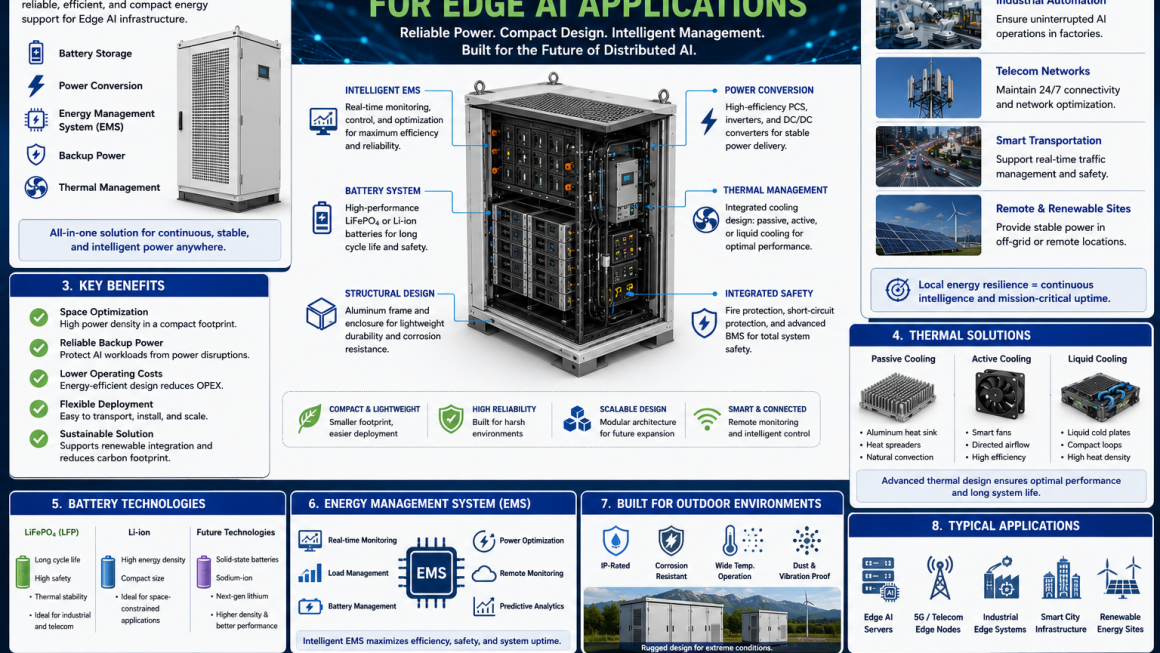
Power Is Becoming a Critical Part of Edge AI Infrastructure
As artificial intelligence moves beyond centralized data centers, Edge AI deployments are rapidly expanding across industries.
Today, AI systems are increasingly operating in:
- Smart factories
- Telecom networks
- Transportation hubs
- Renewable energy sites
- Healthcare facilities
- Remote industrial locations
Unlike hyperscale data centers, edge environments often face:
- Limited space
- Variable power quality
- Harsh operating conditions
- Restricted maintenance access
As a result, reliable local energy infrastructure is becoming essential.
👉 Compact energy modules are emerging as a key technology for supporting next-generation Edge AI applications.
1. What Is a Compact Energy Module?
A compact energy module is an integrated power system designed to provide reliable electrical support for distributed computing infrastructure.
These systems may include:
- Lithium battery storage
- Power conversion equipment
- Energy management systems (EMS)
- Backup power functionality
- Thermal management components
The goal is to deliver stable power within a compact footprint.
Unlike traditional power rooms, modern energy modules can often be integrated directly into:
- Edge AI cabinets
- Telecom shelters
- Outdoor AI enclosures
- Industrial computing platforms
👉 Power infrastructure is becoming increasingly decentralized.
2. Why Edge AI Needs Local Energy Storage
Many Edge AI applications require continuous operation.
Examples include:
Industrial Automation
Machine vision systems cannot afford unexpected shutdowns.
Telecom Networks
AI-powered network optimization must remain operational during power disturbances.
Smart Transportation
Traffic management and autonomous infrastructure require uninterrupted computing.
Remote Monitoring
Systems may operate far from traditional power infrastructure.
In these environments, battery-supported energy modules help provide:
- Backup power
- Grid stabilization
- Improved reliability
- Operational continuity
👉 Local energy resilience is becoming a competitive advantage.
3. Space Constraints Drive Compact Design
Unlike large data centers, edge deployments often have severe space limitations.
Common deployment locations include:
- Utility cabinets
- Roadside installations
- Telecom towers
- Manufacturing facilities
Every cubic centimeter matters.
Compact energy modules help optimize:
- Power density
- Equipment integration
- Service accessibility
- Deployment flexibility
This enables more computing capability within smaller footprints.
4. Thermal Management Challenges
Power systems generate heat.
Battery systems produce heat during:
- Charging
- Discharging
- High-load operation
Power electronics generate heat through:
- Voltage conversion
- Current regulation
- Continuous operation
When combined with AI hardware, thermal loads increase significantly.
Modern compact energy modules increasingly incorporate:
Passive Cooling
- Aluminum heat spreaders
- Conductive enclosures
- Thermal interface materials
Active Cooling
- Fans
- Directed airflow systems
Liquid Cooling
For higher-density edge computing environments.
👉 Thermal design directly impacts system performance and lifespan.
5. The Role of Aluminum in Compact Energy Modules
Aluminum has become one of the most widely used materials in modern energy systems.
Lightweight Construction
Compared with steel, aluminum reduces overall system weight.
Benefits include:
- Easier transportation
- Faster deployment
- Lower structural loading
This is particularly valuable for rooftop and telecom installations.
Thermal Performance
Aluminum offers good thermal conductivity.
Applications include:
- Battery enclosures
- Heat spreaders
- Structural cooling components
This allows mechanical structures to contribute to thermal management.
Corrosion Resistance
Outdoor and industrial deployments often expose equipment to:
- Moisture
- Humidity
- Pollutants
Aluminum’s natural oxide layer improves long-term durability.
👉 Aluminum supports both structural and thermal functions.
6. Battery Technologies for Edge AI Energy Modules
Several battery technologies are commonly used.
Lithium Iron Phosphate (LFP)
Advantages:
- Long cycle life
- Excellent safety
- Thermal stability
Common in:
- Telecom systems
- Industrial AI infrastructure
- Outdoor energy storage
Lithium-Ion Systems
Advantages:
- High energy density
- Compact design
Suitable for applications where space is extremely limited.
Future Technologies
Emerging developments include:
- Solid-state batteries
- Sodium-ion batteries
- Advanced lithium systems
These technologies may further improve compact energy storage performance.
7. Energy Management Systems (EMS)
Modern energy modules increasingly include intelligent control systems.
An EMS can manage:
- Battery charging
- Load balancing
- Power optimization
- Remote monitoring
For Edge AI applications, EMS platforms may also coordinate:
- AI workload scheduling
- Power availability
- Cooling system operation
👉 Intelligent power management improves both efficiency and reliability.
8. Outdoor Deployment Considerations
Many Edge AI systems operate outdoors.
Energy modules must withstand:
- High temperatures
- Rain
- Dust
- UV exposure
- Mechanical vibration
Design considerations include:
- IP-rated enclosures
- Corrosion-resistant materials
- Thermal protection systems
- Integrated monitoring sensors
Outdoor-ready energy modules are becoming increasingly important for distributed AI networks.
9. The Future of Compact Energy Modules
As Edge AI adoption accelerates, compact energy systems will continue evolving.
Key trends include:
Higher Energy Density
More storage capacity within smaller footprints.
Integrated Cooling Systems
Combining power and thermal management.
Modular Architectures
Supporting rapid deployment and scalability.
Renewable Energy Integration
Including solar and microgrid compatibility.
Smart Energy Optimization
Using AI to manage power resources dynamically.
👉 Future energy modules will become intelligent infrastructure platforms rather than simple battery systems.
The expansion of Edge AI is creating growing demand for reliable, compact, and efficient power infrastructure.
Compact energy modules help support:
- Continuous operation
- Thermal management
- Space optimization
- Scalable deployment
Through the integration of:
- Battery storage
- Power electronics
- Energy management systems
- Lightweight aluminum structures
these systems are becoming a foundational component of modern distributed computing infrastructure.
👉 As Edge AI continues to expand, compact energy modules will play a critical role in delivering reliable power wherever intelligent computing is deployed.