The continuous development of artificial intelligence (AI), high-performance computing (HPC), and advanced data center systems is creating increasingly complex requirements for hardware infrastructure.
Modern AI systems are no longer composed only of electronic components and traditional metal structures. Instead, they require coordinated mechanical, thermal, electrical, and protective solutions.
As computing density increases, infrastructure designers are increasingly adopting multi-material design approaches, combining different materials to achieve balanced system performance.
A typical AI hardware infrastructure platform may integrate:
- Aluminum structural components
- Engineering polymers
- Composite materials
- Copper thermal components
- Protective coatings
- Advanced interface materials
Rather than replacing one material with another, multi-material design focuses on assigning the appropriate material to each functional requirement.
This article discusses the role of aluminum, polymers, and composites in AI hardware infrastructure and explains how material combinations can support modern data center mechanical design.
Why Multi-Material Design Matters in AI Infrastructure
Traditional mechanical design often relied on a limited number of materials, such as steel or aluminum structures.
However, AI infrastructure introduces new challenges:
- Higher rack power density
- More complex thermal management
- Increased cable volume
- Greater mechanical integration requirements
- More demanding installation environments
A single material may not provide the optimal balance of:
- Strength
- Weight
- Thermal performance
- Electrical properties
- Manufacturing flexibility
- Cost efficiency
Multi-material design allows engineers to combine different material advantages.
The Principle of Functional Material Selection
A key concept in multi-material engineering is:
Select materials according to function, not simply according to material category.
Different components within AI infrastructure may have different priorities.
For example:
| Component Function | Possible Material Selection |
|---|---|
| Structural frame | Aluminum / Steel |
| Electrical insulation | Engineering Polymer |
| Protective cover | Polymer / Composite |
| Thermal interface | Aluminum / Copper |
| Lightweight reinforcement | Composite |
The final design depends on application requirements and validation.
Aluminum in AI Hardware Infrastructure
Aluminum remains one of the most important materials for modern mechanical infrastructure.
Potential applications include:
- Server rack frames
- Structural profiles
- Cable management systems
- Cooling support structures
- Mounting brackets
- Heat dissipation components
Advantages of Aluminum Structures
Lightweight Characteristics
Aluminum has a relatively low density compared with many structural metals.
Potential benefits include:
- Easier installation
- Reduced handling requirements
- Flexible modular design
This can be valuable in large-scale infrastructure projects where many components must be installed and maintained.
Manufacturing Flexibility
Aluminum supports multiple manufacturing processes, including:
- Extrusion
- CNC machining
- Sheet fabrication
- Surface treatment
This allows designers to create customized components for different AI infrastructure requirements.
Thermal Considerations
Aluminum has good thermal conductivity compared with many structural materials.
It may be considered for components where both mechanical support and thermal behavior are relevant.
However, actual thermal performance depends on:
- Component geometry
- Contact interfaces
- Heat source characteristics
- System design
Engineering Polymers in AI Infrastructure
Polymers play an important role in areas where metals may not be the ideal choice.
Potential applications include:
- Cable guides
- Insulation components
- Protective covers
- Connector housings
- Vibration reduction elements
Advantages of Polymer Components
Electrical Insulation
Many engineering polymers provide electrical insulation properties.
Potential applications include:
- Cable separation
- Protective interfaces
- Electrical isolation components
Design Flexibility
Injection molding and other polymer manufacturing processes allow:
- Complex geometries
- Integrated features
- Lightweight components
This can reduce assembly complexity for certain applications.
Protection and Interface Functions
Polymer components may be used where contact with sensitive equipment requires:
- Edge protection
- Surface protection
- Reduced mechanical contact
Composite Materials in AI Infrastructure
Composite materials combine different material phases to achieve specific characteristics.
Potential applications include:
- Lightweight structural panels
- Reinforced components
- Protective covers
- Specialized mechanical parts
Advantages of Composite Structures
Weight Reduction
Composite materials may provide high stiffness-to-weight ratios in certain applications.
This can be useful when:
- Weight reduction is important
- Structural reinforcement is required
Design Customization
Composite materials can be engineered for specific requirements.
Possible considerations include:
- Mechanical strength
- Thermal properties
- Environmental resistance
Specialized Applications
Composite materials are often considered when conventional materials cannot fully meet application requirements.
Combining Aluminum, Polymer, and Composite Materials
A practical AI infrastructure system may use different materials together.
For example:
Aluminum Structural Frame
Provides:
- Mechanical support
- Mounting foundation
- Modular integration
Polymer Interface Components
Provide:
- Electrical isolation
- Protective contact surfaces
- Cable organization
Composite Panels or Covers
Provide:
- Lightweight protection
- Additional reinforcement
- Specialized functions
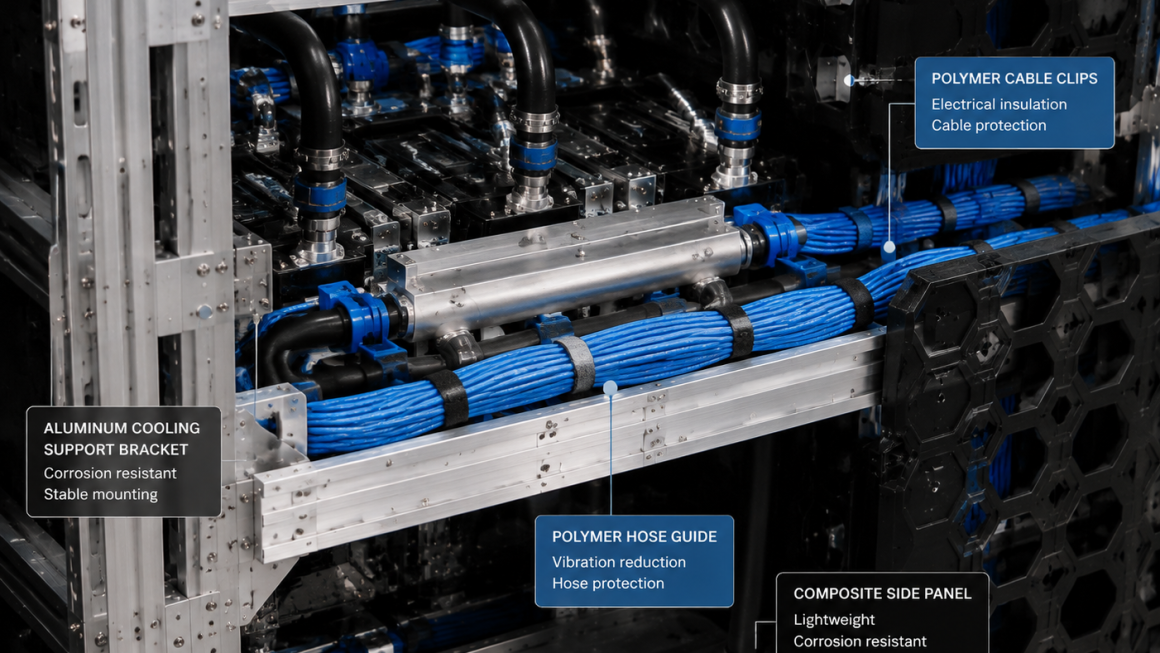
Multi-Material Design in AI Server Racks
AI server racks are a good example of multi-material integration.
A rack system may include:
Aluminum Components
- Frame structures
- Rails
- Brackets
- Cable channels
Polymer Components
- Cable clips
- Insulation parts
- Protective covers
Composite Components
- Panels
- Reinforcement elements
- Lightweight structures
Each material contributes different functions.
Integration With Liquid Cooling Systems
Liquid cooling introduces additional material requirements.
A liquid-cooled AI system may include:
- Aluminum mounting structures
- Polymer hose guides
- Composite protective components
- Copper or aluminum thermal interfaces
Material selection must consider:
- Mechanical compatibility
- Thermal requirements
- Fluid environment
- Long-term reliability
Material Interface Engineering
The connection between different materials is often as important as the materials themselves.
Important considerations include:
Mechanical Interfaces
Examples:
- Fasteners
- Adhesive bonding
- Mechanical clips
- Embedded structures
Thermal Interfaces
Considerations include:
- Contact resistance
- Thermal expansion differences
- Heat transfer paths
Environmental Compatibility
Different materials may interact differently under:
- Temperature changes
- Humidity
- Chemical exposure
Engineering evaluation is required for long-term applications.
Manufacturing Considerations
Multi-material systems require coordinated manufacturing processes.
Aluminum Manufacturing
Common processes:
- Extrusion
- CNC machining
- Anodizing
Applications:
- Frames
- Structural profiles
- Precision components
Polymer Manufacturing
Common processes:
- Injection molding
- Extrusion molding
- Machining
Applications:
- Covers
- Insulation parts
- Cable accessories
Composite Manufacturing
Processes may include:
- Compression molding
- Layered fabrication
- Machining
Applications depend on material structure and performance requirements.
Design for Assembly
A successful multi-material system should consider assembly from the beginning.
Important factors include:
- Component compatibility
- Fastener selection
- Manufacturing tolerance
- Maintenance access
Poor interface design can reduce the advantages of advanced materials.
Challenges of Multi-Material Systems
Material Compatibility
Different materials may have different:
- Thermal expansion rates
- Mechanical properties
- Environmental behavior
Engineers must consider these differences during design.
Manufacturing Complexity
Multiple materials may increase:
- Production steps
- Quality control requirements
- Supply chain coordination
Cost Optimization
The most advanced material is not always the best solution.
Effective design balances:
- Performance requirements
- Manufacturing feasibility
- Project budget
Future Trends
Integrated Material Platforms
Future AI infrastructure may increasingly combine:
- Metal structures
- Polymer components
- Composite materials
into more integrated mechanical platforms.
Lightweight Infrastructure
As AI facilities continue to scale, lightweight materials may help support:
- Modular construction
- Easier installation
- Flexible expansion
Customized Manufacturing
Growing AI infrastructure diversity may increase demand for:
- Custom aluminum profiles
- Precision polymer components
- Hybrid assemblies
Conclusion
Multi-material design is becoming an important approach in AI hardware infrastructure development.
Rather than selecting a single universal material, engineers are increasingly combining aluminum, polymers, and composites according to specific functional requirements.
Aluminum provides structural support and manufacturing flexibility. Polymers provide insulation, protection, and design freedom. Composite materials offer additional options for specialized mechanical requirements.
The success of multi-material AI infrastructure depends not only on material properties, but also on:
- Interface engineering
- Manufacturing capability
- Assembly design
- System-level validation
As AI hardware continues to evolve, coordinated material design will play an increasingly important role in building efficient, adaptable, and reliable physical infrastructure.