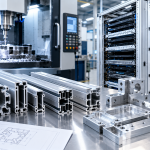
As AI computing systems move toward higher GPU density and greater thermal loads, server chassis design is becoming more than a matter of holding components together.
A modern AI server chassis must simultaneously support heavy GPUs and power components, accommodate liquid cooling hardware, maintain structural rigidity, provide sufficient airflow or coolant routing space, and allow engineers and technicians to access components efficiently.
This makes the aluminum AI server chassis an increasingly important mechanical platform for high-density computing infrastructure.
Aluminum frames can provide a useful combination of low weight, structural flexibility, thermal conductivity, corrosion resistance, and manufacturing versatility. However, the material alone does not determine chassis performance. The real engineering challenge is how the AI server frame, cooling architecture, component mounting system, and service access are designed as one integrated structure.
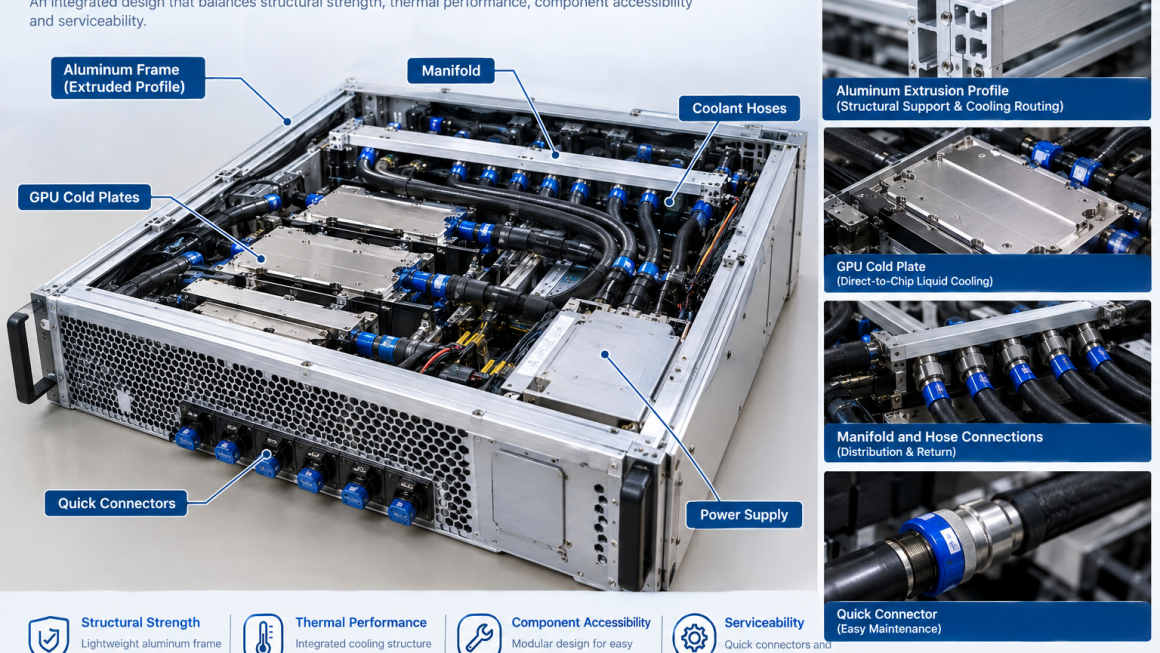
For liquid-cooled systems, this becomes even more important. Cold plates, manifolds, hoses, quick connectors, pumps, and other cooling interfaces must be mechanically supported without making maintenance unnecessarily difficult.
A well-designed chassis therefore needs to balance four fundamental requirements:
Structural Strength → Thermal Integration → Component Accessibility → Serviceability
1. Why AI Server Chassis Design Is Becoming More Complex
Traditional server chassis were primarily designed around relatively standardized air-cooled architectures.
The mechanical priorities were often straightforward:
- Support the motherboard and storage devices
- Hold CPUs and expansion cards
- Provide airflow paths
- Protect internal components
- Fit standard rack dimensions
- Allow basic component replacement
AI servers introduce additional mechanical requirements.
High-performance GPUs can be significantly heavier than conventional expansion cards. Multiple GPUs may be installed in a dense configuration, while power supplies, busbars, cables, cooling hardware, and structural brackets add further loads.
At the same time, direct liquid cooling introduces another layer of mechanical complexity.
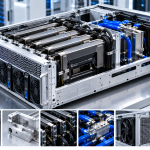
A liquid-cooled AI server may contain:
- GPU cold plates
- CPU cold plates
- Coolant manifolds
- Flexible hoses
- Quick-disconnect couplings
- Coolant distribution channels
- Pump or CDU interfaces
- Leak detection components
- Drainage or service interfaces
These components cannot simply be added after the chassis has been designed.
Their positions influence the load paths, available service space, cable routing, component removal sequence, and overall chassis stiffness.
This is why the design of an aluminum GPU chassis should begin with the system architecture rather than with an isolated enclosure panel.
2. The Role of an Aluminum AI Server Chassis
Aluminum is widely used in mechanical structures because it offers a useful balance between density, strength, manufacturability, and corrosion resistance.
For AI server applications, aluminum can be used in several forms:
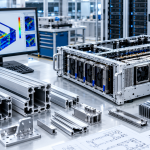
- Extruded structural profiles
- CNC-machined brackets
- Chassis rails
- GPU support frames
- Cooling support structures
- Heat-spreading plates
- Mounting plates
- Enclosure panels
- Manifold brackets
- Cable-management structures
An aluminum AI server chassis can therefore be designed as a combination of structural and functional components rather than simply as a metal box.
Key advantages include:
Low density
Aluminum is considerably lighter than steel for equivalent volume, which can help reduce the weight of modular server structures.
Good specific strength
Although aluminum generally has a lower elastic modulus than steel, properly designed profiles and load paths can provide sufficient stiffness for many chassis applications.
Thermal conductivity
Aluminum can help distribute heat locally and can be integrated with thermal management components.
Excellent extrusion capability
Complex cross-sectional geometries can be produced through extrusion, allowing structural ribs, mounting channels, cable paths, and other features to be incorporated into the profile.
Machining flexibility
CNC machining can create precise mounting surfaces, connector interfaces, cooling passages, and assembly features.
Surface treatment options
Anodizing and other surface treatments can improve surface durability and provide controlled appearance and environmental resistance.
The important point is that these advantages come from the combination of material + geometry + manufacturing + system design.
3. Start With the Load Path, Not the Chassis Wall
One of the most important principles in AI server frame design is understanding where mechanical loads actually travel.
A high-density GPU configuration may create concentrated loads around:
- GPU mounting points
- Motherboard mounting locations
- PCIe interfaces
- GPU support rails
- Power supply mounts
- Cooling plate attachments
- Rack mounting points
A poorly designed chassis may transfer these loads through thin panels or localized fasteners.
A better architecture establishes clear load paths.
For example:
GPU → Support Bracket → Aluminum Extrusion → Vertical Frame → Rack Interface
This allows the structural members to carry loads directly instead of relying on enclosure panels to provide most of the stiffness.
For an aluminum GPU chassis, extruded profiles can be particularly useful because their cross-sectional geometry can be optimized for bending and torsional stiffness.
4. Aluminum Extrusions for AI Server Frames
Extrusion is one of the most flexible manufacturing methods for aluminum server structures.
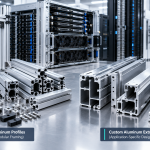
Instead of designing the chassis entirely from flat sheet metal, engineers can use customized or semi-standard profiles for the primary frame.
A typical AI server frame may include:
- Vertical structural rails
- Horizontal cross members
- GPU support rails
- Front and rear mounting structures
- Cooling support rails
- Cable-management channels
The extrusion profile can incorporate:
- Internal cavities
- Reinforcing ribs
- T-slots
- Screw channels
- Mounting grooves
- Cable-routing spaces
- Locating features
This can reduce the number of separate brackets required during assembly.
It also allows the chassis architecture to be adapted for different server configurations.
For example, the same basic vertical frame may support different combinations of:
GPU Module + Cooling Module + Power Module + Storage Module
This is particularly useful for modular AI infrastructure.
5. Structural Stiffness Matters More Than Simply Material Strength
When designing an AI server chassis, engineers often focus on the strength of the aluminum alloy.
However, stiffness can be equally important.
A chassis may technically have sufficient strength but still experience excessive deformation under load.
This can affect:
- GPU alignment
- Connector engagement
- Cold plate contact
- PCB mounting
- Door or panel alignment
- Hose connections
- Rack installation
- Long-term vibration performance
For many chassis structures, controlling deformation is therefore a primary design objective.
The geometry of the aluminum profile becomes critical.
Increasing the second moment of area can improve bending stiffness without simply increasing material thickness everywhere.
This is one reason optimized aluminum extrusions can be attractive for AI server frames.
6. Designing Around Heavy GPUs
GPU density creates a unique mechanical challenge.
Several GPUs may be installed in parallel within a relatively compact chassis. Their combined weight can create concentrated loads on support rails and mounting points.
The frame should therefore prevent:
- Localized deformation
- Rail bending
- Excessive PCB loading
- Connector misalignment
- GPU movement during transportation
- Vibration-induced loosening
A robust design may distribute the GPU load through multiple structural members.
Instead of:
GPU → Thin Panel
the architecture can be:
GPU → Precision Bracket → Horizontal Support Rail → Vertical Aluminum Frame
This load-path approach can significantly improve mechanical stability.
7. Liquid Cooling Changes the Chassis Architecture
A liquid cooled server chassis requires substantially more mechanical coordination than a conventional air-cooled chassis.
The cooling system introduces components that have their own:
- Weight
- Pressure
- Movement
- Thermal expansion
- Connection forces
- Maintenance requirements
A typical cooling path may look like:
Manifold → Hose → Quick Connector → Cold Plate → GPU → Return Connector → Return Manifold
The chassis must support this entire mechanical chain.
The structural frame should therefore be designed around the cooling interfaces rather than simply providing empty space for them.
8. Cold Plate Mounting and Mechanical Stability
Cold plates must maintain reliable thermal contact with the heat-generating component.
The chassis therefore has to provide accurate mechanical support around the cold plate.
Important considerations include:
- Mounting position
- Contact pressure
- Flatness
- Fastener arrangement
- Thermal expansion
- Component tolerances
- Removal sequence
A cold plate should not be forced to compensate for a flexible chassis.
If the supporting frame deforms significantly, the cold plate interface may become less uniform.
For this reason, the local aluminum structure around a cold plate should have sufficient stiffness and dimensional stability.
9. Manifold and Quick Connector Support
Liquid cooling manifolds can become substantial mechanical components in high-density systems.
They need to remain stable while hoses are connected and disconnected.
Quick connectors can also introduce mechanical loads.
Every connection and disconnection operation may create forces on:
- Connector bodies
- Manifold mounting points
- Hose assemblies
- Aluminum brackets
- Adjacent components
The chassis should therefore provide dedicated support for the manifold.
A useful design principle is:
Do not allow the hose or connector to become an unintended structural member.
Instead:
Manifold → Dedicated Support Bracket → Aluminum Frame
while:
Hose → Flexible Routing → Cold Plate
This separates structural loads from fluid-routing components.
10. Hose Routing Must Be Designed Into the AI Server Frame
Hoses require more space than rigid pipes because they need appropriate routing geometry.
The design must account for:
- Minimum bend radius
- Connector orientation
- Hose movement
- Installation clearance
- Removal clearance
- Thermal expansion
- Vibration
- Potential abrasion
An aluminum extrusion can provide dedicated routing channels or protective features around hoses.
However, sharp aluminum edges should never be allowed to contact flexible hoses directly.
Potential solutions include:
- Rounded extrusion edges
- Protective sleeves
- Polymer inserts
- Dedicated hose clamps
- Edge guards
- Separate routing channels
This is a small mechanical detail that can have a major impact on long-term reliability.
11. Thermal Management Is More Than Heat Dissipation
An aluminum AI server chassis can participate in thermal management, but its structural role should not be confused with that of a dedicated heat sink or cold plate.
The chassis may help:
- Spread localized heat
- Support thermal components
- Maintain cooling interfaces
- Provide thermal pathways
- Separate hot and sensitive components
- Support liquid cooling hardware
However, the primary cooling path should be clearly defined.
For a direct-to-chip liquid-cooled GPU system, for example:
GPU → TIM → Cold Plate → Coolant → Manifold → CDU
The aluminum chassis provides the mechanical infrastructure around this thermal path.
Its job is to keep the components aligned, supported, accessible, and protected.
12. Thermal Expansion Must Be Considered
Aluminum has a relatively high coefficient of thermal expansion.
This becomes important when the chassis combines aluminum with:
- Copper cold plates
- Stainless-steel fittings
- Steel rack structures
- Copper pipes
- Electronic assemblies
Different materials expand at different rates as temperature changes.
If all components are rigidly constrained, thermal cycling can generate mechanical stress.
Therefore, an AI server chassis may require:
- Floating mounting points
- Controlled clearances
- Flexible hose routing
- Sliding interfaces
- Compliant mounting elements
- Appropriate fastener strategies
The objective is not to eliminate thermal movement.
The objective is to control where the movement occurs.
13. Serviceability Should Be Designed From the Beginning
A high-density AI server may contain expensive and frequently serviced components.
Serviceability therefore becomes a mechanical design requirement rather than an afterthought.
Technicians may need to access:
- GPUs
- Memory
- Storage
- Power supplies
- Cooling connectors
- Filters
- Fans
- Manifolds
- Sensors
- Cables
- Control boards
A chassis that is extremely compact but difficult to service can increase downtime and maintenance cost.
The design should answer a basic question:
What components need to be removed first, and what components must remain in place?
14. Design the Component Removal Sequence
A good AI server frame should allow engineers to define a predictable maintenance sequence.
For example:
Open Access Panel
↓
Disconnect Power
↓
Disconnect Cooling Interface
↓
Release GPU Retention
↓
Remove GPU Module
↓
Inspect Cold Plate and Connector
This sequence should not require unnecessary removal of unrelated components.
If a technician must remove several cables, structural brackets, and neighboring GPUs simply to access one serviceable component, the chassis architecture needs improvement.
15. Quick-Disconnect Interfaces Improve Serviceability
Quick-disconnect couplings can make liquid-cooled server maintenance easier, but only if they are positioned correctly.
The connector should ideally be:
- Accessible
- Clearly oriented
- Mechanically supported
- Protected from accidental impact
- Located where technicians can operate it safely
The surrounding aluminum structure should provide enough clearance for the operator’s hands and tools.
This creates an important design relationship:
Connector Location ↔ Frame Geometry ↔ Service Clearance
A connector that technically fits inside the chassis may still be poorly designed if it cannot be reached during maintenance.
16. Cable Management and Cooling Routing Should Work Together
AI servers can contain a large number of power, data, sensor, and cooling connections.
Poor routing can create interference between:
- High-current power cables
- High-speed signal cables
- Cooling hoses
- Structural members
- Service access areas
An aluminum AI server chassis can incorporate separate routing zones.
For example:
Upper Zone → Cooling Manifold
Middle Zone → GPU Modules
Side Channel → Power Cables
Rear Zone → Data and Network Connections
This type of spatial organization can improve both reliability and serviceability.
17. Avoid Over-Constraining the Chassis
A common mistake is trying to make every component completely rigid.
In reality, different components may need different degrees of freedom.
For example:
- Structural members may need high stiffness.
- Cold plates may require controlled mounting compliance.
- Hoses require flexibility.
- Thermal expansion may require sliding interfaces.
- Service panels require easy removal.
Therefore, the best chassis is not necessarily the most rigid chassis.
It is the chassis that provides the right constraint at the right location.
18. Aluminum Profile Geometry for Modular Chassis Design
Extruded aluminum profiles are especially useful when the AI server platform may evolve over time.
A modular profile system can allow changes to:
- GPU count
- Server depth
- Cooling hardware
- Power supply configuration
- Storage layout
- Cable routing
- Mounting brackets
Instead of redesigning the entire chassis, engineers can modify selected structural components.
This can be particularly valuable during prototype and pilot production.
For lower-volume AI infrastructure projects, extrusion combined with CNC machining can provide a practical path between rapid prototyping and production.
19. CNC Machining for Precision Interfaces
Extrusion provides the basic structural geometry, while CNC machining can create precision interfaces.
Typical machined features include:
- Mounting holes
- Counterbores
- Connector openings
- Cold plate interfaces
- Manifold mounting surfaces
- Locating pins
- Threaded holes
- Bracket interfaces
This hybrid manufacturing approach can combine the efficiency of extrusion with the dimensional control of CNC machining.
A typical process can be:
Aluminum Extrusion → Cutting → CNC Machining → Deburring → Surface Treatment → Assembly → Inspection
20. Surface Treatment and Environmental Reliability
Surface treatment can also influence the long-term performance of an aluminum server chassis.
Depending on the application, options may include:
- Anodizing
- Chemical conversion treatment
- Powder coating
- Machined or brushed finishes
Selection should consider:
- Corrosion environment
- Electrical contact requirements
- Wear resistance
- Appearance
- Grounding requirements
- Assembly interfaces
Care must be taken around electrical grounding points and precision mating surfaces.
Not every surface should necessarily receive the same treatment.
21. Structural Simulation and Physical Validation
For high-density AI server chassis, simulation can help identify potential mechanical problems before production.
Typical analysis may include:
Static Structural Analysis
Evaluate:
- GPU weight
- Cooling component loads
- Power supply loads
- Rack mounting loads
Modal Analysis
Evaluate:
- Natural frequencies
- Vibration sensitivity
- Structural resonance
Thermal-Structural Analysis
Evaluate:
- Temperature gradients
- Thermal deformation
- Differential expansion
- Interface movement
Assembly Tolerance Analysis
Evaluate:
- Component alignment
- Connector positioning
- Mounting-hole tolerance
- Cold plate alignment
Simulation should not replace physical testing.
A practical development cycle is:
CAD → FEA → Prototype → Assembly Test → Thermal Test → Vibration Test → Serviceability Test → Design Optimization
22. Serviceability Testing Should Be a Real Engineering Test
Serviceability can be measured.
A development team can evaluate:
- Time required to replace a GPU
- Number of tools required
- Number of components that must be removed
- Cooling connection accessibility
- Cable reconnection difficulty
- Risk of damaging adjacent components
- Number of fasteners involved
This transforms serviceability from a subjective design preference into an engineering parameter.
For large-scale AI deployments, even small reductions in maintenance time can become meaningful over the lifetime of the equipment.
23. Common Design Mistakes in AI Server Chassis
Several problems appear repeatedly when structural and cooling systems are designed separately.
Mistake 1: Designing the frame first and adding cooling later
This often results in poor hose routing and insufficient connector clearance.
Mistake 2: Treating aluminum as a direct replacement for steel
Equivalent dimensions do not necessarily provide equivalent stiffness.
Mistake 3: Ignoring GPU load concentration
Heavy GPU modules require appropriate support and load distribution.
Mistake 4: Rigidly fixing every component
This can create problems with thermal expansion and tolerance accumulation.
Mistake 5: Routing hoses through sharp structural areas
This can introduce abrasion and long-term leakage risk.
Mistake 6: Prioritizing density over serviceability
A few millimeters saved during assembly can become significant maintenance difficulty later.
Mistake 7: Treating connectors as unsupported components
Quick connectors and manifolds need mechanical support.
Mistake 8: Designing only for prototype assembly
A chassis that works once in a laboratory may not be suitable for repeated production, transportation, installation, and field service.
24. Designing the Aluminum AI Server Chassis as a System
The most effective chassis architecture considers the following elements together:
Structural Frame
Supports GPUs, motherboards, power systems, and rack interfaces.
Thermal Architecture
Defines the physical relationship between heat sources, cold plates, heat spreaders, and coolant paths.
Cooling Interfaces
Provides mechanical support for manifolds, hoses, and quick connectors.
Cable Management
Separates and organizes power, signal, sensor, and cooling routes.
Service Access
Allows components to be inspected and replaced without unnecessary disassembly.
Manufacturing Architecture
Uses extrusion, CNC machining, sheet metal, joining, and surface treatment according to production requirements.
This integrated approach is more valuable than optimizing any single component in isolation.
25. From Prototype to Production
AI server chassis development often begins with relatively small quantities.
During early development, the priorities may be:
- Rapid design changes
- CNC prototypes
- Standard aluminum profiles
- Quick assembly
- Functional testing
As the design becomes stable, production can move toward:
- Customized aluminum extrusion
- Dedicated machining fixtures
- Higher-volume CNC processes
- Integrated brackets
- Controlled surface treatment
- Assembly optimization
- Production inspection
The manufacturing strategy should therefore evolve together with the product.
For example:
Prototype → Small Batch → Pilot Production → Production Optimization
This approach reduces the risk of investing too early in dedicated tooling before the mechanical and cooling architecture has been validated.
26. A Practical Design Checklist
Before finalizing an aluminum AI server chassis, engineers should review at least the following:
Structural
- GPU weight and distribution
- Frame stiffness
- Rack mounting loads
- Transportation loads
- Vibration
- Fastener reliability
Thermal
- Heat-source locations
- Cold plate mounting
- Heat spreader interfaces
- Thermal expansion
- Temperature gradients
Liquid Cooling
- Manifold position
- Hose routing
- Minimum bend radius
- Quick connector accessibility
- Connector support
- Leak-management considerations
Serviceability
- GPU removal path
- Cable access
- Cooling connection access
- Tool requirements
- Maintenance clearance
- Component replacement sequence
Manufacturing
- Extrusion geometry
- CNC machining requirements
- Surface treatment
- Assembly sequence
- Tolerances
- Inspection requirements
27. The Future of Aluminum AI Server Chassis Design
As AI computing becomes increasingly dense, the server chassis will continue to evolve from a passive enclosure into an integrated mechanical platform.
The next generation of AI server structures may combine:
- High-strength aluminum profiles
- Precision-machined cooling components
- Integrated liquid-cooling interfaces
- Modular GPU support structures
- Lightweight enclosure systems
- Advanced thermal materials
- Sensor integration
- Service-oriented mechanical architecture
This creates opportunities for aluminum structures to participate directly in the design of AI computing infrastructure.
The goal is not simply to make the chassis lighter.
The goal is to create a structure that makes the entire AI server more reliable, thermally manageable, modular, manufacturable, and serviceable.
Structure, Cooling, and Serviceability Must Be Designed Together
The design of an aluminum AI server chassis requires a system-level approach.
A successful chassis must carry heavy GPU and power-system loads while maintaining dimensional stability. It must accommodate liquid cooling without compromising structural integrity. It must provide enough space for hoses, manifolds, connectors, and cables while still allowing technicians to access critical components.
The most effective design philosophy is therefore:
Load Path → Aluminum Frame → Cooling Interface → Thermal Movement → Component Access → Serviceability → Manufacturing → Validation
For AI infrastructure manufacturers and system integrators, aluminum extrusion, CNC machining, thermal structures, and custom mechanical components can provide a flexible foundation for developing next-generation AI server frames, aluminum GPU chassis, and liquid cooled server chassis.
The strongest chassis is not simply the one with the most material or the highest mechanical strength.
It is the one in which structure, cooling, and maintenance work together as a single engineered system.