As artificial intelligence (AI) infrastructure continues to scale, modern data centers are facing increasing challenges related to power density, equipment integration, and physical system complexity.
High-performance AI servers require large amounts of electrical power and high-speed data communication. As a result, cable systems within AI infrastructure environments are becoming more complex, with increased requirements for:
- Thermal management
- Mechanical protection
- Installation reliability
- Long-term durability
Cable protection systems are no longer only used to organize cables. They have become an important part of physical infrastructure design, helping protect critical connections from environmental and mechanical stresses.
This article discusses the thermal and mechanical considerations involved in designing cable protection systems for AI data centers and high-density computing environments.
The Growing Need for Cable Protection in AI Infrastructure
AI server environments differ from traditional computing installations.
Modern AI racks may include:
- High-power electrical connections
- High-speed network cables
- Fiber optic assemblies
- Liquid cooling components
- Monitoring systems
The increasing density of cables creates several engineering challenges.
Potential concerns include:
- Heat accumulation
- Cable bending stress
- Abrasion during installation
- Mechanical interference
- Limited maintenance space
Cable protection solutions help address these challenges through appropriate material selection and structural design.
Thermal Considerations in Cable Protection Systems
Heat Generation in AI Infrastructure
High-density AI systems consume significantly more power than conventional servers.
Power cables and electrical components may experience increased thermal loads due to:
- Higher current levels
- Increased rack power density
- Continuous operating conditions
Therefore, cable protection designs should consider the surrounding thermal environment.
Thermal Insulation vs Thermal Dissipation
Cable protection systems must balance two different requirements.
Thermal Protection
In some applications, cables may require protection from nearby heat sources.
Examples include:
- High-temperature equipment areas
- Power distribution sections
- Industrial environments
Protective materials may help reduce direct exposure to external heat.
Thermal Dissipation
In other applications, excessive insulation may prevent heat from escaping.
Therefore, designers may consider:
- Ventilation
- Material selection
- Protective layer thickness
- Installation spacing
The appropriate solution depends on cable type and operating conditions.
Materials Used for Thermal Cable Protection
Different materials provide different levels of thermal and mechanical performance.
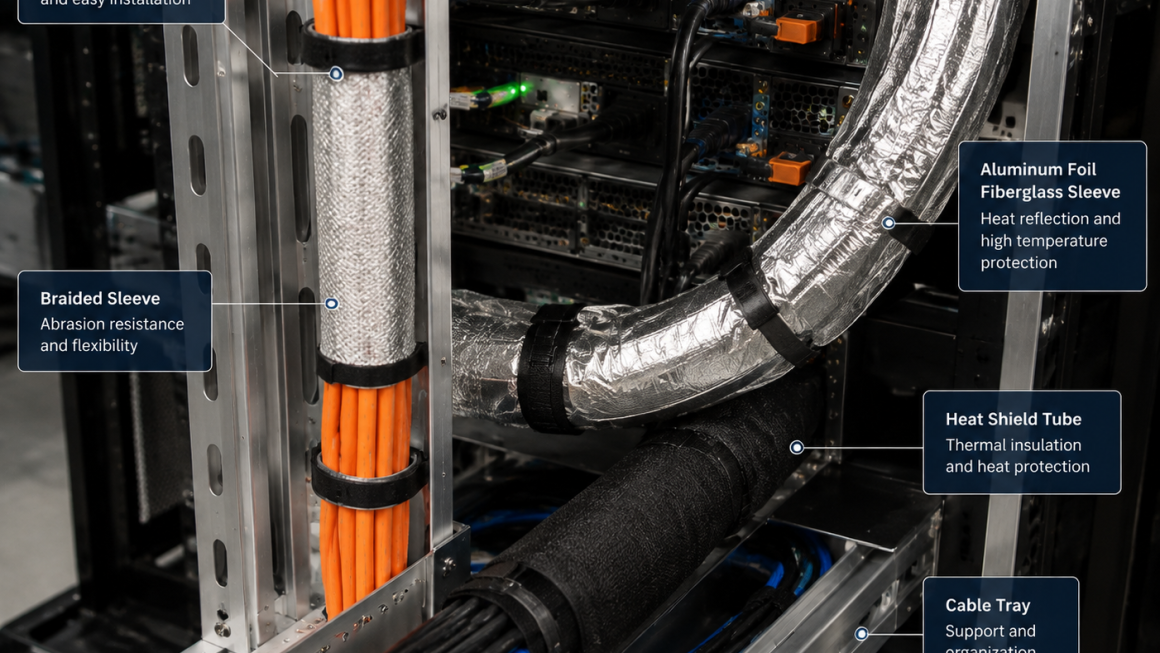
Fiberglass-Based Protection
Fiberglass materials are commonly considered for applications requiring:
- Thermal resistance
- Mechanical durability
- Flexible installation
Potential applications include:
- Cable sleeves
- Heat protection covers
- High-temperature protective layers
Aluminum Foil Composite Protection
Aluminum foil-based protection systems may be used where reflective heat shielding is required.
Potential advantages include:
- Lightweight structure
- Reflective surface characteristics
- Flexible integration
Applications may include:
- Heat shielding layers
- Protective wraps
- Cable insulation systems
Polymer-Based Protection
Engineering polymers may be used for:
- Abrasion resistance
- Flexible cable management
- Mechanical protection
Material selection depends on:
- Temperature range
- Chemical exposure
- Mechanical requirements
Mechanical Considerations in Cable Protection
Abrasion Protection
During installation and operation, cables may contact:
- Metal edges
- Structural components
- Cable trays
- Mounting brackets
Protective systems may reduce risks associated with:
- Surface wear
- Repeated movement
- Installation damage
Bend Radius Management
Modern AI infrastructure contains many types of cables, including:
- Power cables
- High-speed data cables
- Fiber cables
Each cable type has specific bending limitations.
Cable protection systems should consider:
- Minimum bend radius
- Flexible routing
- Stress reduction
Proper routing helps avoid unnecessary mechanical loading.
Vibration and Mechanical Stress
Although data centers are generally controlled environments, mechanical stresses may still occur due to:
- Fan operation
- Equipment installation
- Maintenance activities
- Rack movement
Cable protection structures should help maintain cable stability while allowing practical service access.
Protection Against Environmental Factors
Depending on the installation environment, cable protection may address:
Dust and Contamination
Protective covers and sleeves may help reduce exposure to:
- Dust
- Particles
- Installation debris
Moisture Considerations
Some applications may require protection from:
- Humidity
- Condensation risks
- Environmental exposure
The selected protection method should match the actual operating environment.
Integration With AI Data Center Structures
Cable protection systems must work together with other infrastructure components.
Important integration points include:
- Server racks
- Aluminum frames
- Cable trays
- Liquid cooling pipes
- Power distribution systems
A well-designed protection system should support:
- Easy installation
- Clear cable routing
- Maintenance accessibility
Aluminum-Based Cable Protection Structures
Aluminum can play an important role in cable protection infrastructure.
Potential applications include:
- Protective channels
- Cable covers
- Support brackets
- Mounting profiles
Advantages of Aluminum Structures
Lightweight Design
Aluminum structures can reduce installation weight compared with some traditional metal alternatives.
Custom Manufacturing Capability
Aluminum extrusion enables customized designs including:
- Specific channel dimensions
- Integrated mounting grooves
- Modular connection features
Surface Treatment Options
Depending on requirements, aluminum components may use:
- Anodizing
- Coatings
- Other finishing processes
to improve surface durability.
Design Considerations for Cable Protection Systems
Protection Level
The required protection level depends on:
- Cable type
- Installation environment
- Mechanical exposure
- Temperature conditions
Maintenance Requirements
Protection systems should allow technicians to:
- Inspect cables
- Replace components
- Perform upgrades
A balance is required between protection and accessibility.
Modular Design
Modular protection systems may support:
- Faster installation
- Easier expansion
- Simplified replacement
This is particularly valuable in rapidly evolving AI infrastructure environments.
Manufacturing Considerations
Cable protection components may involve several manufacturing processes.
Extrusion Manufacturing
Suitable for:
- Aluminum channels
- Protective profiles
- Structural guides
Benefits include:
- Consistent geometry
- Scalable production
- Custom profile development
CNC Machining
Used for:
- Mounting components
- Precision connectors
- Customized brackets
Flexible Manufacturing
AI infrastructure projects often require customized solutions.
Flexible manufacturing supports:
- Prototype development
- Small-batch production
- Project-specific modifications
Challenges in Future AI Infrastructure
Increasing Power Density
As AI systems become more powerful:
- Cable loads may increase
- Thermal management becomes more important
- Protection requirements may become more complex
Integration With Liquid Cooling
Future AI racks may combine:
- Electrical cables
- Cooling pipes
- Mechanical structures
Cable protection systems must be designed to coexist with liquid cooling infrastructure.
Balancing Protection and Accessibility
More protection does not always mean better performance.
Engineers must balance:
- Protection level
- Weight
- Cost
- Maintenance convenience
Future Development Trends
Integrated Cable Management Systems
Future infrastructure may combine:
- Cable routing
- Protection
- Structural support
into integrated solutions.
Lightweight Materials
Advanced aluminum structures and composite materials may provide new options for reducing weight while maintaining mechanical performance.
Customized AI Infrastructure Components
As AI data centers become more specialized, suppliers may increasingly provide:
- Custom profiles
- Protective components
- Mechanical assemblies
designed for specific deployment requirements.
Cable protection systems are becoming increasingly important in high-density AI infrastructure environments.
Effective protection requires consideration of both thermal and mechanical factors, including heat exposure, cable routing, bending stress, abrasion, and long-term maintenance requirements.
There is no single universal protection solution. The appropriate design depends on cable type, operating conditions, environmental requirements, and system architecture.
Through proper material selection, structural design, and manufacturing capability, cable protection systems can support more reliable and maintainable AI data center infrastructure.