AI Infrastructure Must Scale Faster Than Ever
The global expansion of artificial intelligence is creating unprecedented demand for computing infrastructure.
Organizations are deploying AI systems across:
- Hyperscale data centers
- Enterprise computing environments
- Edge AI facilities
- Telecom networks
- Industrial automation platforms
As AI adoption accelerates, infrastructure providers face a critical challenge:
How can AI hardware be deployed rapidly, efficiently, and economically at scale?
The answer increasingly lies in modular engineering.
Among the many technologies enabling scalable deployment, modular aluminum systems are emerging as a key foundation for next-generation AI infrastructure.
Their combination of:
- Lightweight construction
- Structural strength
- Manufacturing flexibility
- Cooling compatibility
- Recyclability
makes them particularly well suited for modern AI environments.
The Shift Toward Modular AI Infrastructure
Traditional IT deployments often relied on highly customized installations.
While effective at smaller scales, this approach becomes increasingly difficult when AI infrastructure must be deployed across hundreds or thousands of locations.
Modern operators increasingly prefer:
- Standardized modules
- Pre-engineered assemblies
- Scalable architectures
- Rapid installation systems
Benefits include:
- Faster deployment
- Lower installation costs
- Simplified maintenance
- Easier future expansion
Modularity allows infrastructure growth without complete redesigns.
For AI operators, this flexibility has become a strategic advantage.
Why Aluminum Is Ideal for Modular Systems
Material selection directly affects the success of modular infrastructure.
Aluminum offers several advantages compared with traditional structural materials.
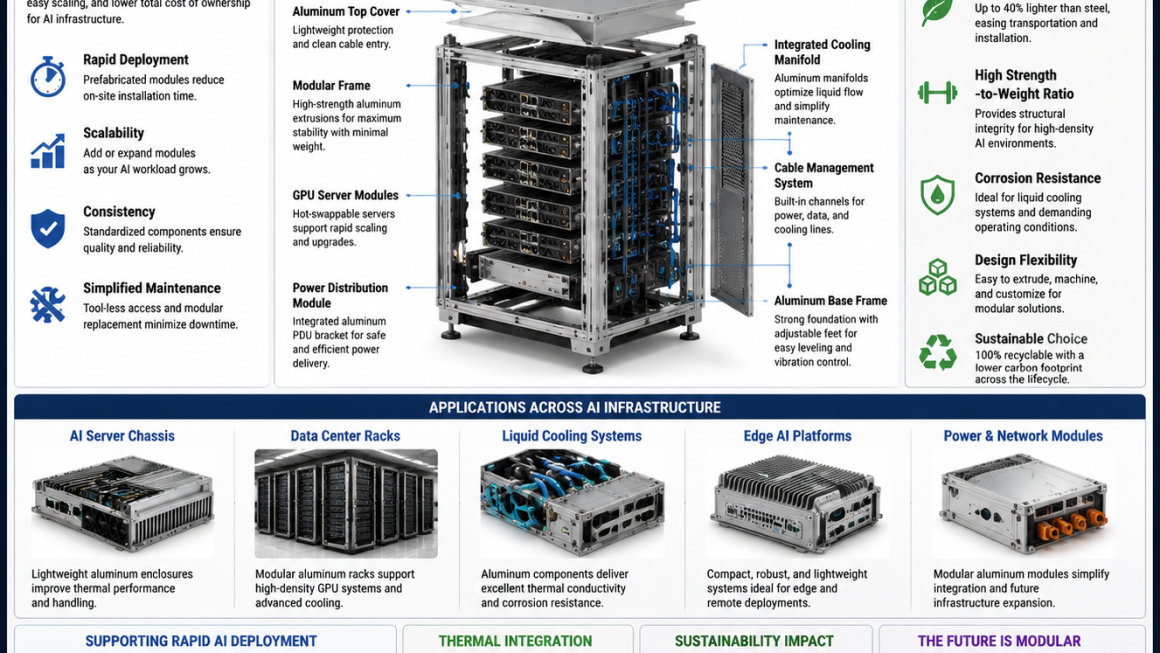
Lightweight Construction
Weight reduction is increasingly important as AI hardware becomes denser.
Modern deployments include:
- Multi-GPU servers
- Liquid cooling equipment
- Power distribution hardware
- High-speed networking systems
Using aluminum can significantly reduce overall infrastructure weight while maintaining structural integrity.
This improves:
- Transportation efficiency
- Installation speed
- Rack handling safety
High Strength-to-Weight Ratio
Aluminum combines:
- Mechanical durability
- Structural rigidity
- Reduced mass
This allows engineers to create lightweight yet robust support systems for demanding AI environments.
Corrosion Resistance
Many AI systems are moving toward liquid cooling technologies.
In these environments, corrosion resistance becomes critical.
Aluminum naturally develops a protective oxide layer that helps improve durability in long-term operating conditions.
Manufacturing Flexibility
Aluminum can be:
- Extruded
- Machined
- Welded
- Formed into complex profiles
This supports highly customized modular infrastructure without sacrificing scalability.
Applications of Modular Aluminum Systems in AI Infrastructure
Aluminum structures now appear throughout modern AI facilities.
Server Chassis
Many next-generation server platforms use aluminum components for:
- Structural support
- Weight reduction
- Thermal integration
The result is improved handling and easier deployment.
Rack Systems
AI racks increasingly incorporate aluminum assemblies for:
- Frame structures
- Equipment mounting
- Cooling integration
Lightweight racks simplify installation while supporting high equipment densities.
Cooling Infrastructure
Liquid cooling systems often include aluminum components such as:
- Cold plate housings
- Manifold structures
- Heat exchanger frames
- Cooling distribution assemblies
The material provides a balance between thermal performance and mechanical reliability.
Edge AI Platforms
Edge deployments frequently operate in locations where:
- Space is limited
- Maintenance access is restricted
- Environmental conditions vary
Modular aluminum enclosures provide a practical solution through:
- Lightweight transportation
- Rapid installation
- Durable operation
Supporting Rapid AI Deployment
One of the biggest challenges in AI infrastructure is deployment speed.
Organizations increasingly require:
- Faster construction schedules
- Rapid hardware rollout
- Flexible expansion capability
Modular aluminum systems support these goals through:
Prefabrication
Components can be manufactured and assembled before arriving on-site.
This reduces installation time and labor requirements.
Standardization
Reusable modules simplify:
- Procurement
- Maintenance
- Inventory management
Scalability
Additional infrastructure can be added using the same structural platform.
This approach supports long-term growth while minimizing redesign requirements.
Thermal Integration Benefits
AI infrastructure is increasingly constrained by heat management.
Modern racks may exceed:
- 50 kW
- 80 kW
- 100 kW+
Thermal infrastructure is becoming inseparable from structural design.
Aluminum supports this integration through:
- Good thermal conductivity
- Lightweight support structures
- Compatibility with liquid cooling systems
As a result, structural components can contribute to overall thermal performance.
Sustainability Advantages
Sustainability is becoming an important factor in infrastructure planning.
Aluminum offers several environmental benefits.
Recyclability
Aluminum can be recycled repeatedly without significant loss of material properties.
This supports circular manufacturing strategies.
Lower Transportation Impact
Because aluminum is lightweight, transportation energy requirements are reduced.
This becomes increasingly important for large-scale deployments.
Long Service Life
Durable structures help reduce replacement frequency and lifecycle costs.
For hyperscale operators, this contributes to both sustainability and operational efficiency.
Future Trends in Modular Aluminum Infrastructure
Over the next decade, modular aluminum systems are expected to become even more important.
Emerging developments include:
Integrated Liquid Cooling Platforms
Structural systems designed specifically around cooling architectures.
Smart Infrastructure
Embedded sensors for:
- Structural monitoring
- Thermal tracking
- Vibration analysis
Hybrid Material Architectures
Combining:
- Aluminum structures
- Composite reinforcements
- Advanced thermal materials
- Carbon-based technologies
Factory-Built AI Modules
Entire AI infrastructure units may increasingly be assembled off-site and deployed as complete systems.
As AI infrastructure expands globally, deployment speed, scalability, and efficiency are becoming critical competitive factors.
Modular aluminum systems offer an attractive solution by combining:
- Lightweight engineering
- Structural reliability
- Cooling compatibility
- Manufacturing flexibility
- Sustainability benefits
From server chassis and rack structures to liquid cooling platforms and edge AI deployments, aluminum is becoming a foundational material for scalable AI infrastructure.
As the industry continues moving toward modular, high-density computing environments, modular aluminum systems will play an increasingly important role in enabling the next generation of AI deployment.