Primary Keyword: AI data center aluminum infrastructure
Supporting Keywords: AI infrastructure aluminum solutions, AI data center materials, aluminum thermal infrastructure
Aluminum Is More Than a Structural Material
Artificial intelligence is changing the physical requirements of data centers.
Higher computing density, increasingly demanding thermal loads, liquid cooling adoption, complex cable routing, and rapid hardware upgrades are placing new demands on the infrastructure surrounding AI servers.
These changes require more than individual aluminum components. They require coordinated engineering across materials, manufacturing, structural design, thermal management, and system integration.
This is where AI data center aluminum infrastructure becomes important.
Aluminum can serve multiple functions within an AI infrastructure environment. It can provide structural support for server racks, form precision mounting interfaces, enable modular equipment enclosures, support cooling assemblies, and contribute to heat dissipation through appropriately designed thermal components.
However, aluminum alone does not guarantee better performance.
The final result depends on how the alloy is selected, how the profile is designed, how the component is manufactured, how interfaces are integrated, and how the complete assembly is validated.
Understanding this relationship requires looking beyond individual parts and examining the complete engineering chain:
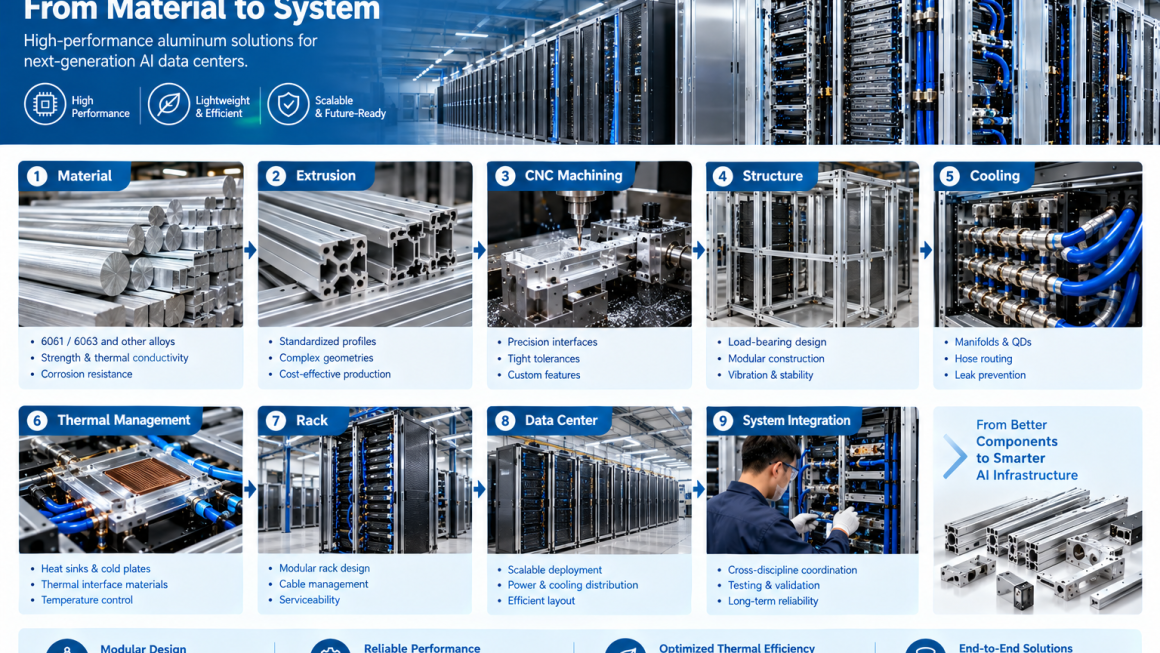
Material → Extrusion → CNC Machining → Structure → Cooling → Thermal Management → Rack → Data Center → System Integration
Each stage influences the next. A decision made at the material or profile-design stage can affect manufacturing cost, assembly accuracy, cooling performance, serviceability, and long-term reliability.
This article explains how these elements work together to support next-generation AI infrastructure.
1. Material: Establishing the Engineering Foundation
Every aluminum infrastructure component begins with material selection.
Different components have different priorities. A structural frame may require stiffness and load-bearing capacity, while a heat sink requires suitable thermal properties and manufacturable fin geometry. A precision cooling interface may place greater emphasis on dimensional stability, surface condition, and compatibility with adjoining materials.
The material should therefore be selected according to the component’s function rather than by alloy designation alone.
6061 and 6063 Aluminum
Two commonly considered alloys are 6061 and 6063.
6061 aluminum is frequently used for CNC-machined components, structural brackets, mounting interfaces, and parts requiring a useful combination of strength and machinability.
6063 aluminum is widely used for extrusion profiles where cross-sectional geometry, surface appearance, and profile-manufacturing characteristics are important.
Their suitability depends on temper, geometry, manufacturing process, and operating conditions.
| Selection factor | 6061 aluminum | 6063 aluminum |
|---|---|---|
| Typical application focus | Machined and structural parts | Extruded profiles and complex sections |
| Manufacturing emphasis | CNC machining and structural fabrication | Profile extrusion and secondary machining |
| Design considerations | Strength, interfaces, machining requirements | Profile geometry, extrusion feasibility, stiffness |
| Common AI infrastructure uses | Brackets, precision mounts, structural blocks | Rack profiles, mounting channels, selected heat sinks |
This comparison is a starting point, not a universal ranking. The final choice should be based on actual mechanical requirements, dimensional tolerances, thermal needs, and production methods.
Beyond Alloy Selection
Material decisions may also include:
- Required alloy temper and mechanical properties
- Thermal conductivity requirements
- Corrosion resistance
- Compatibility with coolant and adjoining metals
- Surface treatment requirements
- Availability and lead time
- Material certification and traceability
For AI infrastructure, material selection should be coordinated with the intended manufacturing route from the beginning.
A material that appears attractive on a datasheet may become less suitable if it creates unnecessary machining complexity, difficult surface treatment, or inconsistent production results.
The objective is to select a material that supports the entire component lifecycle—not simply one desirable property.
2. Extrusion: Turning Material into Functional Geometry
Aluminum extrusion transforms a selected alloy into a continuous profile with a defined cross-section.
This manufacturing method is particularly useful for AI infrastructure because many structural components require repeated geometry along a length.
Examples include:
- Vertical rack members
- Horizontal structural beams
- Modular mounting channels
- Cable management profiles
- Equipment enclosure frames
- Heat sink profiles
- Cooling equipment supports
The main advantage of extrusion is the ability to incorporate multiple functions into one profile.
A well-designed cross-section may include mounting slots, internal cavities, reinforcing ribs, cable-routing spaces, and interfaces for additional components.
This can reduce the number of separate parts required in an assembly.
Profile Geometry Influences System Performance
Extrusion design affects more than appearance.
The profile cross-section influences:
- Bending stiffness
- Torsional resistance
- Material consumption
- Fastener placement
- Assembly flexibility
- Machining requirements
- Thermal behavior where relevant
For example, increasing section depth may improve bending stiffness more efficiently than simply increasing wall thickness everywhere.
Internal ribs can reinforce selected regions, while mounting channels can provide repeatable interfaces for modular components.
However, complex geometry may introduce extrusion constraints, additional tooling requirements, or dimensional-control challenges.
The profile must therefore be designed around both engineering performance and manufacturing feasibility.
Standardized Profiles Enable Modular Infrastructure
Standardized profile families can support multiple applications across an AI infrastructure platform.
The same profile system may be adapted for different rack heights, enclosure dimensions, equipment configurations, and mounting arrangements.
Secondary machining can then create application-specific holes, slots, and interfaces.
This combination provides a useful balance between standardization and customization.
3. CNC Machining: Creating Precision Interfaces
Extrusion establishes the main geometry of many aluminum components, but it does not necessarily provide every feature required for final assembly.
CNC machining adds the precision interfaces needed to connect components and integrate them into larger systems.
Typical applications include:
- Precision mounting holes
- Threaded features
- Connector openings
- Cold plate interfaces
- Manifold mounting surfaces
- Structural brackets
- Custom equipment housings
- Alignment features
For AI infrastructure, these features can be particularly important because structural alignment and thermal interfaces often depend on accurate dimensions.
A cooling component may fit within a rack but still perform poorly if its mounting surface, alignment, or contact pressure is unsuitable.
Likewise, an extrusion may meet its overall dimensional requirements while requiring additional machining to achieve the tolerances needed at critical connection points.
Combining Extrusion and CNC Machining
A common production route is:
Profile design → Extrusion → Cutting → CNC machining → Surface treatment → Inspection → Assembly
The extrusion provides the main cross-section, while machining introduces features that depend on the final application.
This approach can help reduce unnecessary machining of solid material and support repeatable production.
The most effective strategy is to distinguish between:
- Features that should be created directly through extrusion
- Features that require secondary machining
- Surfaces that need controlled finishing
- Interfaces that require tight dimensional tolerances
Not every surface needs the same level of precision. Tolerances should be concentrated where they affect function, assembly, sealing, or thermal contact.
For custom AI infrastructure components, early coordination between design and manufacturing can reduce rework and improve production efficiency.
4. Structure: Converting Components into Load-Bearing Systems
Once individual components are manufactured, they must function as a mechanical structure.
AI racks may support heavy server assemblies, GPU hardware, power distribution equipment, cooling manifolds, cable systems, and associated accessories.
These loads are not always distributed evenly.
Concentrated loads around mounting rails and equipment interfaces can create local deformation, while the overall frame may experience bending, torsion, and vibration.
Structural design must therefore consider the complete load path.
Key Structural Considerations
Engineers should evaluate:
- Total equipment weight
- Concentrated loads
- Load distribution between supports
- Beam spans and section stiffness
- Connection strength
- Fastener placement
- Rack deflection
- Torsional resistance
- Vibration
- Installation and transportation loads
- Future hardware upgrades
The performance of an aluminum frame depends on alloy properties, cross-sectional geometry, joint design, and support conditions.
A stronger alloy cannot automatically compensate for an inefficient structural layout or weak connection.
Design for Modularity and Serviceability
Structural components should also support practical assembly and maintenance.
Modular interfaces can allow mounting rails, cooling brackets, access panels, and cable management elements to be replaced without rebuilding the complete frame.
However, modularity must be engineered carefully. Connection stiffness, repeatability, alignment, and load transfer remain essential.
A successful structure balances three requirements:
Strength + accessibility + adaptability
The objective is to create a frame that supports current hardware while accommodating future changes without unnecessary structural redesign.
5. Cooling: Integrating Mechanical Infrastructure with Liquid Systems
AI cooling systems increasingly involve multiple components that must work together mechanically.
A liquid-cooled rack may include:
- Coolant distribution manifolds
- Flexible hoses
- Quick-disconnect couplings
- Cold plates
- Pumps and sensors
- Mounting brackets
- Leak detection equipment
- Service and isolation interfaces
These components require more than adequate space inside a rack.
They need reliable mounting, appropriate clearances, manageable hose routing, and access for inspection and replacement.
Aluminum as a Cooling-System Enabler
Aluminum structures can provide mounting surfaces and mechanical support for cooling equipment.
Custom extrusions may incorporate channels or interfaces for routing and attachment. CNC-machined parts may provide precise mounting features for manifolds and other cooling components.
Depending on the design, aluminum may also be used in heat sinks, heat spreaders, cold plate bodies, or related thermal components.
However, structural integration and coolant handling are separate engineering responsibilities.
A structural profile that supports a cooling module should not automatically be treated as a pressure-containing coolant component. If an aluminum component contains pressurized fluid, its geometry, material, joining method, sealing design, and operating conditions require dedicated engineering and validation.
Designing for Reliable Cooling Integration
Important considerations include:
- Manifold mounting stability
- Hose bend radius and movement
- Quick-disconnect accessibility
- Connection loads
- Thermal expansion
- Vibration
- Leak detection access
- Service isolation
- Drainage and fluid management
- Corrosion compatibility
Material compatibility deserves particular attention where aluminum, copper, stainless steel, and coolant come together.
Galvanic corrosion depends on the material pairing and operating environment, including electrical continuity and coolant chemistry. Compatibility should be evaluated at the system level rather than assumed from the material names alone.
Good cooling integration begins with coordinated mechanical and fluid-system design.
6. Thermal Management: From Conductive Material to System Performance
Thermal management is one of the most important areas in AI infrastructure, but it is also one of the easiest to oversimplify.
Aluminum offers useful thermal conductivity and low density. Yet a component made from aluminum does not necessarily deliver effective cooling.
The final performance depends on the complete heat-transfer path.
Aluminum Heat Sinks and Heat Spreaders
Aluminum heat sinks use a base and fin structure to transfer heat to moving air.
Their performance depends on:
- Base thickness
- Fin height and spacing
- Fin thickness
- Fin length
- Airflow distribution
- Pressure drop
- Contact resistance
- Surface area
- Manufacturing constraints
Increasing fin density may improve available surface area but also increase airflow resistance. The best design balances heat-transfer area with the airflow that the system can actually deliver.
Heat spreaders serve a related but different purpose. They distribute heat across a larger area to reduce local temperature concentration before the heat is removed by another mechanism.
Liquid Cooling and Thermal Interfaces
For liquid-cooled systems, the thermal path may involve a cold plate, a thermal interface material, coolant channels, and a heat rejection system.
Important factors include:
- Contact flatness
- Interface pressure
- Thermal interface material
- Coolant flow rate
- Channel geometry
- Pressure drop
- Coolant temperature
- Thermal resistance
- Temperature uniformity
Aluminum thermal infrastructure must therefore be evaluated in the context of the entire cooling architecture.
Validate Actual Performance
Thermal conductivity is a material property. It is not a complete system-performance metric.
Depending on the application, validation may require temperature mapping, thermal resistance measurement, transient testing, flow testing, or thermal cycling.
The relevant operating conditions should be documented so that test results can be compared meaningfully.
Effective thermal management comes from coordinated design of the material, interface, geometry, and heat rejection system.
7. Rack: Bringing Structure, Cooling, and Hardware Together
The AI rack is where many individual engineering decisions become one physical assembly.
It must accommodate server dimensions, mounting arrangements, power distribution, cable routing, cooling infrastructure, monitoring equipment, and maintenance access.
The rack therefore acts as a mechanical integration platform.
Structural Integration
Aluminum frames and mounting rails establish the primary geometry for server installation.
They must maintain alignment while supporting the relevant equipment loads.
Thermal Integration
Cooling equipment must fit within the rack architecture without creating unnecessary interference with structural members, cables, or service panels.
Cable Integration
Power cables, data cables, control wiring, and sensor connections need organized routing paths.
Where practical, cooling lines and cables should have dedicated routing zones to reduce congestion and simplify maintenance.
Serviceability
A rack should be designed around the practical steps required to inspect, isolate, remove, replace, and reconnect components.
A component that is technically removable may still be difficult to service if it is blocked by adjacent hardware or requires multiple unrelated assemblies to be dismantled.
For liquid-cooled AI racks, access to manifolds, quick-disconnects, hoses, and replaceable cooling components should be considered during the initial layout.
Designing for Future Upgrades
Rack architecture should also account for potential changes in server dimensions, cooling requirements, and equipment weight.
Standardized interfaces and modular aluminum structures can make these changes easier to accommodate.
The goal is not to predict every future hardware configuration. It is to avoid unnecessary restrictions on future configurations.
8. Data Center: Scaling from Individual Racks to Infrastructure
A well-designed rack must also work within the wider data center environment.
At this level, the relevant considerations extend beyond individual component performance.
They include:
- Rack layout and installation clearances
- Equipment transportation and replacement
- Power distribution
- Cooling distribution
- Cable pathways
- Maintenance access
- Floor loading and support conditions
- Environmental exposure
- Expansion planning
- Operational reliability
For example, a compact rack configuration may reduce its footprint but create difficulties when cooling manifolds or server assemblies need to be replaced.
Similarly, a structural arrangement that works well for one rack may become inefficient when repeated across a large deployment.
Standardized aluminum infrastructure can support consistency across multiple racks and equipment configurations, provided the interfaces, dimensions, and acceptance criteria are appropriately controlled.
Scalability Requires Repeatability
Scaling AI infrastructure is not simply a matter of manufacturing more components.
The components must fit together consistently, and their mechanical and thermal performance must remain within the required limits.
This requires repeatable manufacturing, controlled tolerances, documented assembly procedures, and an appropriate quality-management process.
The same engineering principles should be maintained from prototype to pilot production and larger deployments.
9. System Integration: Connecting Every Engineering Layer
The final stage is system integration.
A component may meet its individual drawing requirements but still create problems when combined with other components.
For example:
- A structural bracket may obstruct a hose connection.
- A cooling module may interfere with a removable panel.
- A surface coating may affect an electrical contact.
- A mounting tolerance may create misalignment at a thermal interface.
- A cable tray may restrict access to a quick-disconnect.
- A heavier replacement server may exceed the original structural design assumptions.
These issues demonstrate why AI infrastructure must be evaluated as an interconnected system.
Integration Requires Cross-Functional Coordination
Successful projects align several engineering disciplines:
Materials engineering defines the alloy, temper, and material requirements.
Manufacturing engineering establishes extrusion geometry, machining operations, surface treatment, and process controls.
Mechanical engineering verifies loads, stiffness, interfaces, and serviceability.
Thermal engineering evaluates heat-transfer paths and cooling performance.
Fluid-system engineering addresses coolant compatibility, pressure boundaries, flow, sealing, and leak prevention.
Quality engineering defines inspection, testing, traceability, and acceptance criteria.
The precise division of responsibility varies by project, but these functions need to exchange requirements early.
Prototype and Validation
A practical development process may include:
- Requirement definition
- Material and profile selection
- Mechanical and thermal design
- Manufacturing feasibility review
- Prototype production
- Assembly and interface verification
- Structural and thermal testing
- Pilot production
- Production qualification
- Ongoing quality control
Simulation can identify potential problems before physical manufacturing, but it should complement—not automatically replace—testing where actual assembly conditions, material behavior, coolant interactions, or production variation matter.
System integration is successful when the complete assembly meets its defined requirements, not merely when every individual component has passed a separate inspection.
10. Manufacturing Strategy: From Custom Components to Repeatable Production
AI infrastructure projects often evolve through several production stages.
The earliest stage may involve a small number of custom components. After the design is validated, the project may move into pilot production and eventually larger production volumes.
The manufacturing strategy should evolve with the project.
Prototype Stage
Priorities include speed, flexibility, and the ability to modify designs.
Standard extrusion profiles combined with CNC machining may be useful where they reduce initial tooling requirements.
Pilot Stage
The focus shifts toward repeatability, assembly consistency, inspection methods, and validation of the complete manufacturing process.
This stage can expose issues involving tolerances, surface treatment, fastener access, or production variation.
Production Stage
At larger quantities, opportunities may include dedicated extrusion tooling, optimized machining fixtures, standardized components, and more repeatable inspection processes.
The appropriate approach depends on quantity, complexity, tolerance requirements, and forecast stability.
A useful strategy is:
Standardize the core geometry → Customize critical interfaces → Validate the assembly → Scale the manufacturing process
This approach can help balance engineering flexibility with production efficiency.
11. Quality and Validation Across the Entire Chain
Quality should not be treated as a final inspection performed after manufacturing.
It should be established across the entire engineering chain.
Material Quality
Confirm alloy, temper, required mechanical properties, and relevant material documentation.
Extrusion Quality
Evaluate profile dimensions, straightness, surface condition, and relevant geometric requirements.
CNC Quality
Inspect critical dimensions, hole positions, flatness, threads, and mating interfaces.
Surface Treatment Quality
Verify coating requirements, appearance, corrosion protection, and functional contact areas.
Assembly Quality
Check alignment, fastener installation, fit, clearances, and accessibility.
Functional Validation
Perform the structural, thermal, fluid, or other testing required by the application.
The test plan should be risk-based. A structural enclosure, an aluminum heat sink, and a pressure-containing cold plate do not require identical qualification procedures.
For critical components, documented acceptance criteria, inspection records, traceability, and change control help maintain consistency between prototypes and production units.
12. How to Evaluate an AI Infrastructure Aluminum Supplier
Selecting an AI infrastructure aluminum supplier involves more than comparing material prices.
The supplier’s engineering and manufacturing capabilities can influence the feasibility, cost, quality, and delivery of the complete project.
Useful evaluation criteria include:
- Aluminum alloy and temper control
- Custom extrusion capability
- CNC machining capability
- Surface treatment coordination
- Engineering drawing review
- Dimensional inspection
- Structural and thermal validation support
- Prototype and pilot production
- Production scalability
- Documentation and traceability
- Engineering change management
A supplier that understands only the extrusion process may be able to manufacture a profile but may not identify an assembly or cooling-interface problem.
Likewise, a machining supplier may meet drawing dimensions without having enough information to assess the component’s role in the overall thermal or structural system.
For custom AI infrastructure projects, early engineering collaboration can help identify manufacturing constraints, simplify component geometry, and reduce avoidable redesign.
The objective is to connect material selection and manufacturing capability with the actual application requirements.
13. A Unified Framework for AI Data Center Aluminum Infrastructure
The complete engineering chain can be summarized as follows.
| Engineering stage | Primary objective | Key decision |
|---|---|---|
| Material | Establish suitable properties | Alloy, temper, compatibility |
| Extrusion | Create efficient profile geometry | Cross-section, stiffness, tooling |
| CNC machining | Produce precision features | Interfaces, tolerances, machining strategy |
| Structure | Support mechanical loads | Load paths, deflection, connections |
| Cooling | Integrate cooling hardware | Mounting, routing, access, compatibility |
| Thermal management | Achieve required heat transfer | Interfaces, geometry, airflow or coolant |
| Rack | Integrate hardware | Fit, alignment, cable routing, serviceability |
| Data center | Support deployment at scale | Layout, repeatability, expansion |
| System integration | Verify complete performance | Testing, quality, operational requirements |
These stages should not be managed as completely separate activities.
A change in profile geometry may affect structural stiffness, extrusion feasibility, cable routing, and cooling access. A change in surface treatment may affect corrosion resistance, dimensional fit, or electrical contact. A new GPU generation may affect both rack loads and thermal requirements.
The best results come from understanding these relationships early.
Build AI Infrastructure as an Integrated Engineering System
AI data centers require infrastructure that can support demanding structural loads, complex thermal requirements, modular hardware, and rapid technology changes.
Aluminum provides a versatile foundation for this infrastructure, but its value depends on how it is engineered and integrated.
The complete process begins with material selection, continues through extrusion and CNC machining, and extends into structural design, cooling integration, thermal management, rack architecture, data center deployment, and system-level validation.
Each stage contributes to the performance of the final system.
For AI infrastructure developers, equipment manufacturers, and engineering teams, the most effective approach is to treat aluminum components as part of a coordinated platform rather than as isolated purchased parts.
This creates opportunities to improve manufacturability, simplify assembly, support future upgrades, and maintain consistent performance as projects scale.
At Aluminum4AI, this engineering perspective connects custom aluminum extrusion, CNC machining, structural integration, thermal component development, and prototype-to-production planning for AI infrastructure applications.
From material to component, from component to structure, and from structure to system: the real value of aluminum emerges when every engineering layer works together.