AI data centers are changing faster than traditional data center infrastructure was designed to accommodate.
GPU generations evolve rapidly, rack power density continues to increase, liquid cooling is becoming more common, and server configurations can change significantly over the lifecycle of a facility. A structure designed around one hardware configuration may therefore become a limitation when the next generation of AI hardware arrives.
This is where modular aluminum AI data center infrastructure becomes increasingly valuable.
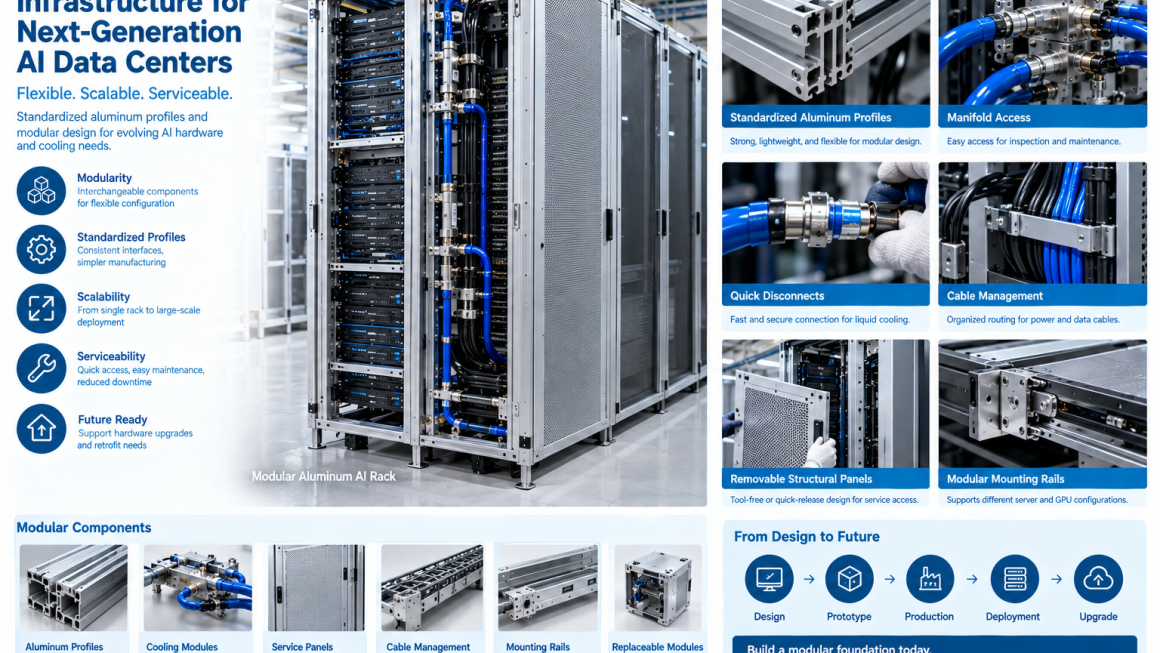
Instead of designing every rack, enclosure, bracket, cooling interface, and structural element as a fixed assembly, modular infrastructure uses standardized aluminum profiles, interchangeable components, configurable connection points, and repeatable mechanical interfaces.
The objective is not simply to make an AI rack easier to assemble.
The objective is to create infrastructure that can evolve with the hardware it supports.
What Is Modular AI Data Center Infrastructure?
Modular AI infrastructure is a system in which structural and functional components can be assembled, modified, replaced, or expanded without redesigning the entire system.
A typical modular aluminum infrastructure system may include:
- Standardized aluminum extrusion profiles
- Modular rack frames
- Adjustable mounting rails
- Removable structural panels
- Cooling support structures
- Manifold mounting brackets
- Cable management channels
- Equipment mounting interfaces
- Replaceable thermal components
- Modular enclosure sections
- Reinforcement members
- Service-access panels
Rather than treating the entire rack as one integrated structure, engineers divide it into functional modules.
For example:
Structural frame → mounting interface → cooling module → cable management → service panel → equipment module
Each module can be optimized independently while maintaining standardized interfaces with the rest of the system.
This creates a more flexible platform for changing AI hardware requirements.
Why Modularity Matters for AI Infrastructure
Traditional infrastructure often assumes relatively stable equipment configurations.
AI infrastructure operates differently.
A rack originally designed for one generation of GPU hardware may later need to accommodate:
- Higher GPU power
- Greater rack density
- Different server dimensions
- New cooling interfaces
- Larger coolant manifolds
- Additional power distribution
- Different cable configurations
- New monitoring equipment
- Additional structural reinforcement
If every component is permanently integrated, upgrading one subsystem can require extensive modification.
A modular approach changes the equation.
Instead of replacing the entire structure, engineers can replace or modify specific modules.
For example:
Old cooling bracket → New cooling bracket
Standard rail → reinforced rail
Existing cable channel → expanded cable management module
Original access panel → larger service panel
This can significantly reduce the amount of infrastructure that must be redesigned when hardware changes.
Standardized Aluminum Profiles as the Foundation
One of the most important elements of a modular aluminum structure is the use of standardized profiles.
Aluminum extrusion allows engineers to create repeatable structural geometries with:
- T-slots
- Mounting channels
- Internal cavities
- Reinforcement ribs
- Fastener interfaces
- Cable-routing spaces
- Accessory mounting points
A standardized profile can then become a building block for multiple infrastructure configurations.
For example, the same basic extrusion family may be used for:
- AI server racks
- GPU support frames
- Cooling equipment supports
- Equipment enclosures
- Cable management structures
- Edge AI cabinets
- ESS-related structural assemblies
The advantage is not simply manufacturing convenience.
Standardization creates a common mechanical language across different components.
Designing a Modular AI Rack
A modular AI rack should be designed around interfaces rather than individual components.
The structural frame establishes the main reference geometry.
From there, engineers can define standardized interfaces for:
- Server rails
- GPU assemblies
- Cold plates
- Manifolds
- Hoses
- Cable trays
- Power distribution equipment
- Sensors
- Access panels
A simplified architecture might look like:
Primary frame
↓
Equipment mounting modules
↓
Cooling modules
↓
Cable management modules
↓
Service-access modules
Each layer should be removable or replaceable without unnecessarily disturbing the others.
This is particularly important for liquid-cooled systems.
If a cooling manifold needs to be replaced, for example, the design should avoid requiring the complete rack structure to be dismantled.
Interchangeable Components Reduce Upgrade Complexity
A modular system becomes much more useful when components are interchangeable.
This requires engineers to standardize more than just profile dimensions.
Important interfaces may include:
- Hole patterns
- Slot dimensions
- Fastener types
- Mounting heights
- Rail positions
- Panel dimensions
- Connector clearance
- Hose connection locations
- Cable entry points
For example, two generations of cooling modules may have different internal designs but share the same external mounting interface.
This allows the newer module to replace the older one without redesigning the entire rack.
The principle is similar to designing a platform rather than a one-time product.
Modularity and Liquid Cooling
Liquid cooling makes modularity even more important.
A modern AI rack may include:
- Coolant distribution manifolds
- Quick-disconnect couplings
- Flexible hoses
- Cold plates
- Pumps
- Sensors
- Leak detection systems
- Drainage interfaces
These components require both thermal and mechanical integration.
A modular aluminum structure can provide dedicated mounting zones for these systems.
For example, a rack may use a standardized aluminum frame with interchangeable:
Manifold brackets
Hose management modules
Cold plate supports
Service panels
Leak containment elements
This allows cooling architecture to evolve without completely redesigning the primary structural frame.
The mechanical interface becomes the stable platform while the cooling technology can change over time.
Modular Aluminum Structures and Scalability
Scalability is another major advantage.
A data center may begin with a relatively small number of AI racks and later expand significantly.
A modular infrastructure system allows the same structural principles to be repeated across additional racks.
Instead of developing every rack independently, manufacturers can establish a standardized platform.
For example:
Module A — Primary structural frame
Module B — GPU/server mounting
Module C — Liquid cooling
Module D — Cable management
Module E — Service access
The same architecture can then be configured for different rack heights, equipment densities, or cooling requirements.
This creates a more scalable AI infrastructure strategy.
Modular Does Not Mean Structurally Weak
One misconception about modular aluminum structures is that modularity necessarily means reduced structural performance.
That is not the case.
A modular structure still needs to be engineered for:
- Static loads
- Concentrated GPU/server loads
- Rack deformation
- Torsional loads
- Vibration
- Thermal expansion
- Cooling-system loads
- Cable and hose loads
- Transportation and installation loads
The key difference is that structural strength is designed around repeatable interfaces and load paths.
Aluminum profiles can incorporate reinforcing ribs, larger sections, connection plates, and additional structural members where required.
The objective is not to use the minimum amount of material.
It is to place material where it contributes most effectively to structural performance.
Designing for Future Hardware Upgrades
Future hardware compatibility should be considered during the initial structural design.
Engineers should ask:
- Can the mounting height be adjusted?
- Can heavier hardware be supported later?
- Can the cooling system be upgraded?
- Can additional cables be accommodated?
- Can service openings be enlarged?
- Can reinforcement members be added?
- Can the power distribution architecture change?
- Can new sensors or monitoring equipment be installed?
These questions help turn a rack from a fixed product into a long-term infrastructure platform.
A useful design principle is:
Do not only design for today’s hardware. Design the interfaces for tomorrow’s hardware.
Retrofit Applications
Modularity is particularly valuable when upgrading existing data centers.
Replacing an entire rack or structural system may be expensive and disruptive.
A modular aluminum system can instead support partial retrofit.
Potential retrofit modules include:
- New GPU mounting structures
- Reinforced server rails
- Additional cooling brackets
- New manifold supports
- Cable management upgrades
- Larger access panels
- Additional thermal structures
- Equipment mounting adapters
This approach can reduce the amount of infrastructure that needs to be removed during an upgrade.
For operators, the benefit is not only material savings.
It can also mean shorter installation windows and less operational disruption.
Aluminum Extrusion Enables Configuration Flexibility
Aluminum extrusion is particularly suitable for modular infrastructure because profile geometry can be standardized while component length and machining details remain configurable.
A common manufacturing workflow may involve:
Profile design → extrusion → cutting → CNC machining → surface treatment → assembly
This allows a manufacturer to maintain a standardized extrusion platform while producing different component configurations.
For example, the same aluminum profile could be supplied in different lengths for:
- Rack vertical members
- Horizontal beams
- Equipment supports
- Cooling brackets
- Cable channels
Additional CNC machining can then create application-specific holes, slots, interfaces, and connection features.
This combination of standardized extrusion + customized machining is especially useful for low-volume prototypes, pilot production, and scalable AI hardware programs.
Modular Structures Can Support Different Manufacturing Volumes
AI infrastructure programs rarely move directly from concept to high-volume production.
A more realistic path may be:
Engineering prototype
↓
Functional prototype
↓
Pilot production
↓
Small-batch deployment
↓
Production scaling
A modular aluminum architecture can support this progression.
During prototyping, engineers can use standard profiles and flexible connection systems.
During pilot production, selected interfaces can be optimized for repeatability.
At larger production volumes, tooling, machining fixtures, assembly processes, and inspection procedures can be further standardized.
This creates a smoother transition from engineering development to production.
Modularity and Serviceability
Modular design also improves maintenance.
A component that can be independently removed is generally easier to inspect, replace, and upgrade.
This is particularly valuable in liquid-cooled AI infrastructure.
Serviceable modules may include:
- Cooling manifolds
- Quick-disconnect assemblies
- Hose supports
- Cold plate mounting structures
- Cable trays
- Structural panels
- Sensors
- Equipment brackets
However, modularity alone does not guarantee serviceability.
The design must also provide:
- Adequate tool clearance
- Connector access
- Safe isolation points
- Clear maintenance paths
- Removable panels
- Appropriate fastener access
- Space for component removal
A module should not simply be removable in theory.
It should be removable without unnecessarily disturbing adjacent systems.
Thermal Considerations in Modular Aluminum Infrastructure
Aluminum is often selected for its combination of low density, useful thermal conductivity, corrosion resistance, and manufacturability.
However, modular thermal structures still require careful engineering.
Interfaces between modules can introduce:
- Contact resistance
- Thermal gaps
- Uneven pressure
- Differential thermal expansion
- Mechanical distortion
For liquid-cooled systems, the mechanical structure must also accommodate temperature changes in:
- Aluminum frames
- Copper components
- Cold plates
- Manifolds
- Hoses
- Coolant lines
Fixed and floating mounting strategies may therefore be required.
The objective is to maintain structural stability while allowing controlled thermal movement.
Designing a Modular Infrastructure Platform
A practical modular aluminum AI infrastructure platform can be organized around several design layers.
1. Primary Structural Layer
Provides the main load-bearing framework.
Typical components include:
- Vertical profiles
- Horizontal beams
- Cross members
- Reinforcement structures
- Base structures
2. Equipment Layer
Supports servers, GPUs, power equipment, and other hardware.
3. Thermal Layer
Provides mounting and structural integration for:
- Cold plates
- Manifolds
- Hoses
- Heat spreaders
- Thermal interfaces
4. Cable Management Layer
Separates and organizes:
- Power cables
- High-speed data cables
- Control cables
- Sensor wiring
5. Service Layer
Provides:
- Removable panels
- Access openings
- Replaceable modules
- Maintenance paths
This layered architecture makes the overall system easier to configure and upgrade.
Common Mistakes in Modular AI Infrastructure Design
Making every component custom
If every bracket and profile is unique, the system may technically be modular but becomes difficult to manufacture and maintain.
Standardization should be introduced wherever practical.
Standardizing dimensions without standardizing interfaces
A common profile is not enough.
Mounting patterns, connection points, clearances, and service access also need to be considered.
Ignoring future load increases
Next-generation GPUs may significantly change rack-level structural requirements.
Future load cases should be considered during the initial design.
Designing cooling separately from structure
Liquid cooling should be mechanically integrated with the rack architecture from the beginning.
Overusing modular connections
More connection points do not automatically create a better system.
Connections still need appropriate stiffness, strength, tolerance control, and vibration resistance.
Forgetting service paths
A modular component that cannot be accessed after installation is not genuinely serviceable.
Validation of Modular Aluminum Structures
Before production deployment, modular structures should be validated under realistic conditions.
Depending on the application, testing may include:
- Static load testing
- Deflection measurement
- Connection strength testing
- Vibration testing
- Thermal cycling
- Cooling-system integration testing
- Hose and connector load testing
- Dimensional inspection
- Assembly/disassembly testing
- Serviceability validation
FEA can also help evaluate:
- Stress concentration
- Deflection
- Connection loading
- Rack deformation
- Reinforcement requirements
Physical testing remains important because real assemblies include tolerances, fasteners, interfaces, thermal gradients, and installation conditions that may not be fully captured by simulation.
From Standard Profiles to Custom AI Infrastructure
The most effective modular systems are not necessarily built from completely generic components.
A better strategy is often:
Standardize the core → customize the interface → validate the assembly
For example, a manufacturer may maintain a standardized family of aluminum profiles while customizing:
- Length
- CNC features
- Mounting holes
- Brackets
- Panels
- Cooling interfaces
- Surface treatment
- Assembly configuration
This provides a balance between engineering flexibility and manufacturing efficiency.
A Practical Development Workflow
A modular aluminum AI infrastructure project can follow a structured development process:
1. Define the hardware envelope
Identify server, GPU, cooling, power, and cable requirements.
2. Define the structural load cases
Determine current and potential future loads.
3. Establish standard interfaces
Define mounting dimensions, fasteners, connection points, and service clearances.
4. Develop the aluminum profile system
Select alloy, profile geometry, wall thickness, reinforcement, and extrusion strategy.
5. Create modular subsystems
Develop equipment, cooling, cable management, and service modules.
6. Validate mechanical and thermal performance
Combine simulation with prototype testing.
7. Optimize manufacturing
Integrate extrusion, cutting, CNC machining, surface treatment, and assembly.
8. Prepare for future configurations
Confirm that new hardware or cooling modules can be integrated without redesigning the entire structure.
Why Modular Aluminum Infrastructure Matters for the Future of AI
AI infrastructure will continue to evolve.
Future racks may operate at higher power densities, use different cooling architectures, integrate more monitoring systems, and require more sophisticated service strategies.
Infrastructure that cannot adapt may become obsolete before its structural lifetime is complete.
A modular aluminum approach provides another path.
By combining:
- Standardized aluminum profiles
- Interchangeable components
- Configurable interfaces
- Modular cooling structures
- Serviceable assemblies
- Scalable manufacturing
- Retrofit capability
engineers can create infrastructure that is designed not only for today’s AI hardware, but also for future generations.
The real value of modularity is therefore not simply faster assembly.
It is long-term adaptability.
Conclusion
Modular aluminum AI data center infrastructure provides a practical foundation for building scalable, serviceable, and upgrade-ready AI hardware environments.
Standardized aluminum extrusion profiles can form the structural platform, while interchangeable mounting, cooling, cable management, and service modules allow the infrastructure to evolve as hardware requirements change.
For AI data centers, the goal should not be to create a rack that works perfectly for one hardware generation.
The better objective is to create a structural platform that can accommodate multiple hardware generations.
From prototype development and pilot production to retrofit and large-scale deployment, modular aluminum structures can provide the flexibility required by rapidly evolving AI infrastructure.
Standardize the platform. Customize the interfaces. Build for change.