
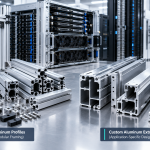

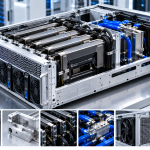
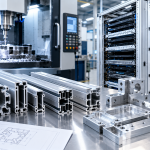
As AI data centers move toward higher rack densities, higher power levels, liquid cooling, and more modular infrastructure, material selection has become an increasingly important engineering decision.
Steel has traditionally been the dominant structural material for server racks, equipment frames, cable infrastructure, and data center support systems. Aluminum, however, offers a different combination of low weight, corrosion resistance, thermal conductivity, and manufacturing flexibility.
This raises an important question for engineers and infrastructure developers:
When should aluminum be selected instead of steel for AI data center structures?
The answer is not simply based on material strength.
The right comparison needs to consider:
- Weight
- Structural stiffness
- Strength
- Corrosion resistance
- Thermal behavior
- Manufacturing
- Installation
- Surface treatment
- Serviceability
- Lifecycle requirements
- Cost and production volume
For many applications, the best solution may not be a complete replacement of steel. A carefully engineered combination of aluminum and steel can sometimes provide a more effective overall architecture.
This article compares aluminum vs steel for AI data centers from a practical structural and manufacturing perspective.
1. Why Material Selection Matters in AI Data Centers
The physical architecture of AI computing is changing rapidly.
Modern AI infrastructure can include:
- High-density GPU racks
- Liquid cooling systems
- Cooling manifolds
- Cold plates
- High-current power distribution
- Large cable pathways
- Modular server frames
- Outdoor AI enclosures
- Edge computing systems
These applications place different demands on structural materials.
A material that works well for a conventional air-cooled server rack may not be the optimal choice for a lightweight liquid-cooled AI infrastructure platform.
Material selection therefore needs to begin with the actual application.
A useful engineering framework is:
Load Requirements → Geometry → Material → Manufacturing → Installation → Lifecycle
Rather than:
Material → Everything Else
2. Aluminum vs Steel: Basic Material Differences
At a fundamental level, aluminum and steel have very different physical characteristics.
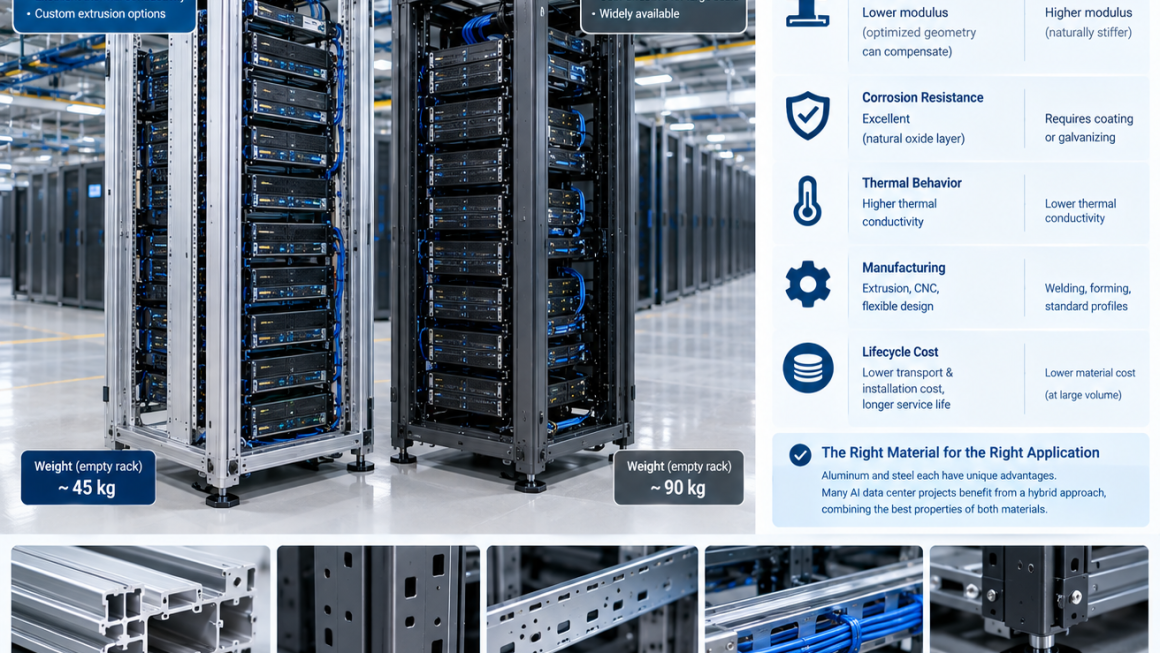
| Property | Aluminum | Steel |
|---|---|---|
| Density | Low | High |
| Elastic modulus | Lower | Higher |
| Specific strength | High for many alloys | High |
| Thermal conductivity | Relatively high | Generally lower |
| Corrosion behavior | Naturally protective oxide layer | Requires protection in many environments |
| Extrusion capability | Excellent | More limited for many structural profiles |
| Machining | Generally straightforward | Generally robust but heavier |
| Weight | Lightweight | Heavy |
| Surface treatment | Anodizing, conversion, coating | Painting, plating, galvanizing, coating |
| Recyclability | High | High |
These differences do not automatically determine which material is better.
They determine which material characteristics are available to the designer.
3. Weight: One of Aluminum’s Strongest Advantages
The density of aluminum is approximately one-third that of conventional steel.
This can create a significant advantage when structural weight becomes important.
For an AI data center structure, lower weight can help reduce:
- Installation effort
- Handling requirements
- Transportation weight
- Structural support requirements
- Retrofit constraints
- Rack movement loads
This is particularly relevant to modular infrastructure.
For example, an aluminum server rack or equipment frame may be easier to move and install than an equivalent steel structure.
However, direct comparisons should always consider structural geometry.
A steel structure and aluminum structure with identical dimensions do not necessarily provide equivalent stiffness.
The real comparison should therefore be:
Equivalent Structural Performance
rather than simply:
Equal Material Volume
4. Aluminum Server Rack vs Steel: The Weight Question
When comparing an aluminum server rack vs steel, the first question should be:
What structural performance is required?
If both racks are designed to carry the same GPU equipment and satisfy the same deformation limits, the aluminum structure may require a different profile geometry.
For example, aluminum extrusions can use:
- Larger section dimensions
- Internal cavities
- Reinforcing ribs
- Optimized wall thickness
- Integrated mounting channels
This can compensate for aluminum’s lower stiffness per unit volume.
The result can be a lightweight structure with an efficient load path.
Therefore:
Lightweight ≠ Thin
A well-engineered aluminum structure may use optimized geometry rather than simply reducing material.
5. Stiffness: Where Steel Has a Natural Advantage
Steel has a significantly higher elastic modulus than aluminum.
This means steel generally provides higher stiffness for the same cross-sectional geometry.
This can be valuable when designing:
- Long-span beams
- Heavy equipment frames
- Large structural supports
- Highly rigid rack structures
- Building-level infrastructure
For applications where deformation must be minimized and space is limited, steel can have a strong advantage.
However, this does not mean aluminum cannot provide sufficient stiffness.
The designer can modify the profile geometry.
For example:
Increase Section Height → Increase Moment of Inertia → Improve Bending Stiffness
This is one of the major advantages of aluminum extrusion.
The designer can create a larger and more structurally efficient profile without necessarily adding excessive mass.
6. Strength and Specific Strength
Steel generally offers a wide range of high-strength structural grades.
Aluminum also provides many structural alloys with different combinations of:
- Yield strength
- Tensile strength
- Elongation
- Corrosion resistance
- Extrudability
- Machinability
For AI infrastructure, the important parameter is not simply maximum tensile strength.
Engineers should evaluate:
- Working loads
- Safety factors
- Deflection
- Connection strength
- Fatigue
- Buckling
- Local deformation
For lightweight structures, specific strength—strength relative to material density—can be particularly useful.
This is one reason aluminum remains attractive for mobile, modular, and equipment-level infrastructure.
7. Corrosion Resistance
Corrosion behavior is another important difference.
Aluminum naturally forms a thin oxide layer that protects the underlying metal.
Steel, depending on grade and environment, may require:
- Painting
- Powder coating
- Galvanizing
- Plating
- Other protective systems
For indoor data centers with controlled environmental conditions, corrosion may not be a major concern.
However, it becomes more important for:
- Outdoor AI infrastructure
- Edge AI systems
- Industrial environments
- Coastal environments
- Humid environments
- Retrofit installations
In these applications, aluminum can simplify certain aspects of corrosion management.
That does not mean aluminum is immune to corrosion.
Material compatibility, surface treatment, water exposure, and galvanic interactions still need to be considered.
8. Thermal Behavior
Thermal performance is becoming increasingly important as AI rack power density rises.
Aluminum has significantly higher thermal conductivity than typical carbon steels.
This can be useful for components such as:
- Heat spreaders
- Heat sinks
- Cooling support structures
- Thermal interface components
- Cold plate structures
- Enclosures
However, thermal conductivity does not automatically mean an aluminum rack will cool an AI server better.
A structural frame is not a substitute for a properly engineered cooling system.
The primary cooling path may still be:
GPU → TIM → Cold Plate → Coolant → Manifold → CDU
The aluminum structure supports this system mechanically and can sometimes provide secondary thermal pathways.
9. Aluminum and Liquid Cooling
Liquid cooling changes the material-selection discussion.
A liquid-cooled AI rack may contain:
- Cold plates
- Manifolds
- Hoses
- Quick connectors
- Pumps
- Cooling distribution hardware
Aluminum can be useful for the structural components surrounding these systems because of its:
- Low weight
- Machinability
- Extrusion capability
- Thermal conductivity
- Corrosion resistance when properly treated
However, the compatibility of aluminum with the coolant loop must be evaluated separately.
A structural aluminum frame is not automatically suitable for direct coolant contact.
The engineer should distinguish between:
Aluminum Structural Components
and
Aluminum Wetted Components
The material requirements can be different.
10. Thermal Expansion
Aluminum generally has a higher coefficient of thermal expansion than steel.
This matters when an AI structure combines:
- Aluminum frames
- Steel rails
- Copper cold plates
- Stainless-steel fittings
- Electronic assemblies
During thermal cycling, these materials can expand and contract at different rates.
Potential consequences include:
- Interface stress
- Alignment changes
- Fastener loading
- Connector movement
- Cold plate positioning changes
Design solutions can include:
- Floating mounting points
- Controlled clearances
- Flexible interfaces
- Expansion allowances
- Appropriate joint design
The goal is not to eliminate thermal movement.
It is to make thermal movement predictable and controlled.
11. Manufacturing: Aluminum Has a Major Extrusion Advantage
Manufacturing is one area where aluminum can offer a particularly strong advantage for AI infrastructure.
Aluminum extrusion allows complex structural profiles to be produced continuously.
A custom AI rack profile can incorporate:
- Mounting channels
- Internal cavities
- Reinforcing ribs
- Cable routing features
- Bracket interfaces
- Fastener channels
This can reduce the number of separate parts required.
A steel rack may rely more heavily on:
- Formed sheet metal
- Welded structures
- Stamped components
- Separate brackets
Neither manufacturing method is universally better.
The optimal approach depends on:
Volume + Geometry + Tolerance + Tooling + Assembly + Cost
12. CNC Machining and Hybrid Aluminum Structures
Aluminum also works well with CNC machining.
A typical AI infrastructure component can be manufactured through:
Extrusion → Cutting → CNC Machining → Deburring → Surface Treatment → Assembly
CNC machining can create precise:
- Mounting holes
- Threads
- Counterbores
- Connector interfaces
- Cooling interfaces
- Bracket locations
This makes aluminum particularly useful for customized AI infrastructure where the geometry may evolve during development.
13. Steel Manufacturing Still Has Important Advantages
Steel remains an extremely important material for data center infrastructure.
It is particularly attractive for:
- Heavy-duty structural frames
- Building-level supports
- Large equipment bases
- Long-span structures
- High-load applications
- Standardized rack systems
Steel also benefits from a mature global supply chain and a wide range of standard structural products.
For large fixed infrastructure where weight is less important, steel can remain the most economical option.
The objective should therefore be application optimization, not material replacement for its own sake.
14. Aluminum vs Steel for Modular AI Infrastructure
Modularity changes the equation.
A modular AI platform may need to be:
- Shipped
- Moved
- Installed
- Reconfigured
- Expanded
- Serviced
Lower structural weight can provide benefits at each stage.
Aluminum is therefore particularly interesting for:
- Modular server frames
- Edge AI enclosures
- Compact AI infrastructure
- Equipment skids
- Portable systems
- Retrofit structures
Steel may remain preferable where the infrastructure is permanently installed and very high structural stiffness is the dominant requirement.
15. Installation and Handling
The material choice also affects installation.
A lighter aluminum structure can reduce:
- Manual handling effort
- Lifting requirements
- Installation time
- Transportation weight
This can become especially valuable for modular systems assembled in constrained spaces.
However, installation savings should be evaluated at the system level.
A lightweight aluminum frame combined with very heavy steel brackets and other components may not provide the expected overall benefit.
16. Lifecycle Considerations
Material selection should not stop at the initial purchase price.
A lifecycle assessment may consider:
- Manufacturing
- Transportation
- Installation
- Maintenance
- Corrosion protection
- Replacement
- Reconfiguration
- Recycling
Aluminum’s low density can reduce transportation weight.
Its corrosion resistance can reduce certain maintenance requirements.
Its extrusion-based modularity can also make component replacement or redesign easier in some applications.
Steel, on the other hand, may offer long service life and excellent structural robustness when appropriately protected.
The correct comparison therefore depends on the expected operating environment and lifecycle strategy.
17. Surface Treatment Comparison
Surface treatment is another area where the materials behave differently.
Aluminum
Common options include:
- Anodizing
- Chemical conversion
- Powder coating
- Mechanical finishing
Steel
Common options include:
- Powder coating
- Painting
- Galvanizing
- Plating
For aluminum AI infrastructure, anodizing can provide a durable surface while preserving the characteristic metallic appearance.
For steel structures exposed to harsh environments, galvanizing or robust coating systems may provide useful corrosion protection.
The correct treatment should be selected based on the environment and function of the component.
18. Galvanic Corrosion in Mixed-Material Structures
Using aluminum and steel together introduces another consideration.
When dissimilar metals are electrically connected in the presence of an electrolyte, galvanic corrosion can occur under suitable conditions.
This is particularly relevant when aluminum is connected to:
- Carbon steel
- Stainless steel
- Copper
Potential solutions include:
- Electrical isolation
- Suitable coatings
- Isolation washers
- Compatible fasteners
- Controlled drainage
- Appropriate joint design
This does not mean aluminum and steel cannot be used together.
In fact, hybrid structures can be highly effective when the interfaces are properly engineered.
19. Aluminum + Steel Hybrid Structures
In some AI infrastructure applications, the best answer may be both materials.
For example:
Steel → Primary building or heavy support structure
Aluminum → Equipment-level frame
Aluminum → Thermal components
Steel → Heavy-duty mounting base
This allows each material to perform the function where it has the greatest advantage.
A hybrid architecture might look like:
Steel Facility Structure
↓
Steel Rack Support
↓
Aluminum AI Equipment Frame
↓
Aluminum Thermal / Cooling Components
This can reduce weight at the equipment level while preserving the stiffness and load capacity of the primary facility structure.
20. When Aluminum Is a Strong Candidate
Aluminum should be seriously considered when the application prioritizes:
- Low weight
- Modular construction
- Custom extrusion
- Thermal functionality
- Corrosion resistance
- Rapid design changes
- CNC machining
- Easy handling
- Equipment-level integration
Typical applications include:
- AI server frames
- GPU chassis
- Cable trays
- Cooling support structures
- Heat sinks
- Heat spreaders
- Edge AI enclosures
- Lightweight equipment frames
21. When Steel May Be the Better Choice
Steel can remain the better choice when the application requires:
- Very high stiffness
- Heavy structural loading
- Long unsupported spans
- Large fixed structures
- Standardized heavy-duty components
- High impact resistance
- Lowest structural material cost at large scale
Typical applications may include:
- Building-level support systems
- Heavy equipment foundations
- Large structural frames
- Certain high-load rack systems
- Facility-level infrastructure
The decision should always be based on actual engineering requirements.
22. Aluminum vs Steel: Application-Level Comparison
| Requirement | Aluminum | Steel |
|---|---|---|
| Low weight | Excellent | Moderate |
| Specific strength | Excellent | Excellent |
| Absolute stiffness | Moderate | Excellent |
| Thermal conductivity | Higher | Lower |
| Corrosion resistance | Good | Requires protection depending on environment |
| Custom extrusion | Excellent | More limited |
| CNC machining | Excellent | Good |
| Modular equipment frames | Excellent | Good |
| Heavy fixed structures | Good | Excellent |
| Outdoor equipment | Strong candidate | Strong with appropriate protection |
| Liquid-cooling support | Strong candidate | Suitable |
| Heat-spreading components | Excellent | Limited compared with aluminum |
| Lightweight retrofit | Excellent | Less favorable |
| Large structural spans | Good with optimized geometry | Excellent |
The table illustrates an important point:
Neither material wins every category.
The engineering objective is to match the material to the application.
23. Cost: Material Price Is Only One Variable
A common mistake is to compare aluminum and steel solely on material price per kilogram.
This can be misleading.
The total cost may include:
- Raw material
- Extrusion tooling
- Machining
- Welding
- Surface treatment
- Fasteners
- Assembly
- Transportation
- Installation
- Maintenance
Because aluminum is lightweight, transportation and handling may be reduced.
Because extrusion can integrate multiple functions, part count and assembly labor may also change.
On the other hand, steel may have an advantage in high-volume standardized structures.
Therefore, the appropriate comparison is:
Total Cost of Ownership
rather than simply:
Material Price
24. Production Volume Changes the Economics
The manufacturing strategy should match the development stage.
Prototype
Possible approach:
Standard Aluminum Profile + CNC Machining
This provides flexibility and avoids premature tooling investment.
Pilot Production
Possible approach:
Semi-Custom Extrusion + CNC + Secondary Fabrication
Production
Possible approach:
Dedicated Aluminum Extrusion + Optimized Machining + Assembly
Steel fabrication may follow a different cost structure depending on welding, stamping, forming, and coating requirements.
The correct process depends on production volume and design stability.
25. Structural Optimization Can Change the Material Decision
The most interesting question is not:
Is aluminum stronger than steel?
It is:
Can aluminum achieve the required structural performance at a lower system weight and acceptable total cost?
For example, an optimized aluminum extrusion can increase section stiffness through geometry.
A simplified design strategy might be:
Steel Plate
→ Increase Thickness
versus
Aluminum Extrusion
→ Increase Section Depth
→ Add Internal Ribs
→ Integrate Mounting Features
→ Optimize Load Path
The second approach may produce a more efficient equipment-level structure even though aluminum itself has lower modulus.
26. AI Data Center Applications Where Aluminum Can Add Value
Aluminum is particularly attractive where structural and thermal functions overlap.
Examples include:
AI Server Frames
Structural support for GPUs, power systems, and cooling hardware.
GPU Chassis
Lightweight structural architecture around high-density accelerator modules.
Cable Trays
Lightweight pathways for power, data, and control cables.
Cooling Structures
Supports for manifolds, hoses, cold plates, and cooling interfaces.
Heat Spreaders
Components designed to distribute localized thermal loads.
Edge AI Enclosures
Lightweight, corrosion-resistant outdoor equipment housings.
Modular AI Infrastructure
Reconfigurable frames that can be shipped, installed, and expanded efficiently.
27. A Practical Material Selection Workflow
For an AI infrastructure project, engineers can use the following process.
Step 1: Define the Load
Determine:
- Equipment weight
- Concentrated loads
- Dynamic loads
- Required safety factors
Step 2: Define the Stiffness Requirement
Establish allowable:
- Deflection
- Alignment tolerance
- Vibration response
Step 3: Define the Environment
Consider:
- Indoor/outdoor
- Humidity
- Corrosion
- Temperature
- Chemical exposure
Step 4: Define Thermal Requirements
Identify:
- Heat sources
- Cooling interfaces
- Thermal pathways
- Temperature range
Step 5: Compare Manufacturing Options
Evaluate:
- Extrusion
- CNC machining
- Sheet fabrication
- Welding
- Assembly
Step 6: Compare Lifecycle Cost
Consider:
- Material
- Manufacturing
- Logistics
- Installation
- Maintenance
- Recycling
Step 7: Select Aluminum, Steel, or Hybrid
The final decision should be based on system-level performance.
28. The Future of AI Infrastructure Materials
As AI infrastructure becomes more distributed and modular, material selection is likely to become increasingly application-specific.
Future AI infrastructure may combine:
- High-strength aluminum alloys
- Steel primary structures
- Copper thermal components
- Advanced thermal interface materials
- Composite materials
- Functional surface treatments
Instead of searching for one universal material, engineers can assign each material a specific role.
This creates a layered material strategy:
Building Structure → Steel
Equipment Structure → Aluminum
Thermal Interface → Aluminum / Copper / Advanced Materials
Cooling Circuit → Application-Specific Compatible Materials
Protective Surface → Engineered Coating
This approach can optimize the entire physical infrastructure rather than one component.
29. Aluminum or Steel? A Practical Decision Matrix
For many AI infrastructure projects, the decision can be summarized as follows.
Choose Aluminum When:
- Weight reduction is important
- The structure is equipment-level
- Custom extrusion provides value
- Thermal integration matters
- Modular design is required
- Corrosion resistance is important
- CNC customization is expected
- Frequent design changes are likely
Choose Steel When:
- Maximum stiffness dominates
- Loads are extremely high
- Structures are large and fixed
- Long spans are required
- Standard heavy-duty structures are available
- Weight is not a major constraint
Consider Hybrid Construction When:
- Building-level stiffness is required
- Equipment-level weight should be reduced
- Thermal components benefit from aluminum
- Multiple material functions can be separated
- Mechanical interfaces can be properly isolated
Choose the Material Around the Application
The question of aluminum vs steel for AI data centers should not be reduced to which material is universally stronger, cheaper, or lighter.
Steel remains an excellent choice for heavy-duty, high-stiffness, fixed infrastructure.
Aluminum offers significant advantages when low weight, extrusion flexibility, thermal functionality, corrosion resistance, modularity, and equipment-level integration become important.
For an aluminum server rack vs steel comparison, the most meaningful question is therefore:
Which material can deliver the required structural, thermal, manufacturing, and lifecycle performance for the specific AI infrastructure application?
In many cases, the answer will be aluminum.
In others, it will be steel.
And increasingly, the most efficient solution may be a combination of both.
The engineering decision can be summarized as:
Load → Stiffness → Environment → Thermal Requirements → Manufacturing → Lifecycle → Material Selection
For AI infrastructure developers, this approach creates opportunities to use aluminum where its advantages are strongest—such as AI server frames, GPU chassis, cable trays, cooling structures, heat-spreading components, and lightweight data center structures—while retaining steel where its high stiffness and heavy-duty structural performance provide greater value.
The goal is not to replace steel with aluminum.
The goal is to build better AI infrastructure by using the right material in the right structural role.