
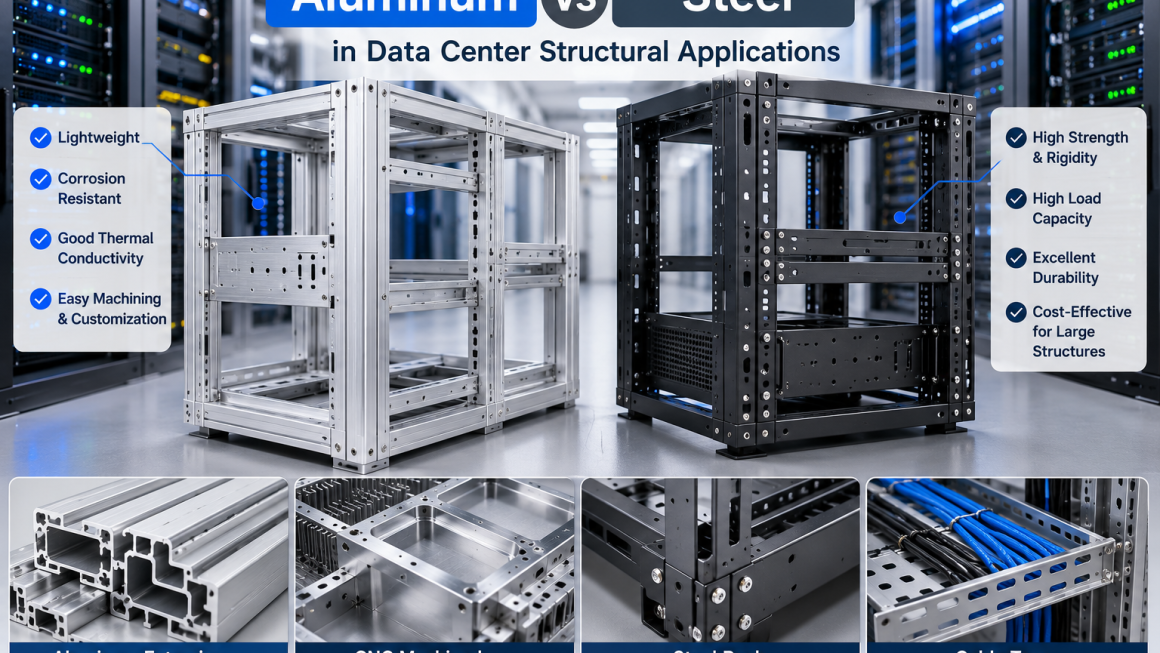
The rapid expansion of artificial intelligence (AI) infrastructure has increased demand for reliable, scalable, and mechanically robust data center systems. While processors, networking equipment, and cooling technologies often receive significant attention, structural materials remain a fundamental part of modern data center engineering.
Structural components support server racks, computing equipment, liquid cooling systems, cable management assemblies, and power distribution hardware. Their material selection influences mechanical performance, manufacturing methods, installation efficiency, maintenance accessibility, and long-term operational stability.
Among the most widely used structural materials are aluminum and steel. Both have well-established industrial applications, yet they offer different engineering characteristics that make them suitable for different environments and design objectives.
Rather than considering one material as universally superior, engineers typically evaluate aluminum and steel according to the specific mechanical, thermal, manufacturing, and lifecycle requirements of each project.
This article compares aluminum and steel in the context of AI data center structural applications and discusses factors that may influence material selection.
The Role of Structural Systems in Data Centers
A modern AI data center is composed of numerous interconnected mechanical systems.
Typical structural components include:
- Server chassis
- Equipment racks
- Mounting rails
- Structural frames
- Cooling equipment supports
- Cable trays
- Pipe support brackets
- Equipment enclosures
These structures must provide:
- Mechanical stability
- Dimensional accuracy
- Long-term durability
- Accessibility for maintenance
- Compatibility with cooling systems
- Support for future expansion
Material selection directly affects how these objectives are achieved.
Aluminum in Data Center Structures
Aluminum alloys are widely used throughout the electronics and computing industries.
Typical applications include:
- Server frames
- Equipment enclosures
- Heat sink supports
- Modular rack components
- Cable management systems
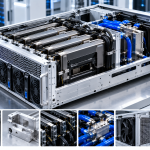
- Liquid cooling support structures
Advantages of Aluminum
Lightweight Construction
Aluminum has a relatively low density compared with steel.
Reducing structural weight may assist with:
- Equipment transportation
- Installation
- Modular assembly
- Handling of large infrastructure projects
Weight reduction may also simplify maintenance where components require frequent replacement or repositioning.
Good Thermal Conductivity
Aluminum provides significantly higher thermal conductivity than most structural steels.
Although structural members are not primary cooling devices, aluminum components may contribute to:
- Heat spreading
- Thermal integration
- Mechanical support for cooling assemblies
This characteristic is particularly useful where structural components are positioned near heat-generating equipment.
Manufacturing Flexibility
Aluminum supports multiple manufacturing methods, including:
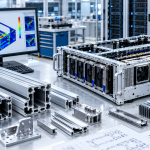
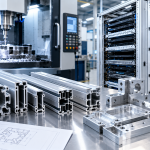
- CNC machining
- Extrusion
- Sheet metal fabrication
- Die casting
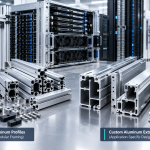
Extruded aluminum profiles are especially common in modular structural systems because they combine design flexibility with efficient manufacturing.
Corrosion Resistance
Aluminum naturally develops a protective oxide layer.
Additional surface treatments such as anodizing or protective coatings may further improve corrosion resistance depending on the operating environment.
Steel in Data Center Structures
Steel remains one of the most widely used engineering materials for industrial infrastructure.
Applications commonly include:
- Heavy-duty server racks
- Equipment cabinets
- Structural bases
- Floor support systems
- Mechanical framework
- Facility infrastructure
Advantages of Steel
High Structural Strength
Steel offers high mechanical strength and stiffness, making it suitable for applications involving substantial static or dynamic loads.
Examples include:
- Large equipment cabinets
- High-capacity rack structures
- Structural supports for mechanical equipment
Rigidity
Steel generally provides greater stiffness than aluminum for equivalent structural configurations.
This characteristic may be beneficial where minimizing structural deflection is a primary design objective.
Established Industrial Supply Chain
Steel fabrication technologies are widely available and support:
- Welding
- Forming
- Machining
- Surface finishing
This contributes to broad manufacturing capability across many industrial sectors.
Weight Comparison
One of the most noticeable differences between aluminum and steel is density.
Aluminum is considerably lighter than steel.
For data center projects, lower structural weight may contribute to:
- Easier transportation
- Reduced installation effort
- Simplified modular deployment
- Lower handling requirements
However, the significance of weight reduction depends on project requirements. Permanent facility structures may prioritize structural capacity over minimum weight.
Thermal Considerations
Thermal management is increasingly important as AI computing density continues to rise.
Aluminum
Because of its relatively high thermal conductivity, aluminum is often selected for components that interact closely with cooling systems.
Examples include:
- Heat sink structures
- Cold plate supports
- Liquid cooling frames
Steel
Steel generally has lower thermal conductivity than aluminum.
As a result, steel structures are typically selected primarily for their mechanical properties rather than their contribution to thermal performance.
Manufacturing Considerations
Material selection also depends on manufacturing strategy.
Aluminum Manufacturing
Typical processes include:
- Precision CNC machining
- Extrusion
- Laser cutting
- Sheet metal bending
- Surface anodizing
These methods are well suited for customized and modular components.
Steel Manufacturing
Common steel fabrication methods include:
- Welding
- Forming
- Structural fabrication
- Machining
- Powder coating
Steel is frequently used where robust welded structures are required.
Application Examples
Server Chassis
Aluminum is commonly selected because of its lightweight properties and compatibility with thermal management systems.
Equipment Racks
Both aluminum and steel are used depending on design priorities.
Steel is often chosen for higher load-bearing structures, while aluminum may be considered where reduced weight and modularity are advantageous.
Liquid Cooling Infrastructure
Mechanical supports for liquid cooling equipment may use aluminum because of its compatibility with thermal systems and machining flexibility.
Steel may be incorporated into larger support assemblies where additional structural capacity is required.
Cable Management
Cable trays, routing channels, and mounting brackets may be manufactured from either material depending on:
- Load requirements
- Environmental conditions
- Installation methods
- Project specifications
Hybrid Structural Designs
Many modern AI infrastructure systems combine aluminum and steel rather than relying exclusively on one material.
Examples include:
- Steel rack frames with aluminum equipment panels
- Aluminum cooling assemblies mounted within steel cabinets
- Hybrid modular support structures
Hybrid designs allow engineers to optimize different portions of the system according to their functional requirements.
Future Trends
Several developments may influence structural material selection in AI infrastructure.
Modular Data Center Design
Standardized modular systems may increase demand for lightweight structural components that simplify transportation and installation.
Advanced Manufacturing
Precision CNC machining, automated fabrication, and digital manufacturing technologies continue to expand the design possibilities for both aluminum and steel components.
Multi-Material Engineering
Future structural systems may integrate:
- Aluminum
- Steel
- Engineering polymers
- Composite materials
to achieve application-specific combinations of strength, weight, thermal performance, and manufacturability.
Both aluminum and steel play important roles in AI data center structural applications. Aluminum offers advantages in lightweight construction, thermal conductivity, corrosion resistance, and manufacturing flexibility, making it well suited for server structures, modular assemblies, and cooling-related components.
Steel continues to provide excellent structural strength and rigidity for equipment racks, support systems, and facility infrastructure where high load capacity is required.
Rather than selecting materials based on a single characteristic, engineers typically evaluate project-specific requirements such as mechanical performance, thermal integration, manufacturing methods, maintenance needs, and lifecycle considerations.
As AI infrastructure continues to evolve, hybrid structural designs combining aluminum, steel, and other advanced materials are expected to remain an important approach for balancing performance, reliability, and manufacturing efficiency.