
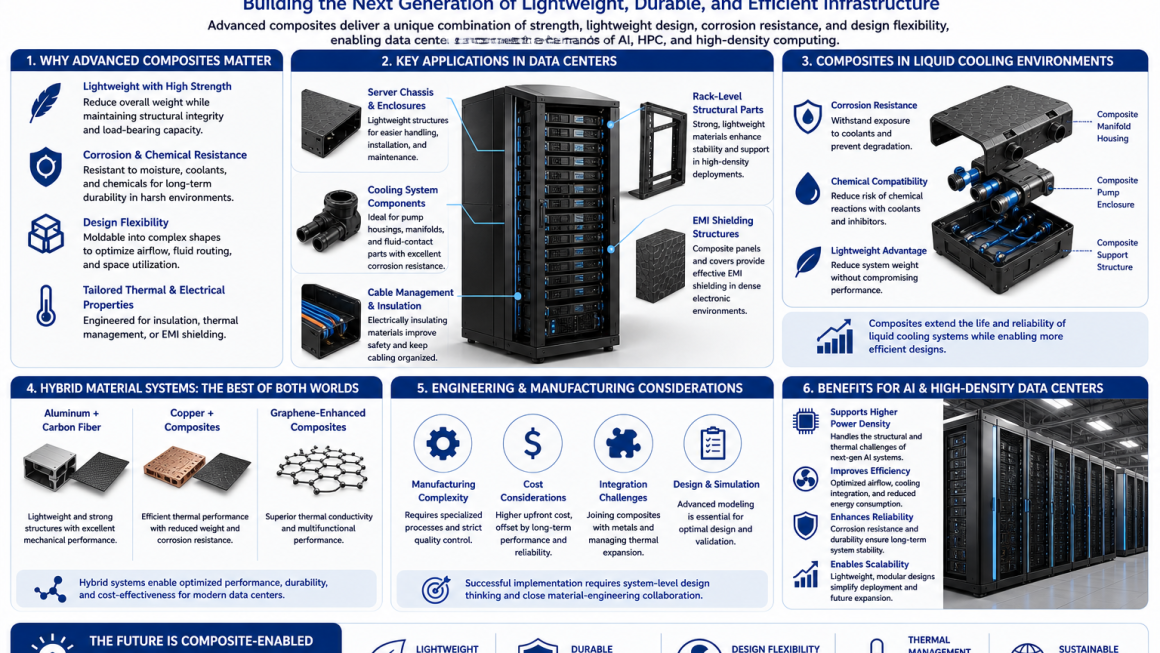
Rethinking Materials in Modern Data Centers
As data centers evolve to support AI, HPC, and high-density workloads, traditional materials alone are no longer sufficient.
With:
- Increasing rack power density (50kW → 100kW+)
- Complex liquid cooling systems
- Heavy GPU and server configurations
👉 There is a growing need for materials that combine strength, lightweight properties, and thermal performance.
Advanced composites are emerging as a key solution.
1. What Are Advanced Composites?
Advanced composites are engineered materials that combine:
- Reinforcing elements (e.g., carbon fiber, glass fiber)
- Matrix materials (e.g., polymers, resins, metals)
Common types:
- Carbon fiber composites
- Glass fiber reinforced polymers (GFRP)
- Hybrid composites (carbon + metal systems)
👉 These materials are designed to deliver superior mechanical and functional performance compared to traditional materials.
2. Why Composites Matter in Data Centers
Lightweight with High Strength
- Significant weight reduction vs steel or copper
- High structural integrity
Corrosion Resistance
- Resistant to moisture and chemical exposure
- Ideal for liquid-cooled environments
Design Flexibility
- Can be molded into complex shapes
- Enables optimized airflow and fluid routing
Thermal and Electrical Properties
- Can be engineered for insulation or conduction
- Useful for EMI shielding and thermal management
👉 Composites enable new design possibilities not achievable with metals alone.
3. Key Applications in Data Centers
Server Chassis and Enclosures
- Lightweight structures reduce overall rack load
- Improved handling and installation
Rack-Level Structural Components
- Enhanced load-bearing capacity with reduced mass
- Better stability in high-density deployments
Cooling System Components
- Housings for pumps, manifolds, and piping
- Corrosion-resistant fluid-contact structures
Cable Management and Insulation
- Electrically insulating materials improve safety
- Organized system integration
EMI Shielding Structures
- Composite layers can provide effective shielding
- Important in dense electronic environments
4. Composites in Liquid Cooling Environments
Advanced composites offer strong advantages in liquid cooling systems:
- Corrosion resistance vs metal degradation
- Reduced risk of chemical interaction with coolants
- Lightweight alternatives for non-critical thermal components
They are particularly suitable for:
- Manifold housings
- Pump enclosures
- Structural supports around cooling loops
👉 Composites complement metals rather than replace them.
5. Hybrid Material Systems: The Best of Both Worlds
The future of data center design lies in hybrid material integration.
Typical combinations:
- Aluminum + carbon fiber (lightweight + structural strength)
- Copper + composite structures (thermal + mechanical balance)
- Graphene-enhanced composites (thermal + functional performance)
👉 Hybrid systems allow engineers to:
- Optimize weight
- Improve thermal efficiency
- Enhance durability
- Control cost
6. Engineering and Manufacturing Considerations
While composites offer advantages, they require careful engineering:
Manufacturing Complexity
- Specialized processes (layup, molding, curing)
- Quality control is critical
Cost Considerations
- Higher upfront material and production cost
- Offset by long-term performance and durability
Integration Challenges
- Joining composites with metals
- Managing thermal expansion differences
👉 Successful implementation requires system-level design thinking.
7. Benefits for AI and High-Density Data Centers
In modern AI infrastructure, composites help address:
- Weight challenges in GPU-heavy systems
- Structural stability at rack level
- Corrosion risks in liquid cooling environments
- Scalability requirements for large deployments
👉 This makes them highly relevant for:
- Hyperscale data centers
- Edge AI deployments
- High-performance computing systems
A New Material Layer for Data Center Design
Advanced composites are not just alternative materials—they represent a new design layer in data center engineering.
By combining:
- Lightweight strength
- Corrosion resistance
- Design flexibility
They enable more efficient, scalable, and reliable infrastructure.
👉 As AI systems continue to evolve, advanced composites will play a critical role in shaping the next generation of data center architecture.