

Why Materials Are Becoming the Bottleneck
As AI systems scale to unprecedented levels of performance, traditional materials such as aluminum and copper are approaching their limits.
With:
- 1000W+ AI accelerators
- Ultra-high-density server architectures
- Advanced liquid and immersion cooling systems
👉 The next breakthrough is no longer just in chips or cooling—but in materials.
Carbon-based materials—including graphene, carbon nanotubes (CNTs), and advanced carbon composites—are emerging as key enablers for the next generation of AI infrastructure.
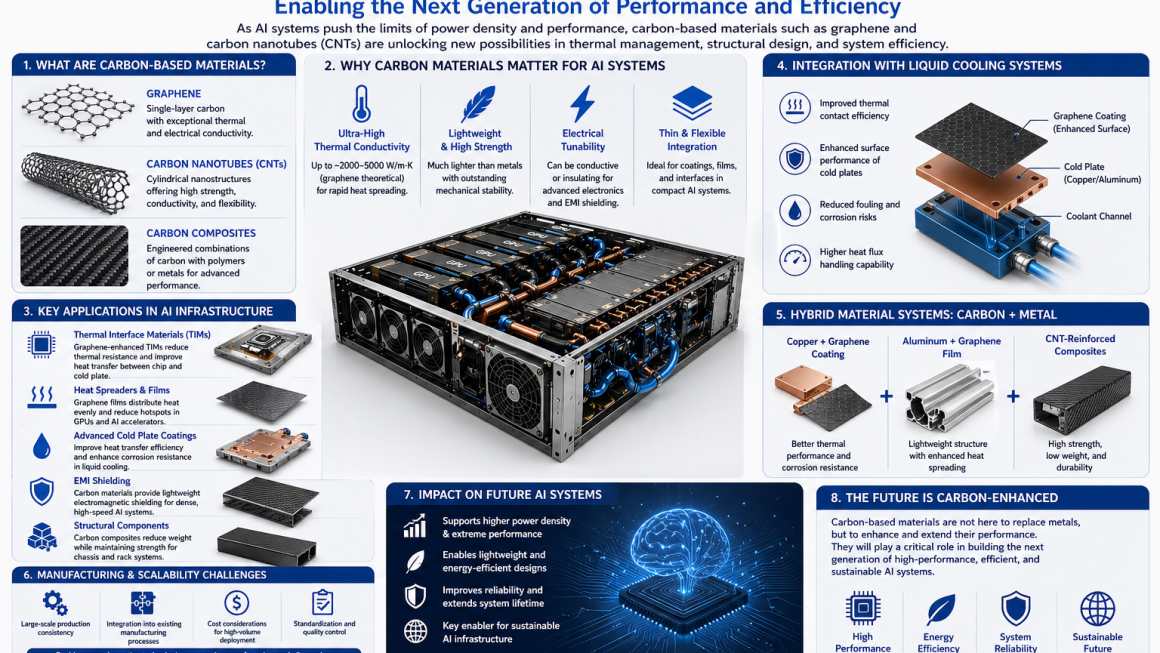
1. What Are Carbon-Based Materials?
Carbon-based materials are engineered structures built from carbon atoms with unique physical properties.
Key types:
- Graphene – single-layer carbon with exceptional thermal and electrical conductivity
- Carbon Nanotubes (CNTs) – cylindrical nanostructures with high strength and conductivity
- Carbon Composites – engineered materials combining carbon with polymers or metals
👉 These materials offer unmatched combinations of thermal, mechanical, and electrical performance.
2. Why Carbon Materials Matter for AI Systems
Ultra-High Thermal Conductivity
- Graphene: up to ~2000–5000 W/m·K (theoretical)
- Enables rapid heat spreading at chip level
Lightweight with High Strength
- Significantly lighter than metals
- High mechanical stability
Electrical Tunability
- Can be conductive or insulating depending on structure
- Useful for EMI shielding and advanced electronics
Thin and Flexible Integration
- Ideal for coatings, films, and interface materials
👉 These properties directly address thermal, structural, and integration challenges in AI systems.
3. Key Applications in AI Infrastructure
Thermal Interface Materials (TIMs)
- Graphene-enhanced TIMs reduce thermal resistance
- Improve heat transfer between chip and cold plate
Heat Spreaders and Films
- Graphene films distribute heat evenly
- Reduce hotspots in GPUs and AI accelerators
Advanced Cold Plate Coatings
- Improve heat transfer efficiency
- Enhance corrosion resistance in liquid cooling
EMI Shielding
- Carbon materials provide lightweight electromagnetic shielding
- Important in dense AI systems
Structural Components
- Carbon composites reduce weight while maintaining strength
- Useful in chassis and high-density rack systems
4. Integration with Liquid Cooling Systems
Carbon-based materials complement existing cooling technologies:
- Improve thermal contact efficiency in direct-to-chip cooling
- Enhance surface performance of cold plates
- Reduce fouling and corrosion risks with advanced coatings
- Enable higher heat flux handling
👉 Instead of replacing metals, carbon materials enhance and extend their performance.
5. Manufacturing and Scalability Challenges
Despite their advantages, carbon materials face challenges:
- Large-scale production consistency
- Integration into existing manufacturing processes
- Cost considerations for high-volume deployment
- Standardization and quality control
However, rapid progress in:
- Coating technologies
- Composite manufacturing
- Pilot-scale production
is making these materials increasingly viable for industrial use.
6. The Role of Hybrid Material Systems
The future is not “carbon vs metal”—it is carbon + metal systems.
Examples:
- Copper cold plates with graphene coatings
- Aluminum structures with carbon-enhanced surfaces
- CNT-reinforced composites for structural components
👉 Hybrid systems deliver:
- High thermal performance
- Reduced weight
- Improved durability
- Cost optimization
7. Why This Matters for Future AI Systems
As AI infrastructure evolves:
- Power density will continue to increase
- Thermal constraints will tighten
- Efficiency and reliability will become critical
Carbon-based materials enable:
- Better thermal management at extreme loads
- Lightweight and scalable system design
- Longer system lifetimes
👉 They are a key enabling layer for next-generation AI hardware.
Materials Will Define the Next Leap
The future of AI systems will not be defined by compute alone—but by the materials that support it.
Carbon-based materials offer:
- Breakthrough thermal performance
- Structural advantages
- New possibilities in system design
👉 Companies that adopt and integrate these materials early will gain a significant competitive advantage in AI infrastructure.