
AI Is Expanding Beyond the Data Center
AI infrastructure is rapidly evolving.
What began as centralized cloud computing is now expanding toward:
- Edge AI systems
- Distributed computing architectures
- Real-time intelligent devices
- Autonomous and industrial AI platforms
This transformation creates a new engineering challenge:
👉 How do we deliver high-performance AI computing in smaller, denser, and thermally constrained environments?
The answer increasingly depends on:
- Advanced thermal management
- Efficient system integration
- Next-generation materials
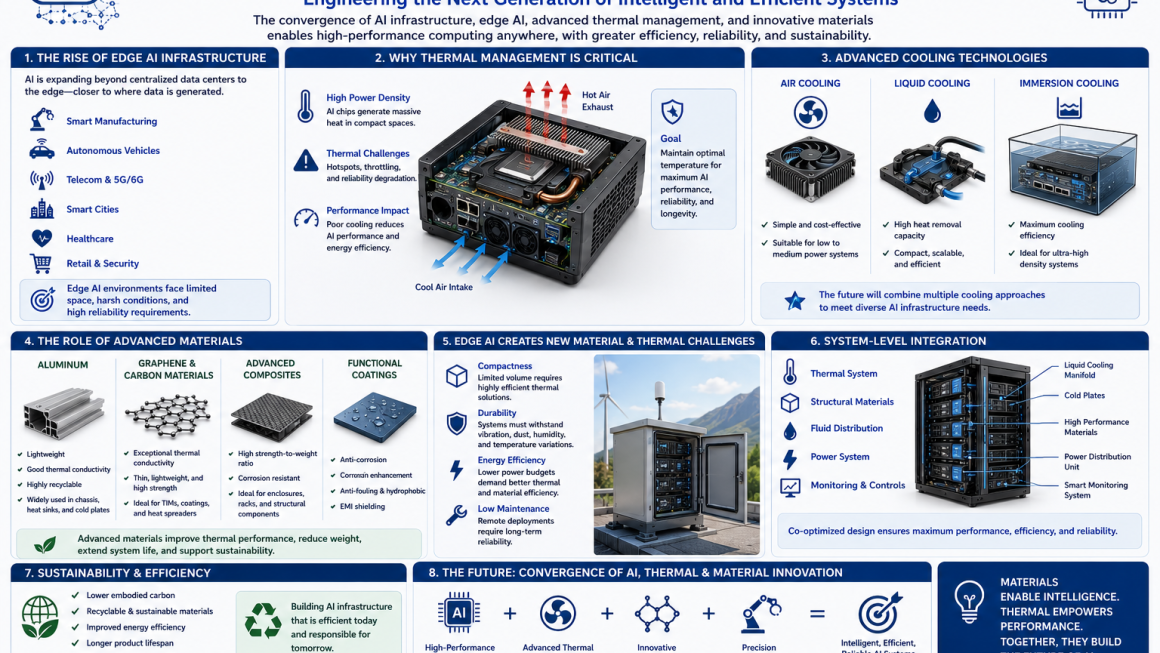
1. The Rise of Edge AI Infrastructure
Edge AI refers to deploying AI processing closer to where data is generated.
Typical edge AI environments:
- Smart factories
- Autonomous vehicles
- Telecom infrastructure
- Medical systems
- Retail and smart cities
Unlike hyperscale data centers, edge systems operate under:
- Limited space
- Restricted airflow
- Variable environmental conditions
- Lower maintenance accessibility
👉 This makes thermal and mechanical design significantly more challenging.
2. Why Thermal Management Is Critical
Modern AI accelerators generate extremely high heat densities.
In edge environments:
- Cooling space is limited
- Airflow may be restricted
- Systems must remain compact and reliable
Key thermal challenges:
- Hotspot formation
- Thermal throttling
- Reliability degradation
- Increased energy consumption
👉 Efficient thermal management becomes essential for maintaining AI performance and system stability.
3. Advanced Cooling Technologies for AI Infrastructure
Air Cooling
Still widely used for:
- Smaller edge devices
- Lower-power AI systems
Advantages:
- Simplicity
- Lower cost
Limitations:
- Reduced efficiency at high power density
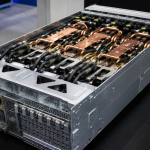
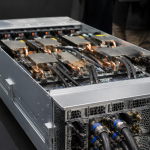
Liquid Cooling
Increasingly adopted for:
- High-density GPU systems
- AI edge servers
- Compact compute nodes
Benefits:
- Higher heat removal capability
- Reduced thermal resistance
- Better scalability
Technologies include:
- Direct-to-chip cooling
- Cold plate systems
- Rack-level liquid cooling
Immersion Cooling
Emerging for:
- Ultra-high-density AI systems
- Specialized edge deployments
Advantages:
- Extremely efficient heat transfer
- Compact system design
- Reduced airflow dependence
👉 Future AI infrastructure will likely combine multiple cooling approaches.
4. The Role of Advanced Materials
As thermal and structural demands increase, traditional materials alone are no longer sufficient.
Advanced materials help improve:
- Heat transfer
- Weight reduction
- Structural integrity
- Reliability
Aluminum
Widely used because of:
- Lightweight properties
- Good thermal conductivity
- Scalability for large systems
Applications:
- Chassis
- Heat sinks
- Cooling structures
- Rack systems
Graphene and Carbon-Based Materials
Emerging applications:
- Thermal interface materials (TIMs)
- Heat spreaders
- Conductive coatings
- EMI shielding
Advantages:
- Exceptional thermal conductivity
- Thin and lightweight integration
- Improved hotspot management
Advanced Composites
Used for:
- Lightweight structural components
- Corrosion-resistant cooling structures
- High-strength rack systems
Benefits:
- Reduced server weight
- Better structural efficiency
- Enhanced durability
👉 Future AI systems will increasingly rely on hybrid material architectures.
5. Edge AI Creates New Material Challenges
Unlike centralized data centers, edge AI systems require:
Compactness
- Limited physical volume
- Dense component integration
Durability
- Exposure to vibration, dust, humidity, and temperature variation
Energy Efficiency
- Lower power budgets
- Thermal efficiency becomes critical
Low Maintenance
- Remote deployments require long-term reliability
👉 Materials and thermal systems must now support both performance and environmental resilience.
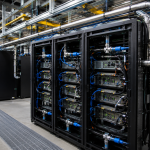
6. Rack-Level and System-Level Integration
Modern AI infrastructure is no longer designed component-by-component.
Instead, systems are engineered holistically:
- Thermal systems
- Structural materials
- Fluid distribution
- Power systems
- Monitoring and controls
This requires:
- Co-optimization between cooling and structure
- Modular architectures
- Intelligent thermal monitoring
👉 AI infrastructure is becoming a fully integrated engineering ecosystem.
7. Sustainability and Efficiency
Future AI growth must also address sustainability.
Advanced materials contribute by:
- Reducing cooling energy demand
- Lowering structural weight
- Extending equipment lifespan
- Supporting recyclable system design
Examples:
- Recyclable aluminum structures
- Lightweight composites reducing transportation impact
- Graphene-enhanced cooling efficiency
👉 Sustainability is increasingly tied directly to material innovation.
8. The Future: Convergence of AI, Thermal Engineering, and Materials Science
Over the next decade:
- AI hardware density will continue increasing
- Edge AI deployments will accelerate
- Thermal constraints will intensify
This will drive convergence between:
- AI infrastructure engineering
- Advanced cooling technologies
- Materials science
- Manufacturing innovation
👉 The companies leading future AI infrastructure will not only design chips—they will master the integration of:
- Thermal systems
- Structural engineering
- Advanced materials
- Scalable manufacturing
The Future of AI Infrastructure Is Material-Driven
The next generation of AI systems will depend on more than processing power.
Success will require:
- Efficient thermal architectures
- Lightweight and scalable structures
- Advanced cooling technologies
- High-performance materials
👉 AI infrastructure, Edge AI, thermal management, and advanced materials are no longer separate topics—they are becoming one integrated engineering discipline.