
AI Growth Is Hitting Physical Limits
For years, AI infrastructure development focused primarily on:
- Faster chips
- More GPUs
- Larger models
- Better software optimization
But today, the industry is approaching a new bottleneck.
👉 The challenge is no longer only computational—it is increasingly physical and material-driven.
As AI systems scale toward:
- 1000W+ accelerators
- Ultra-dense racks
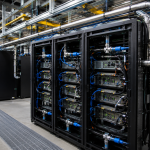
- Massive liquid cooling deployments
- Multi-megawatt AI clusters
the limitations of traditional materials and thermal systems are becoming impossible to ignore.
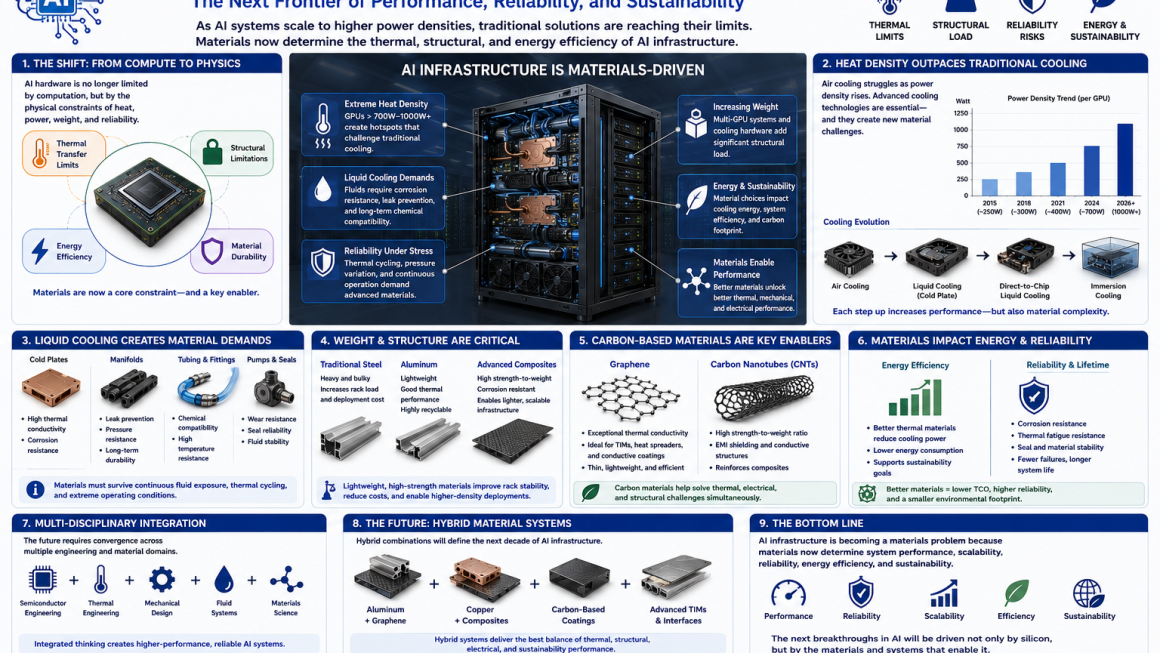
1. The Shift from a Compute Problem to a Physics Problem
Modern AI hardware generates unprecedented:
- Heat density
- Power consumption
- Mechanical stress
- Cooling complexity
This creates a fundamental reality:
👉 AI infrastructure is now constrained by:
- Thermal transfer limits
- Structural limitations
- Energy efficiency
- Material durability
In many cases, the bottleneck is no longer the processor itself—but the system’s ability to:
- Move heat
- Support weight
- Maintain reliability
- Operate efficiently over time
2. Heat Density Is Growing Faster Than Traditional Cooling
AI accelerators continue increasing in power.
Examples include:
- Advanced GPUs exceeding 700W–1000W+
- Dense multi-GPU server architectures
- High-bandwidth memory generating concentrated thermal loads
Traditional air cooling struggles because:
- Air has limited heat transfer capability
- High airflow increases energy consumption and noise
- Thermal hotspots become difficult to control
👉 This is driving rapid adoption of:
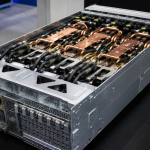
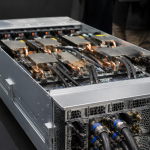
- Direct-to-chip liquid cooling
- Cold plate systems
- Immersion cooling
But these cooling technologies themselves create new material demands.
3. Liquid Cooling Introduces Material Complexity
Liquid cooling systems require:
- Corrosion resistance
- Leak prevention
- Chemical compatibility
- Long-term sealing reliability
Materials must now survive:
- Continuous fluid exposure
- Thermal cycling
- Pressure variation
- High heat flux environments
This affects:
- Cold plates
- Manifolds
- Tubing
- Connectors
- Pump systems
👉 Cooling is no longer only a mechanical system—it is now a materials engineering challenge.
4. Weight and Structural Load Are Becoming Critical
AI servers are becoming significantly heavier due to:
- Multiple GPUs
- Dense power systems
- Liquid cooling hardware
- Reinforced chassis
This creates challenges in:
- Rack stability
- Structural integrity
- Deployment and serviceability
Traditional steel-heavy designs increase:
- Total system weight
- Transportation cost
- Installation complexity
👉 This is driving demand for:
- Lightweight aluminum structures
- Advanced composites
- Hybrid material architectures
5. Carbon-Based Materials Are Emerging as Key Enablers
Advanced carbon materials are gaining attention because they address multiple bottlenecks simultaneously.
Graphene
Potential uses:
- Thermal interface materials
- Heat spreaders
- Conductive coatings
Advantages:
- Exceptional thermal conductivity
- Thin and lightweight integration
Carbon Nanotubes (CNTs)
Applications:
- EMI shielding
- Reinforced composites
- Conductive structures
Advantages:
- High strength-to-weight ratio
- Advanced electrical properties
👉 Carbon materials may become a critical layer in future AI thermal architectures.
6. Materials Now Directly Impact Energy Efficiency
AI infrastructure consumes enormous energy.
Materials influence energy efficiency through:
- Heat transfer efficiency
- Cooling power reduction
- Weight optimization
- Improved airflow and fluid flow behavior
Examples:
- Better thermal materials reduce cooling demand
- Lightweight structures lower deployment and operational costs
- Corrosion-resistant materials extend system life
👉 Material performance increasingly affects both:
- Infrastructure economics
- Sustainability targets
7. Reliability Is Becoming a Material Science Issue
AI infrastructure must operate continuously under extreme conditions.
Key concerns include:
- Thermal fatigue
- Corrosion
- Seal degradation
- Mechanical deformation
- Chemical incompatibility
As power density increases, small material failures can cause:
- System downtime
- Cooling failure
- Expensive hardware damage
👉 Reliability is no longer just a hardware issue—it is increasingly a materials reliability issue.
8. AI Infrastructure Is Becoming Multi-Disciplinary
Future AI systems require integration between:
- Semiconductor engineering
- Thermal engineering
- Fluid systems
- Mechanical design
- Materials science
This means future competitive advantage will depend not only on:
- Chip performance
but also on:
- Material innovation
- Manufacturing capability
- Thermal architecture optimization
- Scalable infrastructure engineering
👉 The companies leading AI infrastructure will increasingly be those that understand both systems and materials.
9. The Future: Hybrid Material Systems
The next decade will likely see the rise of:
- Aluminum + graphene systems
- Copper + composite structures
- Carbon-enhanced cooling surfaces
- Functional coatings and engineered interfaces
Future infrastructure will be designed around:
- Thermal efficiency
- Lightweight engineering
- Reliability
- Sustainability
👉 The future of AI infrastructure is not purely electronic—it is deeply material-driven.
The AI Race Is Also a Materials Race
The rapid expansion of AI is exposing the physical limits of traditional infrastructure.
The next breakthroughs will not come only from:
- Faster chips
- Larger models
but also from:
- Better thermal materials
- Smarter cooling architectures
- Lightweight structural systems
- Advanced material integration
👉 AI infrastructure is becoming a materials problem because materials now determine:
- Performance
- Reliability
- Scalability
- Energy efficiency
- Sustainability
And in the next generation of AI systems, materials may become one of the industry’s most important competitive advantages.