



AI data center infrastructure places demanding requirements on mechanical hardware. GPU server chassis, aluminum rack frames, mounting rails, cable management systems, and cooling-related components must meet defined requirements for strength, dimensional accuracy, assembly compatibility, and production consistency.
For engineering and procurement teams, selecting the right manufacturing partner is therefore more complex than comparing quotations or reviewing a supplier’s equipment list.
A qualified AI data center aluminum hardware manufacturer should be able to translate engineering drawings and functional requirements into manufacturable components, verify critical characteristics, manage design changes, and maintain consistent quality as projects move from prototypes to repeat production.
This guide explains how to evaluate a custom aluminum component supplier across manufacturing capabilities, engineering support, quality control, traceability, and production readiness.
1. Start with Application Understanding, Not Just Equipment Lists
A manufacturer may have extrusion presses, CNC machining centers, and surface treatment partners, but these capabilities alone do not establish whether it is suitable for a particular AI infrastructure project.
The first question is whether the supplier understands the component’s intended function.
For example, an aluminum server chassis rail may primarily require structural stiffness and accurate mounting interfaces. A cable management channel may require smooth edges, consistent dimensions, and reliable mounting. A component associated with liquid cooling may have additional sealing, corrosion, or pressure-related requirements, depending on whether it is a structural support or a coolant-containing part.
These applications require different manufacturing and validation approaches.
Before evaluating a supplier, define:
- The component’s function and installation environment
- The required aluminum alloy and temper
- Critical dimensions and tolerances
- Mechanical loads and relevant performance requirements
- Surface finish and treatment requirements
- Assembly interfaces and mating components
- Prototype quantity and expected production volume
- Required inspection records and documentation
- Any applicable regulatory or customer-specific requirements
A capable manufacturer should ask questions when drawings or specifications are incomplete. It should not automatically assume that every dimension, material designation, or tolerance is practical to manufacture.
2. Evaluate Aluminum Extrusion Capabilities
Custom aluminum extrusion is often the starting point for AI infrastructure components such as structural rails, chassis members, mounting profiles, and cable routing channels.
However, extrusion capability should be evaluated beyond the nominal size of the press or the number of available profile designs.
Cross-section feasibility
Ask whether the manufacturer can review wall thickness, internal cavities, ribs, slot geometry, and transitions between thick and thin sections.
These features affect die design, metal flow, dimensional consistency, straightness, and manufacturing yield.
A useful engineering review should identify potential problems before the extrusion die is manufactured.
Alloy and temper control
Confirm that the supplier can provide the specified alloy and temper, along with appropriate material documentation.
Alloy selection affects mechanical properties, extrusion behavior, machining performance, and surface treatment. The manufacturer should understand how these requirements interact rather than treating material selection as a purchasing detail.
Dimensional consistency
For structural profiles, evaluate the supplier’s ability to control relevant dimensions, straightness, twist, and other characteristics required by the drawing.
The acceptable limits should be defined by the component design and applicable specifications, not by a generic claim that the supplier offers high precision.
Tooling ownership and maintenance
For custom profiles, clarify:
- Who owns the extrusion die
- How the die is identified and stored
- Who authorizes modifications
- How die wear is monitored
- Whether tooling maintenance costs are included
- What happens to the tooling if the supplier relationship ends
These details matter when a project depends on repeat production or long-term supply continuity.
3. Assess CNC Machining and Precision Manufacturing
Many AI hardware components require secondary machining after extrusion. Mounting holes, threaded features, precision end faces, connector interfaces, and assembly slots may all affect final fit.
A manufacturer should demonstrate that it can translate drawing requirements into an appropriate machining and inspection plan.
Review machining suitability
Consider the following questions:
- Does the supplier have suitable CNC equipment for the component’s dimensions and complexity?
- Can the part be fixtured without excessive deformation?
- Can critical features be machined in a way that maintains their positional relationships?
- Are burr removal and edge finishing controlled?
- Can the supplier meet the specified tolerances consistently?
A machine’s advertised positioning accuracy does not automatically establish the achievable tolerance of the finished component. Fixturing, tool wear, material behavior, thermal conditions, and inspection methods also influence the result.
Evaluate tolerance planning
Not every feature needs the tightest possible tolerance.
A good manufacturing partner should distinguish between critical dimensions, functional mating surfaces, and non-critical geometry. This helps prevent unnecessary machining costs while preserving assembly reliability.
For example, a GPU mounting interface may require more precise positional control than a non-functional exterior surface.
The supplier should identify any dimensions that may be difficult to achieve and propose alternatives for engineering approval rather than quietly changing the manufacturing interpretation.
4. Verify Surface Treatment and Finishing Control
Surface treatment can affect corrosion protection, appearance, dimensional fit, electrical bonding, and thermal interfaces.
Common processes for aluminum AI hardware include anodizing, powder coating, and other specified protective finishes.
The supplier should be able to explain how the selected process will be controlled and how it affects the finished component.
Key evaluation points include:
- Surface preparation and pretreatment
- Coating or anodizing specifications
- Required film or oxide-layer thickness
- Color and appearance consistency
- Masking of threads and precision interfaces
- Protection of grounding and electrical contact areas
- Dimensional effects after finishing
- Inspection and acceptance criteria
For critical interfaces, the supplier should understand that surface treatment is part of the engineering specification, not simply a cosmetic operation.
If finishing is subcontracted, ask how the manufacturer controls the subcontractor’s process, verifies the returned parts, and manages nonconforming products.
A supplier that outsources a process can still be suitable, provided its responsibility and control over the complete manufacturing chain are clearly established.
5. Examine the Quality Control System
Quality assurance should be based on defined requirements, inspection methods, and documented results.
A supplier’s general statement that it follows strict quality control is less useful than evidence showing how specific product characteristics are verified.
Incoming material inspection
Confirm how the supplier verifies alloy designation, temper, dimensions, and relevant material documentation.
Depending on the project, additional verification may be required to confirm that the delivered material matches the approved specification.
In-process inspection
Ask how critical characteristics are monitored during extrusion, machining, and finishing.
Examples include profile dimensions, hole positions, thread quality, flatness, surface defects, and features that determine assembly fit.
Final inspection
Final inspection should be linked to the approved drawing and acceptance criteria.
The inspection plan may include dimensional reports, visual inspection, surface treatment checks, and functional or assembly verification where applicable.
Measurement capability
Ask which instruments are used for the critical dimensions and how measurement equipment is calibrated or verified.
For complex parts, coordinate measuring machines (CMMs), profile measurement systems, or dedicated fixtures may be appropriate. The correct method depends on the geometry and required tolerance.
A useful supplier should be able to explain not only what it measures but also why the chosen method is suitable.
6. Evaluate Sampling, Prototyping, and First-Article Approval
A prototype is not simply a small production order. It is an opportunity to verify whether the design, manufacturing process, and inspection approach work together.
For a custom aluminum component supplier, the sampling process should have clear objectives and acceptance criteria.
Before prototype production
Confirm that the supplier has reviewed the drawings, material requirements, critical dimensions, surface finish, and assembly interfaces.
Any proposed deviations should be documented and approved before manufacturing.
During prototype evaluation
The customer and supplier should verify:
- Dimensional conformity
- Fit with mating components
- Assembly sequence and fastener access
- Surface appearance and finish
- Relevant structural or functional performance
- Any design assumptions that remain unverified
Where the component forms part of a cooling system, validation should match its actual role. A structural support near a coolant line does not automatically require the same tests as a pressure-containing cold plate or manifold.
First-article inspection
For projects with critical interfaces or repeat production requirements, first-article inspection can document whether the initial manufactured part conforms to the approved drawing.
The scope should be agreed in advance. Depending on the project, it may include all drawing dimensions, selected critical characteristics, material documentation, and finishing records.
Prototype approval should not automatically be treated as approval for unlimited production. The production process and its controls must also be considered.
7. Check Pilot Production and Scale-Up Readiness
A supplier may successfully produce a few prototype parts but encounter difficulties when manufacturing larger quantities.
Differences can arise from tooling wear, process variation, fixture changes, operator practices, finishing batches, or inconsistent inspection.
Pilot production helps evaluate whether the manufacturing process can deliver repeatable results under more representative production conditions.
What to verify during pilot production
- Dimensional consistency across multiple parts
- Assembly fit across representative samples
- Process stability for critical characteristics
- Production yield and scrap handling
- Finishing consistency between batches
- Inspection records and defect classification
- Packaging and transportation protection
- Capacity and lead-time assumptions
For higher-risk components, the customer may request a documented control plan or other evidence that critical process parameters are monitored.
The acceptance criteria should reflect the project’s actual risk and production requirements.
Ask about capacity realistically
Do not rely solely on the number of machines or the supplier’s stated monthly output.
Evaluate the capacity of the entire production chain, including extrusion, machining, finishing, inspection, and packaging.
A bottleneck in a subcontracted finishing process or a specialized CNC operation may determine the real delivery capacity.
8. Confirm Material and Production Traceability
Traceability becomes increasingly important when components are used in critical infrastructure or when customers require investigation of quality issues.
The appropriate level of traceability depends on the component’s function and contractual requirements.
A practical system may connect:
- Material certificates or batch records
- Alloy and temper identification
- Extrusion production batches
- CNC machining records
- Surface treatment batches
- Inspection results
- Nonconformance reports
- Packaging and shipment records
For more demanding applications, traceability may extend to individual parts or serialized assemblies.
The objective is to make it possible to identify which material and production records relate to a particular delivery or component.
Questions for the supplier
Can the supplier link a delivered batch to its material documentation?
Can it identify the finishing batch used for a shipment?
Can it retrieve inspection records when a customer reports a problem?
Can it isolate affected parts if a material or process issue is discovered?
A supplier should answer these questions with reference to its actual recordkeeping system rather than relying on informal assurances.
9. Review Engineering Change Management
Custom aluminum hardware often evolves during development. A GPU layout may change, a mounting hole may move, a wall thickness may be adjusted, or a surface finish may be revised.
Without controlled engineering change management, different revisions can become mixed during production.
This can create assembly problems even when every individual part appears to meet a drawing.
A controlled change process should include
Change identification: Record the proposed modification and the reason for it.
Impact assessment: Review effects on strength, fit, thermal interfaces, manufacturing feasibility, cost, lead time, and validation requirements.
Customer approval: Obtain approval from the authorized parties before implementing changes that affect the agreed specification.
Revision control: Update drawings, bills of materials, work instructions, inspection criteria, and related documents as applicable.
Implementation timing: Identify when the new revision becomes effective and how existing inventory will be handled.
Verification: Confirm that the modified component meets the updated requirements.
The process should also prevent unapproved substitutions of alloy, temper, surface treatment, tooling, or critical manufacturing methods.
A supplier that proactively communicates engineering risks and documents proposed changes is generally easier to manage over a long-term project.
10. Assess Supplier Control Over Subcontracted Processes
Many manufacturers rely on external partners for anodizing, powder coating, specialized testing, or other operations.
Outsourcing does not automatically make a supplier unsuitable. What matters is whether the supplier maintains responsibility for the final product and controls the external process.
Ask:
- Which operations are performed internally?
- Which processes are subcontracted?
- How are subcontractors selected and qualified?
- How are specifications communicated to them?
- How are finished parts inspected after return?
- Who is responsible for resolving defects?
- How are subcontractor changes communicated?
For AI infrastructure hardware, an integrated supplier may reduce coordination effort by managing extrusion, machining, finishing, and inspection under one commercial and quality framework.
However, an integrated supply chain should still be assessed on actual process control, documentation, communication, and delivery performance.
11. Evaluate Engineering Communication and Problem-Solving
A manufacturer is not only a production resource. For custom aluminum hardware, it can also be an engineering partner.
The quality of communication often becomes visible before the first order is placed.
A capable supplier should be able to:
- Identify ambiguous drawing requirements
- Explain manufacturing constraints in practical terms
- Distinguish critical from non-critical dimensions
- Suggest feasible alternatives without changing requirements unilaterally
- Explain the cost and lead-time effects of design changes
- Provide clear inspection and sampling plans
- Respond to nonconformances with documented corrective actions
A supplier that immediately accepts every requirement without technical review may not have evaluated the actual manufacturing risks.
Conversely, a supplier that raises a concern should explain the issue, its likely impact, and the information needed to resolve it.
The goal is not to avoid all engineering challenges. It is to identify and manage them before they become expensive production problems.
12. Compare Total Cost, Not Just Unit Price
The lowest quotation does not always represent the lowest project cost.
For custom aluminum hardware, the full cost may include:
- Engineering and design-for-manufacturing review
- Extrusion die or other tooling
- Raw material
- CNC machining
- Surface treatment
- Inspection and documentation
- Packaging and transportation
- Rework, scrap, and replacement
- Inventory and lead-time exposure
A lower unit price may be attractive, but its value should be assessed alongside quality requirements, delivery reliability, technical support, and the cost of managing defects.
A practical comparison framework
| Evaluation area | What to compare |
|---|---|
| Technical fit | Ability to meet the approved specification |
| Tooling | Cost, ownership, maintenance, and modification terms |
| Manufacturing | Process capability and internal versus outsourced operations |
| Quality | Inspection methods, records, and nonconformance control |
| Sampling | Prototype lead time and approval process |
| Scale-up | Repeatability, capacity, and production controls |
| Traceability | Material, process, and shipment record availability |
| Change management | Revision control and customer approval |
| Commercial terms | Price, lead time, payment terms, and responsibility for defects |
| Supply continuity | Capacity planning, backup processes, and communication |
A weighted scorecard can be useful when comparing several suppliers, but critical technical or quality requirements should be treated as mandatory gates rather than compensated for by a low price.
13. Questions to Ask Before Selecting a Custom Aluminum Manufacturer
Before placing an order, procurement and engineering teams should be able to obtain clear answers to the following questions.
- Can you review the drawing for extrusion and machining feasibility before quotation?
- Which alloy and temper will be supplied, and what material documentation is available?
- Which processes are performed in-house, and which are subcontracted?
- How are critical dimensions identified and inspected?
- Can you provide a first-article inspection report or an agreed dimensional report?
- How do you control anodizing, powder coating, masking, and other finishing requirements?
- What is the prototype process, and how are design deviations approved?
- How is consistency verified during pilot and repeat production?
- Can material and production records be traced to individual batches or parts as required?
- How are drawing revisions and engineering changes controlled?
- What happens if a delivered component fails to meet the approved specification?
- What are the tooling ownership, storage, maintenance, and transfer arrangements?
The answers should be supported by relevant examples, sample documentation, or a clear explanation of the supplier’s actual process.
For sensitive projects, customer-specific drawings and records should be exchanged through an appropriate confidentiality arrangement.
Conclusion
Selecting an AI data center aluminum hardware manufacturer requires evaluating more than extrusion equipment, machining capacity, or quotation price.
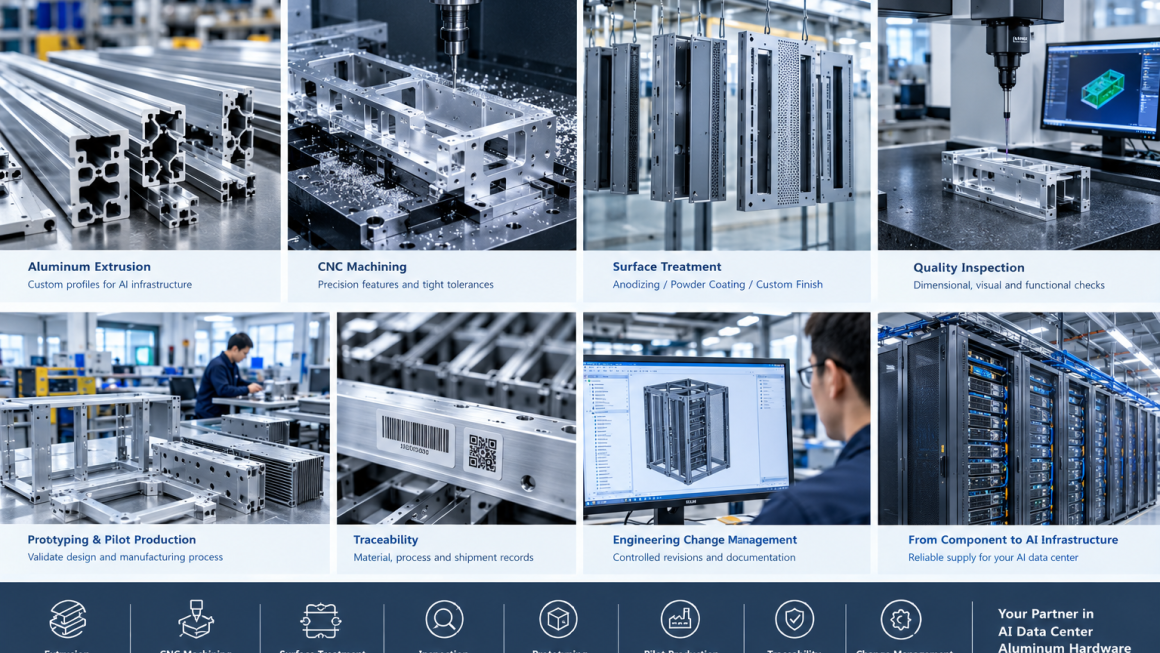
The right manufacturing partner should demonstrate that it can manage the complete path from engineering requirements to repeatable production: profile design, extrusion, CNC machining, surface treatment, inspection, prototyping, pilot production, traceability, and engineering change control.
For procurement teams, the most effective approach is to establish clear technical and quality requirements before comparing suppliers. Critical specifications should be verified through documented processes and agreed acceptance criteria, while cost, capacity, communication, and supply continuity should be evaluated as part of the broader commercial relationship.
At Aluminum4AI, the objective is to support AI infrastructure projects through application-focused aluminum component development and manufacturing coordination. By aligning engineering requirements with manufacturability and quality control early, project teams can reduce avoidable revisions and establish a more reliable path from prototype to production.
A strong supplier relationship is built not on promises alone, but on the ability to deliver the approved component consistently, document the result, and manage changes responsibly.