

1.Why Corrosion Control Matters in AI Liquid Cooling
As AI servers move toward higher power densities, liquid cooling systems are becoming increasingly important for managing processor and accelerator temperatures. Aluminum is widely used in cooling hardware because of its relatively low weight, good thermal conductivity, machinability, and manufacturing flexibility.
Typical aluminum components include:
- Liquid cooling cold plates
- Coolant distribution manifolds
- Extruded cooling channels
- Heat exchangers and heat sinks
- Structural brackets and mounting components
- Custom-machined fluid connectors and housings
However, aluminum components do not operate in isolation. They may be connected to copper heat exchangers, stainless steel fittings, brass connectors, pumps, hoses, and other wetted materials.
The coolant itself is another critical factor. Its pH, dissolved oxygen, ionic contamination, inhibitor package, and long-term chemical stability can all influence corrosion behavior.
Therefore, controlling aluminum corrosion in liquid cooling systems requires more than selecting an appropriate aluminum alloy. It requires a system-level approach to material compatibility, coolant management, surface protection, and validation.
2. Understanding the Main Corrosion Mechanisms
Several corrosion mechanisms may affect aluminum components in liquid cooling systems. Identifying the actual mechanism is essential before selecting a mitigation strategy.
2.1 General and Chemical Corrosion
Aluminum naturally forms a thin oxide layer that provides a degree of protection. However, this passive layer can be damaged or destabilized under unsuitable chemical conditions.
Factors that may accelerate corrosion include:
- Coolant pH outside the qualified operating range
- Excessive chloride or other aggressive ionic contamination
- Incompatible cleaning chemicals
- Degraded corrosion inhibitors
- High dissolved oxygen under certain operating conditions
- Elevated temperatures that accelerate chemical reactions
Aluminum is particularly sensitive to strongly acidic and strongly alkaline environments. The acceptable pH range must be established for the specific alloy, coolant formulation, temperature, and operating duration rather than assumed to be universal.
2.2 Galvanic Corrosion
Galvanic corrosion can occur when two dissimilar metals are electrically connected while exposed to a conductive electrolyte.
In a liquid cooling system, the coolant may act as the electrolyte. If aluminum is electrically connected to a more noble metal, such as copper or certain stainless steels, aluminum may become the anodic material and experience accelerated corrosion.
The risk depends on several factors:
- The electrochemical relationship between the material pair
- Electrical continuity between the metals
- Coolant conductivity and chemical composition
- Relative exposed surface areas
- Temperature and operating conditions
- The effectiveness of inhibitors and protective barriers
Importantly, the presence of two different metals does not automatically mean severe galvanic corrosion will occur. The complete electrochemical and operating environment must be considered.
2.3 Localized Corrosion and Pitting
Localized corrosion is particularly important for thin-walled channels, cold plates, and precision-machined components.
Pitting can create small but deep cavities in an aluminum surface. Even limited material loss may eventually lead to leakage, reduced structural integrity, or contamination of the coolant circuit.
Crevice corrosion may also develop in narrow gaps, threaded connections, gasket interfaces, and areas where stagnant coolant or deposits accumulate.
For liquid cooling hardware, localized corrosion deserves particular attention because a small defect can compromise an otherwise functional cooling assembly.
3. Aluminum, Copper, and Stainless Steel: Managing Dissimilar Metal Combinations
Material combinations are common in AI cooling systems. Each combination should be evaluated according to its electrical, chemical, and mechanical characteristics.
3.1 Aluminum and Copper
Copper is widely used in thermal management because of its high thermal conductivity. Aluminum, meanwhile, offers lower weight and attractive manufacturing economics.
A liquid cooling assembly may therefore combine an aluminum manifold or housing with copper cold plates, heat exchangers, or other thermal components.
The main concern is galvanic corrosion when aluminum and copper are electrically connected and exposed to conductive coolant.
Potential risks include:
- Accelerated corrosion of aluminum near connection points
- Pitting around wetted interfaces
- Corrosion product accumulation in narrow coolant passages
- Progressive degradation of sealing or pressure-containing surfaces
Possible control measures include:
- Avoiding unnecessary direct electrical contact between dissimilar metals
- Using qualified dielectric isolation components where practical
- Evaluating compatible protective coatings or surface treatments
- Selecting coolant formulations designed for the actual metal combination
- Controlling coolant contamination and conductivity
- Validating the complete assembly rather than testing individual materials only
Isolation components must also be evaluated for pressure, temperature, mechanical loading, and long-term sealing performance. Electrical isolation should not compromise the reliability of the fluid connection.
3.2 Aluminum and Stainless Steel
Stainless steel is frequently used for fittings, fasteners, connectors, and other hardware.
Its corrosion resistance makes it attractive for liquid cooling applications, but a stainless steel-to-aluminum combination still requires evaluation.
The galvanic risk depends on the stainless steel grade, aluminum alloy, surface condition, coolant chemistry, electrical connection, and exposed area ratio.
For example, a relatively small aluminum area electrically connected to a much larger stainless steel surface may create an unfavorable area relationship under certain electrolyte conditions.
Design considerations include:
- Minimizing unnecessary wetted metal interfaces
- Reviewing the material grades of fittings and fasteners
- Considering insulating washers, sleeves, or interface components
- Protecting vulnerable aluminum surfaces
- Checking for crevices around threaded connections
- Evaluating the complete assembly under representative coolant conditions
Stainless steel should not automatically be considered harmless simply because it is corrosion-resistant.
3.3 Aluminum and Brass
Brass may appear in connectors, valves, and fittings. However, its copper content and electrochemical behavior make it another material combination that deserves attention.
In mixed-metal systems, the actual brass composition, plating, coolant chemistry, and electrical continuity should be considered.
Where possible, reducing unnecessary metal combinations can simplify corrosion control and long-term maintenance.
4. Aluminum Coolant Compatibility: Chemistry Is a System-Level Decision
Selecting a coolant based only on its freezing point or thermal performance is insufficient.
A coolant suitable for one material combination may not be appropriate for another. For example, a formulation qualified for an aluminum-only loop may not provide adequate protection in a system containing aluminum, copper, and stainless steel.
Important coolant characteristics include:
4.1 pH Stability
Coolant pH influences the stability of aluminum’s protective oxide layer.
Both excessively acidic and excessively alkaline conditions can increase corrosion risk. The operating range should be defined by the coolant supplier and validated against the specific materials in the cooling circuit.
Monitoring pH over time can also help identify coolant degradation or contamination.
4.2 Corrosion Inhibitors
Corrosion inhibitors are designed to reduce metal degradation through chemical or surface-protection mechanisms.
A suitable inhibitor package should be compatible with all wetted materials, not just aluminum.
The formulation may need to address:
- Aluminum alloys
- Copper and copper alloys
- Stainless steel
- Brass
- Solder or brazing materials, where present
- Elastomers and sealing materials
The presence of an inhibitor in a coolant specification does not automatically guarantee protection under every operating condition. Its concentration, stability, compatibility, and service life matter.
4.3 Electrical Conductivity and Ionic Contamination
Coolant conductivity can influence electrochemical corrosion behavior.
Dissolved salts, chloride ions, metal ions, and other contaminants may increase corrosion risk or interfere with inhibitor performance.
Water quality, coolant preparation, flushing procedures, and contamination control should therefore be included in the system specification.
4.4 Temperature and Long-Term Stability
Higher operating temperatures can accelerate chemical reactions and affect inhibitor stability.
A coolant that performs adequately during short-term testing may behave differently after prolonged exposure to elevated temperatures and multiple thermal cycles.
Long-term coolant compatibility should be evaluated under representative operating conditions.
5. Protective Coatings and Surface Treatments for Aluminum
Surface treatments can provide an additional level of protection, but they should not be treated as a substitute for compatible coolant chemistry and sound system design.
5.1 Anodizing
Anodizing creates a controlled oxide layer on the aluminum surface.
It can improve surface hardness and provide corrosion protection in suitable environments. However, its effectiveness depends on the anodizing process, coating thickness, sealing quality, geometry, and actual coolant exposure.
For internal cooling channels, uniform treatment may be difficult. Machined features, threaded ports, edges, and sealing surfaces also require careful consideration.
Anodizing should not be assumed to provide complete protection against every coolant formulation.
5.2 Conversion Coatings
Chemical conversion coatings may provide corrosion protection and improve the surface’s suitability for subsequent treatments.
Their performance depends on the coating chemistry, process control, substrate preparation, and coolant compatibility.
For liquid-contact applications, the coating must be specifically qualified for continuous exposure rather than selected solely on the basis of general atmospheric corrosion performance.
5.3 Organic and Functional Coatings
Polymer-based or other functional coatings may provide a barrier between aluminum and the coolant.
Potential benefits include reduced direct contact with aggressive chemical environments and improved compatibility in selected applications.
However, coating design must consider:
- Adhesion to the aluminum substrate
- Coverage of internal passages
- Pinholes and coating defects
- Chemical resistance to the coolant
- Thermal cycling and expansion mismatch
- Long-term adhesion and wear
- Potential effects on heat transfer
A coating that performs well on an external surface may not be suitable for a narrow internal channel.
5.4 Protecting Critical Interfaces
Some areas deserve special attention:
- O-ring grooves
- Threaded ports
- Machined sealing faces
- Sharp edges and transitions
- Internal channel intersections
- Areas exposed to stagnant coolant
Protective treatment must be compatible with dimensional tolerances and sealing requirements. Coating buildup on precision sealing surfaces can affect assembly and leak performance.
6. System-Level Design Strategies for Corrosion Control
Effective corrosion control should begin during system architecture and component selection.
6.1 Reduce Unnecessary Material Combinations
Every additional wetted metal interface introduces another compatibility consideration.
Where practical, designers should simplify the material architecture and use a consistent material strategy across connected components.
This does not mean that every component must use the same alloy. It means that each material combination should have a clear engineering justification and a defined validation plan.
6.2 Manage Electrical Continuity
Where dissimilar metals are unavoidable, evaluate whether electrical isolation is practical.
Potential measures include:
- Dielectric unions or connectors
- Insulating sleeves
- Non-conductive washers
- Qualified barrier layers
- Isolated mounting arrangements
The design must preserve mechanical strength, pressure containment, and reliable electrical safety practices.
6.3 Avoid Stagnant Zones and Contamination Traps
Poor flow distribution and stagnant regions can create localized chemical conditions that increase corrosion risk.
Designers should review:
- Dead legs and unused ports
- Narrow gaps
- Internal surface transitions
- Drainability and flushing access
- Potential particle accumulation
- Coolant replacement and maintenance procedures
Good hydraulic design can support corrosion management by reducing locations where deposits and contaminants accumulate.
6.4 Consider the Entire Wetted Material Set
The compatibility assessment should include more than the major metal components.
A complete material list may include:
- Aluminum alloys
- Copper and copper alloys
- Stainless steel grades
- Brazing and soldering materials
- Elastomers and O-rings
- Plastics and polymer liners
- Pump and valve wetted components
- Coolant additives and cleaning agents
A system can experience compatibility problems even when its main aluminum and copper components have been individually qualified.
7. Testing and Validation: From Material Coupons to Complete Assemblies
Corrosion control should be supported by testing rather than assumptions.
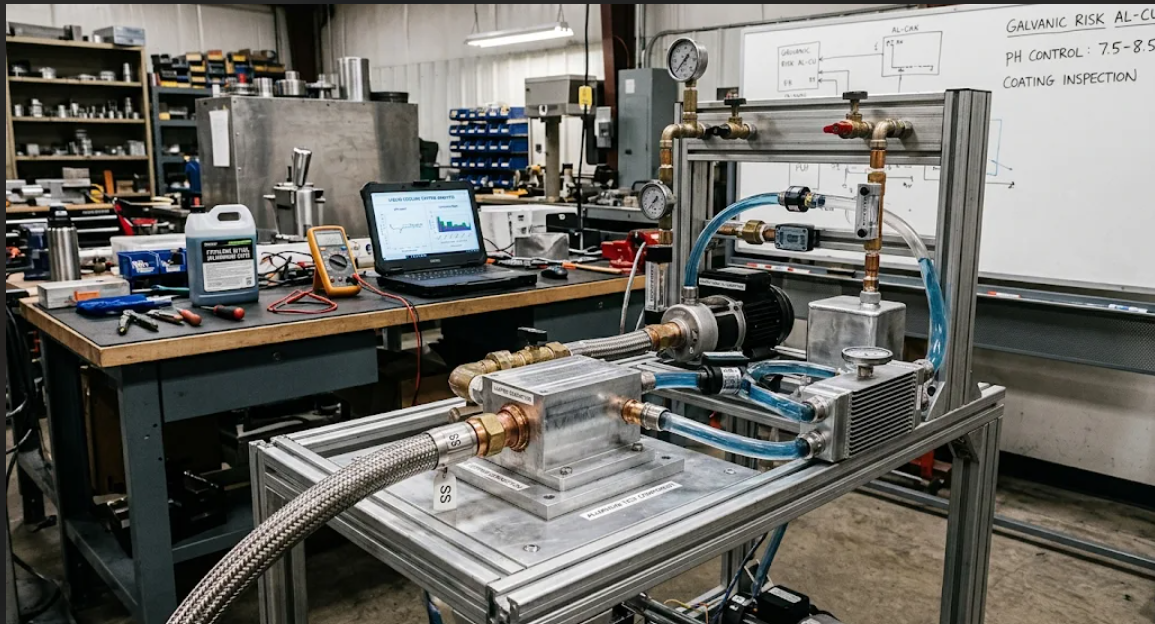
A practical validation program can include several stages.
7.1 Material Compatibility Testing
Expose representative material samples to the proposed coolant under controlled conditions.
Evaluate:
- Mass change
- Surface appearance
- Pitting or localized attack
- Surface degradation
- Changes in coolant chemistry
- Corrosion products
Where multiple metals are present, include representative material combinations rather than testing aluminum alone.
7.2 Galvanic Corrosion Evaluation
Test representative dissimilar-metal couples under controlled electrical and coolant conditions.
Relevant combinations may include:
- Aluminum and copper
- Aluminum and stainless steel
- Aluminum and brass
The test configuration should reflect actual material grades, exposed surface areas, electrical connections, and coolant conditions as closely as practical.
7.3 Coolant Aging and Thermal Cycling
Long-term exposure testing can help identify changes in coolant chemistry and protective performance.
Thermal cycling can also reveal coating degradation, interface damage, and changes in material behavior.
Test temperatures and durations should be selected based on the intended operating envelope and the applicable validation requirements.
7.4 Component-Level Testing
Representative cold plates, manifolds, and machined channels should be tested for:
- Pressure resistance
- Leak tightness
- Flow performance
- Corrosion-related surface changes
- Dimensional stability
- Coating integrity, where applicable
Pressure and leak testing should follow the component’s design requirements and relevant industry procedures. A successful initial pressure test does not, by itself, establish long-term corrosion resistance.
7.5 System-Level Validation
The final validation stage should involve the complete or representative cooling loop.
This helps identify interactions that cannot be captured through isolated material tests, including coolant contamination, mixed-metal effects, pump-related conditions, and changes over time.
8. A Practical Corrosion-Control Checklist for AI Cooling Projects
Before releasing an aluminum liquid cooling component for production, engineering teams should review the following:
| Evaluation Area | Key Questions |
|---|---|
| Aluminum alloy | Is the alloy suitable for the intended coolant and operating environment? |
| Mixed metals | Are copper, stainless steel, brass, or other metals electrically connected? |
| Coolant chemistry | Are pH, conductivity, inhibitor package, and contamination limits defined? |
| Surface treatment | Is the coating or anodizing process qualified for actual coolant exposure? |
| Component geometry | Are there dead zones, crevices, or contamination traps? |
| Sealing interfaces | Can coatings or surface treatments affect O-ring grooves and sealing faces? |
| Validation | Have material compatibility and representative assembly tests been completed? |
| Maintenance | Are coolant monitoring, flushing, and replacement procedures defined? |
This checklist can be used during early design reviews, supplier qualification, and production readiness assessments.
9. Working with an Aluminum Cooling Component Manufacturer
Corrosion control is not solely a coolant supplier’s responsibility. Aluminum component manufacturers also play an important role in ensuring consistent material and surface quality.
For AI liquid cooling projects, a capable manufacturing partner should be able to support:
- Aluminum alloy and material traceability
- Extrusion and CNC machining process control
- Internal channel cleanliness
- Surface treatment process documentation
- Dimensional inspection of sealing interfaces
- Pressure and leak testing
- Sample preparation for compatibility evaluation
- Production quality records
For custom cold plates and manifolds, early communication is especially important. The component manufacturer should understand the intended coolant, connected materials, surface treatment requirements, and operating conditions before finalizing the manufacturing process.
The coolant supplier, system integrator, and aluminum component manufacturer should work from the same material compatibility requirements.
10. Corrosion Control Must Be Designed into the Cooling Loop
Aluminum offers significant advantages for AI liquid cooling hardware, including low weight, good thermal conductivity, and flexible manufacturing options.
However, its long-term reliability depends on more than the aluminum alloy itself.
Copper and stainless steel connections, coolant chemistry, electrical continuity, surface treatments, component geometry, and maintenance practices all influence corrosion behavior.
A reliable corrosion-control strategy should therefore combine:
- Appropriate aluminum alloy selection
- Careful evaluation of dissimilar-metal combinations
- Qualified aluminum coolant compatibility
- Suitable protective surface treatments
- System-level material compatibility testing
- Ongoing coolant monitoring and maintenance
For AI data center cooling systems, corrosion control should be treated as an integral part of component design and system engineering—not as a corrective measure after a leak or performance problem occurs.
Aluminum4AI supports custom aluminum extrusion, CNC machining, cold plate and manifold manufacturing, and surface treatment coordination for AI liquid cooling applications. Early evaluation of material combinations and coolant requirements can help establish a more reliable manufacturing and validation pathway.