
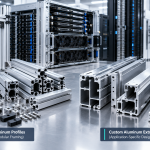
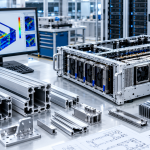
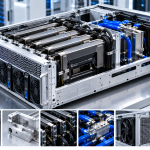
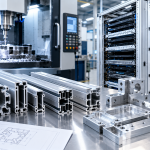
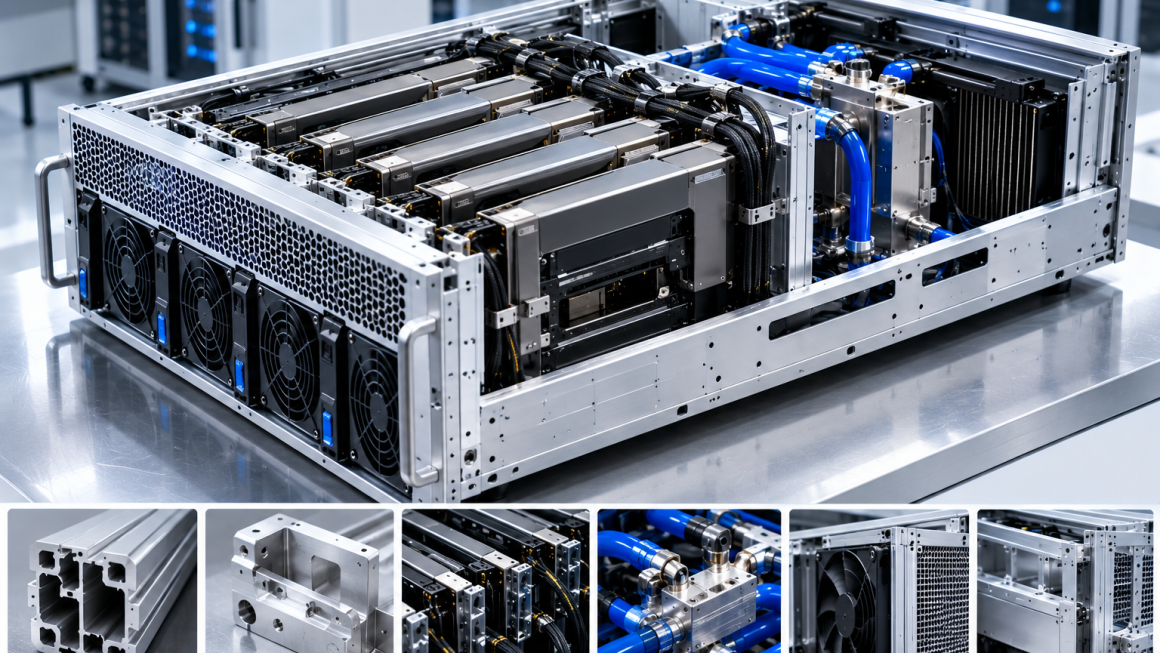
High-density GPU servers are pushing hardware design toward greater computing performance within increasingly limited physical space. As GPU modules, power delivery components, cooling hardware, and high-speed interconnects become more demanding, the server chassis must do more than simply hold electronic components together. It must provide structural stability, efficient space utilization, thermal clearance, reliable interfaces, and practical maintenance access.
Aluminum server chassis design offers a flexible approach to balancing these requirements. Through a combination of aluminum extrusions, CNC-machined components, sheet metal parts, and modular structural elements, manufacturers can develop enclosures tailored to specific GPU configurations and deployment environments.
However, successful design depends on the entire mechanical system. Reducing weight, increasing rigidity, accommodating cooling hardware, and improving serviceability are interconnected objectives that must be evaluated together.
1. Why High-Density GPU Systems Require Different Chassis Design
Traditional server chassis designs may not fully address the mechanical and integration requirements of high-density GPU platforms.
A GPU server can contain multiple accelerator cards, substantial power delivery hardware, high-speed interconnects, and either air-cooling or liquid-cooling components. These elements compete for limited internal space and create additional mechanical constraints.
Key design challenges include:
- GPU installation space: Accelerator dimensions, card spacing, retention mechanisms, and service clearances must be considered together.
- Structural rigidity: The chassis must support component weight and maintain alignment during installation, transportation, and operation.
- Weight management: Structural materials and geometries must provide sufficient strength without creating unnecessary mass.
- Interface layout: Power connectors, data connections, coolant ports, mounting points, and cable paths require coordinated positioning.
- Thermal clearance: Airflow passages, heatsinks, cold plates, and coolant lines need adequate space.
- Maintenance access: Components should be removable without requiring excessive disassembly of surrounding hardware.
These requirements make chassis design a system-level engineering task rather than an isolated enclosure design exercise.
2. Planning GPU Installation Space and Internal Geometry
The first step in GPU server chassis design is to establish the complete component envelope.
The dimensions of the GPU cards are important, but they are not the only consideration. Engineers should also account for card retention brackets, power cables, cooling interfaces, motherboard connectors, and the movement required to install or remove each component.
A practical space-planning process includes the following steps.
Define the component envelope
Create a three-dimensional layout of the GPU modules, motherboard, power supply units, storage devices, and other essential hardware. Use actual component drawings where available rather than relying solely on nominal dimensions.
Establish installation and removal paths
A component that fits inside a chassis may still be difficult to install or replace. Engineers should evaluate insertion direction, fastener access, tool clearance, and the space required to disconnect cables or coolant lines.
Coordinate mounting interfaces
GPU support rails, retention brackets, and chassis mounting points should be positioned to maintain alignment and distribute loads appropriately.
For modular platforms, standardized mounting interfaces can simplify future hardware revisions. However, standardization should not eliminate the flexibility needed for different GPU form factors or cooling configurations.
3. Balancing Structural Rigidity and Lightweight Construction
Weight reduction is valuable in dense server installations, but removing material without understanding the load path can introduce deformation, vibration, or alignment problems.
An aluminum server enclosure must provide sufficient stiffness around critical mounting locations, especially where heavy GPU assemblies, power supplies, and cooling hardware are supported.
Use geometry to improve stiffness
Aluminum extrusions allow engineers to incorporate structural features directly into the profile cross-section. Depending on the application, these may include:
- Internal ribs that improve resistance to local deformation
- Hollow sections that reduce mass while retaining useful structural depth
- Reinforced mounting zones around fasteners and load-bearing interfaces
- Integrated slots or channels for brackets, panels, and cable supports
The effectiveness of each feature depends on the direction and magnitude of the applied loads, the profile geometry, the alloy and temper, and the way individual components are connected.
Reinforce high-load areas selectively
GPU support points, chassis corners, rack attachment locations, and heavy component mounting areas may require additional reinforcement.
Rather than increasing wall thickness throughout the entire enclosure, engineers can evaluate localized ribs, machined reinforcement blocks, corner brackets, or thicker mounting sections where loads are concentrated.
This approach can reduce unnecessary material while maintaining structural performance.
Evaluate the complete assembly
The stiffness of an individual aluminum profile does not determine the stiffness of the finished chassis. Fasteners, joints, panel geometry, support spacing, and mounting conditions all influence overall behavior.
For demanding applications, mechanical analysis should be supported by physical testing under representative loading and installation conditions.
4. Selecting Aluminum Profiles and Manufacturing Methods
The manufacturing strategy influences the chassis geometry, assembly process, cost, and ability to accommodate future design changes.
Different components may benefit from different production methods.
| Manufacturing method | Potential role in GPU chassis design |
|---|---|
| Custom aluminum extrusion | Structural rails, frame members, mounting channels, and integrated slots |
| CNC machining | Precision interfaces, connector openings, mounting holes, and cooling-related features |
| Sheet metal fabrication | Covers, access panels, airflow guides, and lightweight enclosure sections |
| Standard aluminum profiles | Modular frames, adjustable supports, and early-stage prototypes |
| Surface treatment | Corrosion protection, appearance control, and specified surface properties |
Custom extrusion is particularly useful when a repeated cross-section needs to combine several functions. For example, a single profile may incorporate a mounting channel, a reinforcement rib, and a panel-retention feature.
CNC machining can then create precise interfaces at selected locations.
This combination can reduce the number of separate brackets and simplify assembly. Nevertheless, designers should compare tooling investment, machining time, production volume, and tolerance requirements before selecting a manufacturing route.
5. Designing Interfaces for Power, Data, and Cooling
The internal arrangement of a high-density GPU server is strongly influenced by its external and internal interfaces.
Power connectors, high-speed data connections, fans, coolant manifolds, hoses, and service panels must coexist within a limited enclosure volume.
Poor interface planning can lead to cable congestion, restricted access, excessive hose bending, or interference between components.
Power and data connections
Connector locations should reflect the actual cable routing requirements. Engineers should consider connector dimensions, cable bend radius, strain relief, and the space required for safe disconnection.
High-speed interconnects may also have routing and signal-integrity constraints that must be coordinated with mechanical packaging.
Cooling interfaces
For air-cooled systems, the chassis should preserve the intended airflow path and avoid unnecessary obstructions around fans, heatsinks, and exhaust openings.
For liquid-cooled systems, the layout should accommodate cold plates, coolant lines, manifolds, fittings, and quick-disconnect interfaces where applicable.
Hose routing requires particular attention. Bend radius, connector orientation, movement during servicing, and potential interference with GPU retention hardware should be evaluated before finalizing the chassis geometry.
Important: An aluminum structural frame is not automatically suitable for use as a coolant pressure boundary. Any aluminum component that contains pressurized coolant requires a separately engineered and validated design, including appropriate material selection, sealing, pressure testing, and compatibility assessment.
6. Managing Thermal Clearance Without Wasting Space
High-density GPU systems generate substantial heat, but thermal performance cannot be determined from chassis material alone.
Aluminum can support lightweight structural frames and heat-dissipation components, yet the final thermal result depends on the cooling architecture, contact interfaces, airflow or coolant distribution, and system operating conditions.
A well-designed chassis should reserve the space required for the selected cooling solution while avoiding unnecessary interference with other components.
For air-cooled GPU systems
Engineers should examine:
- Air inlet and exhaust locations
- Clearance around heatsinks and fan assemblies
- Potential bypass airflow around critical components
- Cable placement near airflow passages
- Access for fan replacement and dust removal
For liquid-cooled GPU systems
The design should account for:
- Cold plate and GPU assembly dimensions
- Coolant hose routing and connection access
- Manifold positioning and service clearance
- Separation between structural supports and fluid interfaces
- Access for inspection, disconnection, and component replacement
The objective is not simply to maximize open space. It is to preserve the functional clearances required by the selected cooling design while keeping the chassis compact and serviceable.
7. Designing for Maintenance and Component Replacement
A GPU server may undergo multiple hardware upgrades during its service life. A chassis that is difficult to maintain can increase service time and complicate component replacement.
Maintenance access should therefore be treated as a primary design requirement.
Useful considerations include:
- Removable panels with accessible fasteners
- GPU retention mechanisms that allow controlled removal
- Clear access to power and data connectors
- Replaceable brackets and structural subassemblies
- Cable-routing features that reduce interference during service
- Adequate clearance for coolant connections in liquid-cooled systems
Modular aluminum structures can help separate the primary load-bearing frame from replaceable mounting elements. If a specific bracket or interface changes between hardware generations, the entire chassis may not need to be redesigned.
However, modularity must be supported by repeatable interface dimensions, appropriate fastener selection, and clear assembly procedures.
8. Material Selection and Surface Treatment
Aluminum alloy selection should reflect the mechanical, manufacturing, and environmental requirements of the chassis.
For example, 6063 aluminum is commonly used for extruded profiles where cross-section complexity and surface finish are important. 6061 may be appropriate for components requiring a different balance of mechanical properties and machining performance.
Neither alloy is universally superior. The choice should be based on the required strength, profile geometry, temper, machining operations, joining method, and applicable specifications.
Surface treatment should also be selected according to function. Anodizing may be suitable for certain exposed aluminum surfaces, while other applications may require a specified coating or untreated machining surfaces at electrical bonding and precision contact locations.
Designers should define treatment requirements early enough to account for dimensional changes, masking needs, surface contact requirements, and the effects of post-treatment assembly.
9. Tolerances, Assembly, and Production Consistency
A chassis may contain extruded profiles, machined parts, panels, brackets, and electronic hardware sourced from different production processes. The tolerance stack across these components can affect assembly time and component alignment.
Overly tight tolerances increase manufacturing cost without necessarily improving system performance. Conversely, insufficient control at critical mounting interfaces can create alignment problems or inconsistent assembly results.
A practical tolerance strategy distinguishes between:
- Critical dimensions that determine GPU or motherboard alignment
- Mounting-hole positions and interface geometry
- Non-critical exterior dimensions
- Clearances required for cables, hoses, and removable components
- Surfaces that require specific flatness or finish requirements
Early design reviews should identify which features require CNC machining and which can remain within the achievable tolerances of the selected extrusion or fabrication process.
For production programs, first-article inspection, dimensional reports, assembly trials, and change control help establish consistency between prototypes and repeat orders.
10. From Prototype to Production-Ready GPU Chassis
A successful aluminum server chassis should progress through a structured development process.
Step 1: Define requirements. Document GPU configuration, component envelopes, target weight, mounting loads, cooling architecture, interface positions, and maintenance requirements.
Step 2: Develop the mechanical layout. Build a three-dimensional assembly that includes installation clearances, cable paths, cooling components, and access zones.
Step 3: Review design for manufacturability. Evaluate extrusion feasibility, wall thickness transitions, machining access, fastener locations, surface treatment, and assembly sequence.
Step 4: Manufacture a prototype. Use appropriate extrusion, CNC machining, and fabrication methods to verify physical fit and assembly behavior.
Step 5: Validate the assembly. Check component fit, structural stability, service access, and relevant thermal or vibration performance under defined test conditions.
Step 6: Prepare for repeat production. Finalize drawings, inspection criteria, material specifications, surface treatment requirements, and manufacturing change-control procedures.
This workflow helps identify interface conflicts and manufacturing constraints before they become expensive production issues.
11. Common Mistakes in Aluminum Server Chassis Design
Several recurring design decisions can create unnecessary cost or integration problems.
Designing around nominal GPU dimensions only: The complete installation envelope must include retention hardware, connectors, cables, and service clearances.
Reducing weight without evaluating load paths: Material reduction should be based on structural requirements rather than visual simplicity alone.
Treating the chassis as a cooling solution by itself: Aluminum construction does not replace the need for a properly engineered airflow or liquid-cooling system.
Using custom extrusion for every feature: Some details are more economical to manufacture through CNC machining, sheet metal fabrication, or separate brackets.
Ignoring maintenance access: A compact design can become impractical if routine component replacement requires extensive disassembly.
Applying unnecessarily tight tolerances: Critical interfaces need appropriate dimensional control, but non-critical features should not carry the cost of precision machining without a clear reason.
Delaying manufacturability review: Extrusion die constraints, machining access, surface treatment, and assembly requirements should be evaluated during the design stage rather than after the geometry is finalized.
High-density GPU systems require a careful balance between installation space, structural rigidity, weight, interface placement, thermal clearance, and maintenance access.
A well-engineered aluminum server chassis design begins with the complete hardware configuration and translates its mechanical requirements into manufacturable structures. Custom aluminum extrusions can provide integrated structural features, while CNC machining enables precise mounting interfaces and specialized component geometry.
For companies developing GPU servers and AI computing hardware, the most effective approach is to evaluate the chassis as a complete assembly—from material selection and profile design to prototyping, validation, and production consistency.
Aluminum extrusion and CNC machining suppliers can support this process by collaborating on design-for-manufacturing reviews, custom profile development, precision component production, and scalable manufacturing plans.
The goal is not simply to produce a lighter enclosure. It is to create a reliable, manufacturable, and serviceable mechanical platform that supports the requirements of high-density GPU computing.