


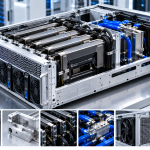
As AI servers continue moving toward higher power density, liquid cooling has become an essential technology for next-generation data center infrastructure.
Modern AI cooling systems often combine multiple materials, including:
- Aluminum structures
- Copper cold plates
- Stainless steel fittings
- Brass connectors
- Polymer hoses
- Various coolant components
Among these material combinations, one of the most frequently discussed engineering questions is:
Can aluminum and copper be used together in AI liquid cooling systems?
The short answer is:
Yes, aluminum and copper can be used together, but the system must be designed to control galvanic corrosion risks.
Understanding the interaction between aluminum and copper is critical for reliable AI cooling infrastructure.
This article explains:
- Why aluminum and copper can create galvanic corrosion
- How coolant chemistry influences corrosion
- Where risks appear in AI cooling loops
- How engineers prevent corrosion
- How aluminum components can be safely integrated into liquid cooling systems
1. Why Aluminum and Copper Are Both Used in AI Cooling Systems
AI liquid cooling systems require excellent thermal performance and reliable mechanical integration.
Copper and aluminum are both widely used because they provide different advantages.
Copper Advantages
Copper is commonly selected for:
- Cold plates
- Microchannel cooling plates
- High heat flux interfaces
Reasons include:
- Very high thermal conductivity
- Excellent heat spreading capability
- Established manufacturing processes
Aluminum Advantages
Aluminum is commonly selected for:
- Structural frames
- Cooling brackets
- Manifolds
- Heat spreaders
- Enclosures
- Lightweight cooling components
Reasons include:
- Low density
- Good thermal conductivity
- Excellent extrusion capability
- Corrosion-resistant oxide layer
- Easy machining
Therefore, many AI cooling architectures naturally include both materials.
The engineering challenge is not avoiding all material combinations.
The challenge is controlling the interfaces.
2. What Is Galvanic Corrosion?
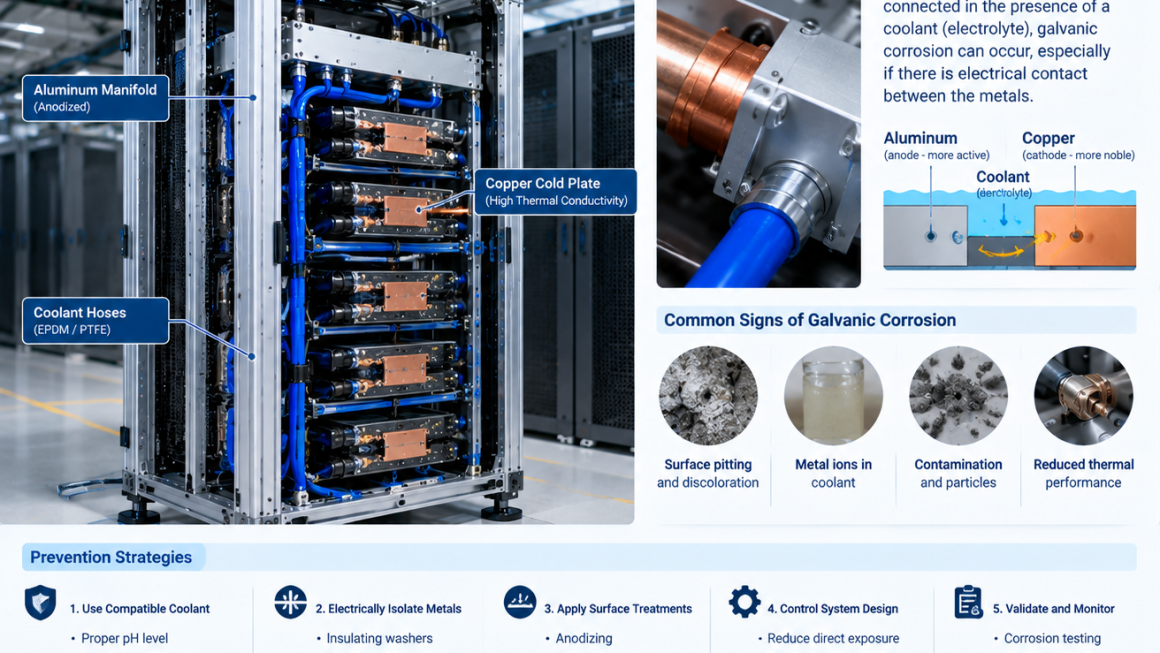
Galvanic corrosion occurs when two different metals are electrically connected in the presence of an electrolyte.
A typical galvanic corrosion condition requires three elements:
- Two dissimilar metals
- Electrical contact between them
- An electrolyte that allows ionic movement
In a liquid cooling system:
- Metal components provide the electrodes
- Coolant provides the electrolyte
- Electrical paths may exist through connected hardware
When these conditions exist, one metal can become more prone to corrosion.
3. Why Aluminum and Copper Create a Corrosion Concern
Aluminum and copper have different electrochemical potentials.
When they are connected in a conductive coolant environment, aluminum can become the more active material.
This means aluminum may experience accelerated corrosion under certain conditions.
Potential effects include:
- Surface degradation
- Metal ion release
- Coolant contamination
- Particle formation
- Reduced thermal performance
- Component lifetime reduction
However, the actual corrosion risk depends heavily on the complete system design.
Material pairing alone does not determine the outcome.
4. Aluminum Copper Cooling System: The Real Engineering Question
A common misconception is:
Aluminum and copper should never be used together.
In practice, many engineered cooling systems contain mixed materials.
The more important question is:
Under what conditions are aluminum and copper exposed to each other?
Engineers should evaluate:
- Coolant composition
- Electrical conductivity
- Temperature range
- Flow conditions
- Surface treatment
- Contact area ratio
- System cleanliness
- Operating lifetime
A properly designed system can successfully manage mixed-metal cooling architectures.
5. Where Galvanic Corrosion Risk Appears in AI Liquid Cooling
AI cooling systems contain many interfaces.
Potential risk areas include:
Copper Cold Plate + Aluminum Manifold
A common high-performance cooling architecture.
Potential concern:
- Direct coolant contact between copper and aluminum
Aluminum Frame + Copper Components
Example:
- Aluminum structural support
- Copper thermal modules
Potential concern:
- Accidental electrical contact
- Condensation exposure
Aluminum Heat Exchanger Components + Copper Tubing
Potential concern:
- Long-term coolant exposure
- Material compatibility
Fasteners and Connectors
Small components can create unexpected corrosion paths.
Examples:
- Steel screws
- Brass fittings
- Stainless connectors
The entire material system must be considered.
6. Coolant Chemistry: A Critical Factor
In liquid cooling systems, the coolant is not simply a heat-transfer medium.
It is also a chemical environment.
Important coolant properties include:
- pH value
- Electrical conductivity
- Additives
- Corrosion inhibitors
- Dissolved oxygen
- Contamination level
A coolant designed for copper-only systems may not be suitable for aluminum-containing systems.
Likewise, an aluminum-compatible coolant may require different chemical control.
Therefore:
Coolant selection must match the material combination.
7. The Role of Corrosion Inhibitors
Many industrial cooling systems use corrosion inhibitors to reduce metal attack.
These additives can help protect:
- Aluminum
- Copper
- Steel
- Brass
A properly formulated coolant can create a more stable environment.
However:
- Inhibitor concentration must remain within specification.
- Long-term degradation must be monitored.
- Compatibility testing should be performed before deployment.
A coolant solution is part of the mechanical design, not an afterthought.
8. Closed-Loop AI Cooling Systems and Corrosion Control
Many AI data center liquid cooling systems use closed-loop designs.
Advantages include:
- Controlled coolant chemistry
- Reduced contamination
- Stable operating conditions
- Easier monitoring
A closed loop can significantly reduce external environmental exposure.
However, corrosion control is still required because the coolant itself interacts with internal materials.
A reliable system should monitor:
- Coolant condition
- Conductivity
- pH
- Particle levels
- Temperature
9. Direct-to-Chip Cooling Material Considerations
Direct-to-chip cooling systems commonly include:
- Copper cold plates
- Coolant channels
- Manifolds
- Quick connectors
- Distribution units
The thermal interface may prioritize copper because it is close to the heat source.
However, surrounding structures may benefit from aluminum.
A practical architecture may separate functions:
Copper → High heat flux thermal interface
Aluminum → Lightweight structural and thermal support
This allows each material to perform where it provides the greatest value.
10. Preventing Galvanic Corrosion Between Aluminum and Copper
Several engineering approaches can reduce corrosion risks.
Method 1: Use Compatible Coolants
The first step is selecting coolant chemistry designed for the actual material combination.
Consider:
- Aluminum compatibility
- Copper compatibility
- Conductivity control
- Inhibitor package
Method 2: Electrically Isolate Dissimilar Metals
Reducing electrical contact can reduce galvanic corrosion risk.
Possible approaches:
- Insulating washers
- Polymer barriers
- Coated interfaces
- Isolation sleeves
The design should maintain required mechanical strength while controlling electrical paths.
Method 3: Apply Surface Treatments
Surface engineering can protect aluminum components.
Possible approaches include:
- Anodizing
- Conversion coatings
- Protective coatings
However, the coating must be selected carefully.
For example:
A protective coating may improve corrosion resistance but affect thermal contact or grounding.
The function of the component must be considered.
Method 4: Control Material Contact Area
The relative area of different metals matters.
A small aluminum area connected to a large copper area can create a more challenging condition.
Engineers should consider:
- Metal surface ratio
- Contact location
- Exposure area
- Coolant flow conditions
Method 5: Use Appropriate Fasteners
Fasteners are often overlooked.
Potential issues include:
- Stainless steel contacting aluminum
- Brass fittings contacting aluminum
- Coated and uncoated metal combinations
Solutions include:
- Compatible materials
- Isolation methods
- Protective coatings
- Proper assembly procedures
11. Aluminum Surface Treatment for Liquid Cooling Applications
For aluminum components in AI cooling systems, surface treatment selection depends on function.
Structural Aluminum Components
Examples:
- Cooling brackets
- Rack structures
- Support frames
Possible solutions:
- Anodizing
- Powder coating
- Protective conversion coating
Thermal Components
Examples:
- Heat spreaders
- Thermal plates
Considerations:
- Surface resistance
- Thermal contact quality
- Interface requirements
Coolant-Contact Aluminum Components
Examples:
- Aluminum channels
- Manifolds
Requirements:
- Internal corrosion protection
- Coolant compatibility testing
- Long-term stability validation
These applications require much stricter evaluation.
12. Aluminum Manifolds in AI Cooling Systems
Manifolds are becoming increasingly important in AI liquid cooling.
They distribute coolant between:
- CDU
- Rack system
- Server modules
- Cold plates
Aluminum manifolds can provide:
- Lightweight construction
- Good machinability
- Integration flexibility
However, internal coolant contact requires careful engineering.
Important considerations include:
- Alloy selection
- Surface treatment
- Coolant compatibility
- Pressure testing
- Long-term corrosion testing
13. Copper Cold Plates and Aluminum Structures: A Practical Architecture
A common AI cooling architecture may separate thermal and structural functions.
Example:
Copper Cold Plate
Function:
- Remove heat from GPU
Aluminum Support Structure
Function:
- Mechanical support
- Weight reduction
- Integration
Polymer Hose
Function:
- Coolant transportation
Stainless Connector
Function:
- Mechanical connection
This type of hybrid architecture can provide excellent performance when properly designed.
14. Thermal Expansion Differences
Aluminum and copper also have different thermal expansion characteristics.
During operation, temperature changes may cause:
- Dimensional variation
- Mechanical stress
- Interface movement
This matters for:
- Cold plate mounting
- Sealing interfaces
- Manifold connections
- Fastener loading
Engineers should consider:
- Operating temperature range
- Expansion allowance
- Joint design
- Material selection
15. Testing Aluminum Copper Cooling Compatibility
Before large-scale deployment, engineers should validate the material combination.
Possible tests include:
Immersion Testing
Evaluate corrosion behavior under coolant exposure.
Flow Loop Testing
Evaluate real operating conditions.
Temperature Cycling
Evaluate long-term thermal stress.
Chemical Analysis
Monitor:
- Metal ions
- Coolant degradation
- Contamination
Pressure Testing
Validate mechanical reliability.
Testing reduces uncertainty before production deployment.
16. Common Mistakes in Aluminum Copper Liquid Cooling Design
Mistake 1: Ignoring coolant chemistry
Material compatibility depends heavily on coolant properties.
Mistake 2: Looking only at thermal conductivity
The best thermal material is not always the best system material.
Mistake 3: Assuming coatings solve everything
Surface treatment helps but does not replace correct system design.
Mistake 4: Ignoring small components
Fasteners and connectors can create unexpected corrosion paths.
Mistake 5: Using copper-only design assumptions
Modern AI cooling systems increasingly require mixed-material solutions.
Mistake 6: Skipping long-term validation
Short-term testing may not reveal lifecycle issues.
17. Design Guidelines for Aluminum-Copper AI Cooling Systems
A practical design approach:
Step 1
Identify all materials in contact with coolant.
Step 2
Evaluate electrochemical compatibility.
Step 3
Select appropriate coolant chemistry.
Step 4
Define surface treatments.
Step 5
Control electrical contact paths.
Step 6
Validate through corrosion testing.
Step 7
Monitor system performance during operation.
18. The Future of Mixed-Material AI Cooling
As AI power density continues increasing, cooling systems will likely become more integrated.
Future systems may combine:
- Copper thermal interfaces
- Aluminum structural components
- Advanced coatings
- Improved coolants
- Composite materials
The future direction is not necessarily a single-material cooling system.
Instead:
Different materials will perform different roles.
The key requirement is intelligent system engineering.
Aluminum and Copper Can Work Together With Proper Design
The question of aluminum copper galvanic corrosion in liquid cooling is one of the most important material compatibility topics in AI infrastructure.
Aluminum and copper provide different advantages:
- Copper delivers excellent thermal performance.
- Aluminum provides lightweight structural and manufacturing advantages.
The challenge is managing the interface.
Reliable aluminum-copper cooling systems require:
Compatible Coolant Chemistry
Controlled Material Interfaces
Appropriate Surface Treatment
Electrical Isolation Where Needed
Long-Term Validation
For AI data centers, the goal is not to eliminate aluminum or copper.
The goal is to design a cooling architecture where each material contributes its strengths while maintaining long-term reliability.
Copper removes AI processor heat.
Aluminum enables lightweight, scalable infrastructure.
Together, with proper engineering, they can support the next generation of high-density AI computing systems.