
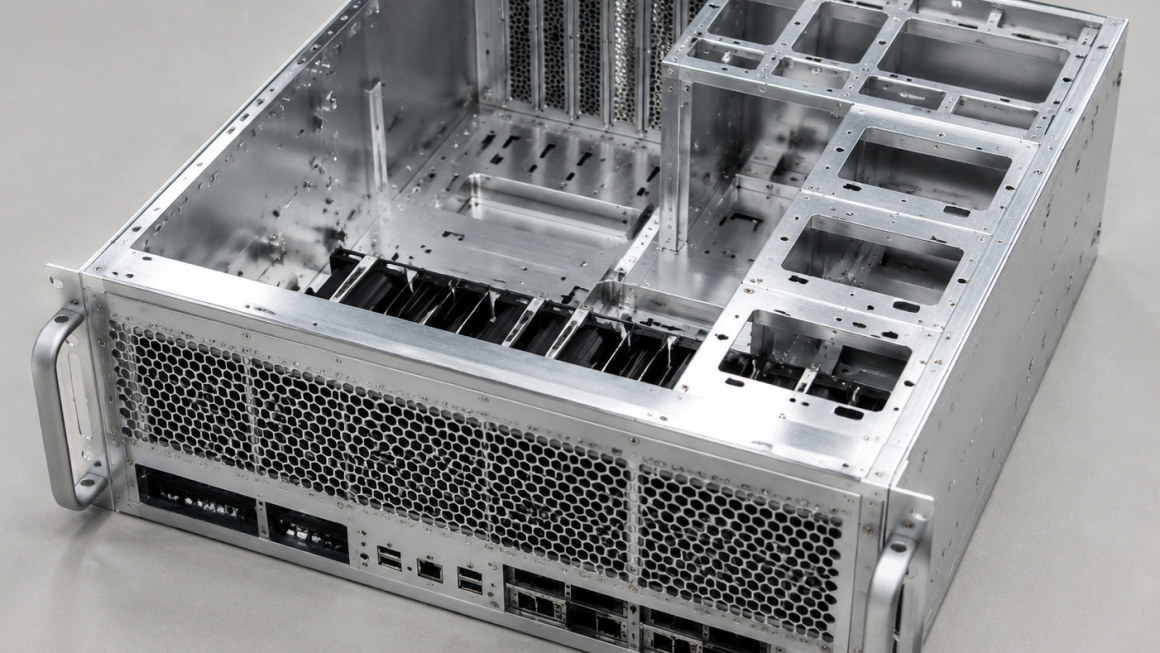
The rapid development of artificial intelligence (AI) computing has significantly increased the demand for high-density GPU clusters and advanced server infrastructure. As AI models become larger and computational workloads become more complex, data center systems require improved mechanical structures capable of supporting higher equipment density, more complex cooling systems, and increasingly demanding operational environments.
Within these systems, server frames and mechanical support structures play an essential role. They provide physical support for computing modules, enable component integration, assist thermal management strategies, and support maintenance operations.
Custom aluminum server frames are increasingly considered for high-performance computing environments because aluminum provides a practical combination of lightweight characteristics, mechanical strength, corrosion resistance, and manufacturing flexibility.
This article explores the role of customized aluminum server frames in high-density GPU clusters and discusses key engineering considerations in their design and manufacturing.
The Increasing Importance of Server Structures in AI Computing
Traditional server systems were primarily designed around standardized computing requirements. However, AI infrastructure introduces new challenges.
High-density GPU clusters often involve:
- Multiple high-power GPUs
- Advanced accelerator modules
- Large power delivery systems
- Complex cable networks
- Liquid cooling components
- Increased mechanical loading
These requirements create new challenges for mechanical structures.
A server frame must not only hold components securely but also support:
- Precise component positioning
- Efficient airflow or liquid cooling integration
- Easy maintenance access
- Mechanical stability during long-term operation
Why Aluminum Is Used for Server Frames
Aluminum alloys are widely used in industrial structures because of their balanced engineering properties.
Lightweight Structural Performance
Compared with many traditional structural metals, aluminum offers lower density while maintaining useful mechanical strength.
This can provide advantages in:
- Server chassis design
- Modular rack structures
- Equipment transportation
- Installation processes
For large-scale data center deployments, reducing unnecessary structural weight may contribute to easier handling and system optimization.
Thermal Management Compatibility
Although server frames are primarily mechanical components, their material properties can influence thermal design.
Aluminum provides moderate thermal conductivity, which allows it to participate in:
- Heat spreading
- Thermal interface support
- Cooling structure integration
In some designs, aluminum mechanical components are developed together with thermal management systems rather than separately.
Manufacturing Flexibility
One important advantage of aluminum is its compatibility with multiple manufacturing methods.
Common processes include:
- CNC machining
- Aluminum extrusion
- Sheet metal fabrication
- Die casting
- Surface treatment
These processes allow manufacturers to develop both standardized components and application-specific structures.
Custom Aluminum Server Frame Applications
Customized aluminum structures may be used in various AI infrastructure applications.
GPU Server Chassis
High-performance GPU servers require precise mechanical structures to support:
- GPU mounting systems
- Motherboards
- Power supply modules
- Cooling assemblies
Custom aluminum chassis designs may be developed according to:
- Equipment dimensions
- Cooling requirements
- Assembly methods
AI Rack-Level Structures
At rack level, mechanical systems must support multiple server units and associated infrastructure.
Applications may include:
- Rack frames
- Support brackets
- Mounting rails
- Modular structural panels
The design focus often includes load capacity, accessibility, and compatibility with existing infrastructure standards.
Liquid Cooling Support Structures
As liquid cooling becomes increasingly common in high-performance computing environments, mechanical structures must accommodate additional components.
Examples include:
- Cold plate mounting frames
- Cooling manifold supports
- Pipe routing structures
- Service access components
Mechanical design must consider factors such as:
- Assembly precision
- Sealing interfaces
- Maintenance requirements
Engineering Considerations for Custom Aluminum Frames
Dimensional Accuracy
AI server systems contain many interconnected components.
Small dimensional variations may influence:
- Component alignment
- Cooling interface contact
- Assembly efficiency
Therefore, precision manufacturing and quality control are important considerations.
Mechanical Rigidity
Server frames must maintain structural stability under:
- Equipment weight
- Transportation conditions
- Installation operations
- Long-term service environments
Design factors may include:
- Material thickness
- Structural geometry
- Reinforcement design
- Connection methods
Surface Treatment
Surface finishing can improve aluminum component performance.
Common treatments include:
Anodizing
Provides:
- Improved surface protection
- Enhanced durability
- Consistent appearance
Coatings
May provide additional surface functionality depending on application requirements.
Selection depends on environmental conditions and engineering needs.
Manufacturing Process for Custom Aluminum Server Frames
A typical development process may include several stages.
Engineering Design
Initial design considerations may include:
- Mechanical requirements
- Component layout
- Cooling integration
- Manufacturing feasibility
Prototype Production
Prototype manufacturing allows evaluation of:
- Assembly compatibility
- Structural performance
- Design improvements
Methods may include:
- CNC machining
- Small-batch fabrication
- Rapid prototyping
Pilot Manufacturing
Pilot production helps evaluate:
- Process stability
- Manufacturing consistency
- Quality control procedures
This stage is often important before larger-scale production.
Production Manufacturing
Once design and processes are validated, manufacturers may establish:
- Production tooling
- Inspection procedures
- Supply chain coordination
Aluminum Frames and Future AI Infrastructure
The future development of AI infrastructure may require more integrated approaches combining:
- Mechanical structures
- Thermal management
- Electrical systems
- Manufacturing processes
Several trends may influence aluminum server frame development.
Hybrid Material Structures
Future systems may combine aluminum with:
- Composite materials
- Engineering polymers
- Thermally conductive materials
Hybrid approaches may allow designers to balance:
- Weight
- Strength
- Thermal performance
- Manufacturing requirements
Modular Infrastructure Design
As AI computing environments continue to evolve, modularity may become increasingly important.
Custom aluminum structures can support modular designs through:
- Standardized interfaces
- Replaceable components
- Flexible configurations
Integration With Liquid Cooling Systems
Higher-density computing may continue to increase demand for advanced cooling solutions.
Mechanical structures will need to support integration with:
- Cold plates
- Cooling manifolds
- Fluid routing systems
Custom aluminum server frames represent an important mechanical foundation for high-density GPU clusters and AI infrastructure systems.
Their value comes not from a single material property, but from the combination of lightweight construction, manufacturing flexibility, structural reliability, and compatibility with evolving cooling technologies.
As AI computing systems continue to develop, mechanical structures will increasingly require close coordination between material selection, thermal design, and manufacturing processes.
For suppliers and manufacturers involved in AI infrastructure components, customized aluminum structures provide an opportunity to support the development of more adaptable and efficient computing systems through practical engineering solutions.
- Custom aluminum frames for AI servers
- Aluminum structures for GPU clusters
- How aluminum is used in data center hardware
- Mechanical design for AI server systems
- Manufacturing aluminum components for AI infrastructure
- Liquid cooling compatible server structures
- Custom CNC aluminum parts for data centers