


Managing Heat in the AI Era
As AI computing continues to scale, thermal management is becoming one of the most critical challenges in server engineering.
Modern AI systems now operate with:
- High-power GPUs exceeding 700W–1000W+
- Dense multi-accelerator server architectures
- High-bandwidth memory modules
- Continuous large-scale workloads
This creates extreme localized heat concentration inside servers.
👉 Efficient heat spreading has become essential for maintaining:
- Performance
- Reliability
- Energy efficiency
- System lifespan
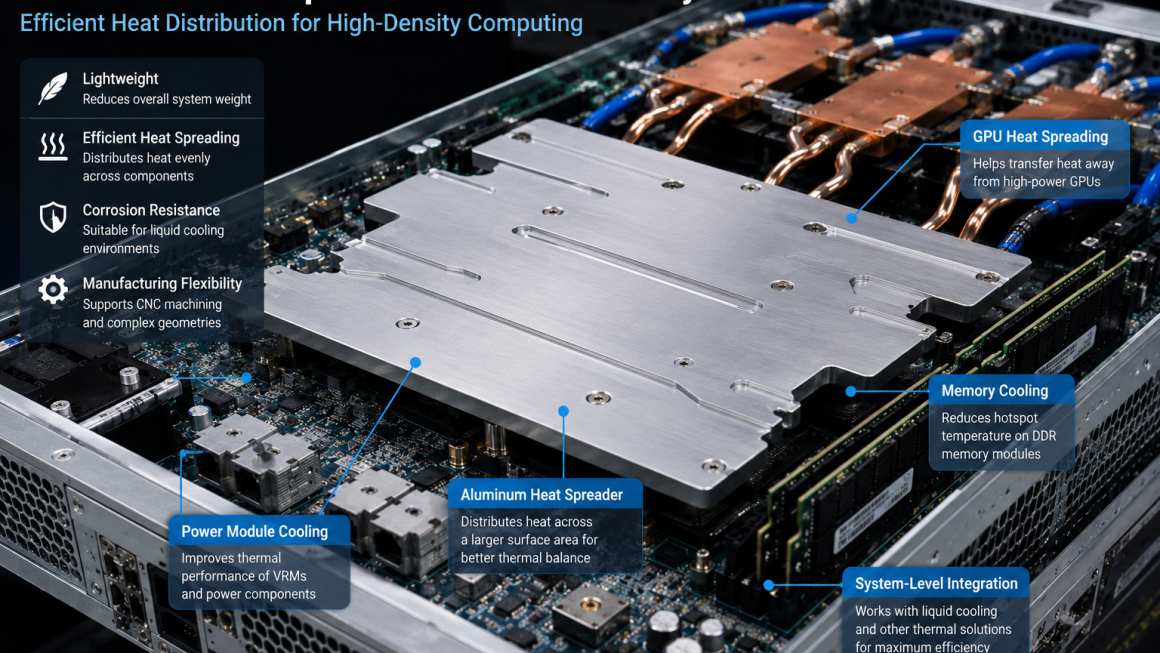
Among the many thermal management solutions, aluminum heat spreaders are playing an increasingly important role in modern AI server systems.
1. What Is a Heat Spreader?
A heat spreader is a thermal component designed to:
- Distribute heat away from hotspots
- Increase effective heat dissipation area
- Improve temperature uniformity across components
Rather than concentrating heat in a small region, heat spreaders help:
- Lower peak temperatures
- Reduce thermal stress
- Improve cooling efficiency
👉 In AI systems, heat spreaders are critical for managing high thermal density.
2. Why AI Servers Need Advanced Heat Spreading
AI accelerators generate extremely concentrated thermal loads.
Challenges include:
- GPU hotspot formation
- Thermal throttling
- Uneven temperature distribution
- High cooling demand
In dense AI systems:
- Even small thermal imbalances can affect overall performance and reliability
Heat spreaders help stabilize:
- GPU temperatures
- Memory temperatures
- Cooling interface efficiency
👉 Thermal spreading is now a key layer of AI server thermal architecture.
3. Why Aluminum Is Widely Used for Heat Spreaders
Aluminum offers a strong balance of:
- Thermal performance
- Lightweight properties
- Manufacturability
- Cost efficiency
Good Thermal Conductivity
Although copper offers higher conductivity, aluminum still provides:
- Efficient heat spreading capability
- Good thermal response for large surfaces
This makes it suitable for:
- Secondary thermal structures
- Chassis-level heat distribution
- Lightweight cooling assemblies
Lightweight Advantage
Compared with copper:
- Aluminum significantly reduces system weight
This becomes increasingly important in:
- Multi-GPU servers
- Rack-scale AI infrastructure
- Liquid cooling systems
👉 Lightweight thermal structures improve deployment and scalability.
Manufacturing Flexibility
Aluminum supports:
- CNC machining
- Extrusion
- Stamping
- Complex structural fabrication
This allows:
- Scalable production
- Custom thermal geometries
- Integration into modular server systems
Corrosion Resistance
AI cooling systems increasingly involve:
- Liquid cooling loops
- Thermal cycling environments
- Humidity-controlled infrastructure
Aluminum naturally forms a protective oxide layer, helping improve:
- Long-term durability
- Cooling system compatibility
👉 Proper surface engineering further enhances reliability.
4. Applications of Aluminum Heat Spreaders in AI Systems
GPU Thermal Structures
Used to:
- Distribute localized GPU heat
- Improve cooling interface performance
Memory Cooling
High-bandwidth memory generates significant heat density.
Aluminum spreaders help:
- Reduce localized thermal accumulation
- Improve thermal stability
Server Chassis Thermal Integration
Structural aluminum components can also contribute to:
- Passive heat spreading
- Thermal balancing across systems
Power Electronics Cooling
AI power delivery systems also generate substantial heat.
Applications include:
- VRM thermal structures
- Power module cooling plates
👉 Aluminum heat spreaders support multiple layers of thermal management.
5. Aluminum vs Copper Heat Spreaders
Copper Advantages
- Higher thermal conductivity
- Better for ultra-high heat flux interfaces
Copper Limitations
- Heavier
- More expensive
- Higher structural load
Aluminum Advantages
- Lightweight
- Lower cost
- Easier large-scale manufacturing
- Better for large-area thermal spreading
👉 Many AI systems increasingly use hybrid copper-aluminum thermal architectures.
6. The Rise of Hybrid Thermal Systems
Future AI cooling systems will likely combine:
- Copper cold plates
- Aluminum heat spreaders
- Graphene-enhanced thermal films
- Carbon-based interface materials
This hybrid approach enables:
- Weight optimization
- Thermal efficiency
- Cost balance
- Improved scalability
👉 AI thermal engineering is becoming increasingly multi-material.
7. Aluminum Heat Spreaders in Liquid Cooling Systems
Even in liquid-cooled AI servers, heat spreaders remain important.
They help:
- Equalize thermal distribution before fluid transfer
- Reduce thermal hotspots
- Improve cold plate effectiveness
Applications include:
- Direct-to-chip cooling systems
- Cold plate support assemblies
- Rack-level thermal modules
👉 Efficient heat spreading improves overall liquid cooling performance.
8. Sustainability and Lightweight Thermal Design
As AI infrastructure expands globally, sustainability is becoming increasingly important.
Aluminum supports:
- Recyclability
- Lightweight transportation
- Reduced structural load
- Lower lifecycle environmental impact
Lightweight thermal structures also help:
- Reduce rack stress
- Improve deployment efficiency
- Lower infrastructure costs
👉 Aluminum aligns well with future sustainable AI infrastructure strategies.
9. The Future of Aluminum Heat Spreaders in AI Systems
As AI hardware continues evolving:
- Thermal density will increase further
- Cooling architectures will become more advanced
- Weight optimization will become increasingly important
Future developments may include:
- Graphene-coated aluminum spreaders
- Integrated vapor chamber structures
- Advanced surface engineering
- AI-optimized thermal geometries
👉 Aluminum will continue playing a major role in scalable thermal infrastructure.
Aluminum Heat Spreaders Support the Foundation of AI Thermal Management
High-density AI systems require advanced thermal architectures capable of managing extreme heat loads.
Aluminum heat spreaders provide:
- Efficient heat distribution
- Lightweight thermal structures
- Scalable manufacturing advantages
- Strong integration flexibility
As AI infrastructure grows in complexity, aluminum thermal components will remain a critical part of:
- GPU cooling
- Server thermal design
- Rack-level infrastructure
- Sustainable AI engineering
👉 In the AI era, thermal spreading is no longer a secondary detail—it is becoming essential to system performance and reliability.