



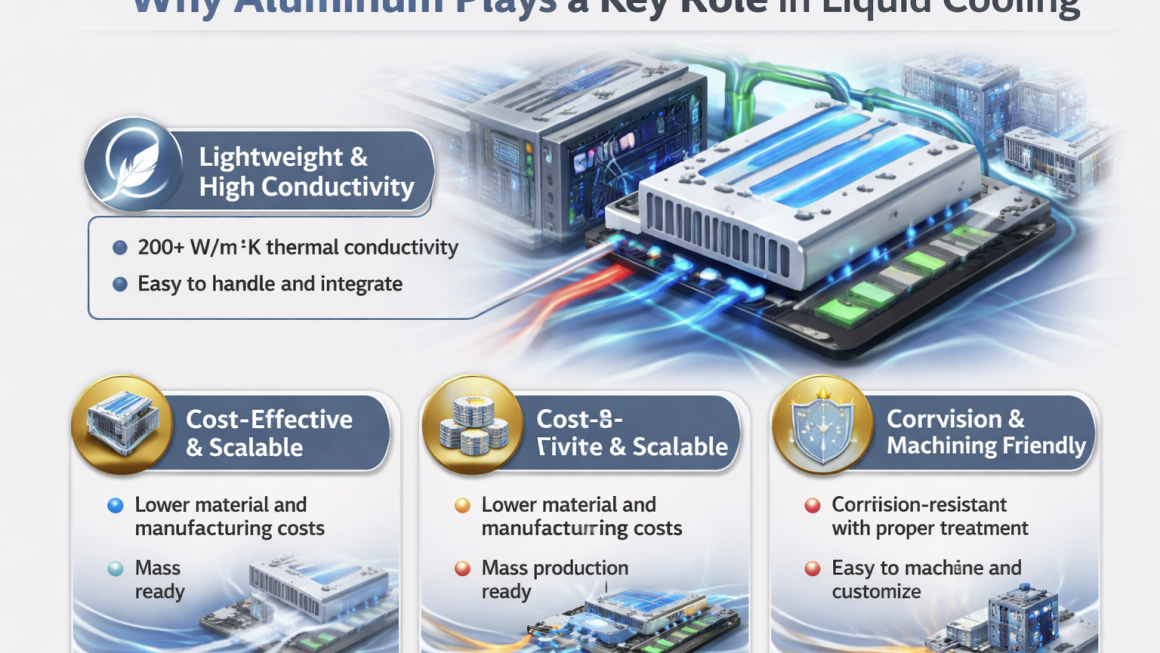
The Rising Importance of Aluminum
As AI workloads become denser and more powerful, liquid cooling systems are essential for maintaining performance and reliability. While copper is often seen as the gold standard for thermal conductivity, aluminum has emerged as a critical material due to its balance of performance, cost, and scalability.
In high-density GPU and CPU clusters, aluminum components—especially in cold plates, heat exchangers, and chassis—are helping data centers stay efficient and future-proof.
1. Thermal Performance Meets Efficiency
Aluminum may not have the thermal conductivity of copper (~200–230 W/m·K vs 400 W/m·K), but it offers sufficient heat transfer for most AI server applications, especially when designed with optimized microchannels and surface treatments.
Key advantages:
- Efficient heat spreading across cold plate surfaces
- Lightweight design allows higher density racks
- Works well with direct-to-chip (D2C) liquid cooling
2. Weight and Cost Advantages
- Aluminum is lighter than copper, reducing rack and shipping weight
- It is more cost-effective, making high-density AI deployment financially feasible
- Easier to machine, extrude, or cast into complex shapes for optimized flow and heat transfer
Result: Data centers can deploy more servers per rack without overloading HVAC or structural limits.
3. Corrosion Resistance and Durability
With proper surface treatments or anodization, aluminum exhibits excellent corrosion resistance, even in water-based or dielectric fluids.
Benefits include:
- Longer component lifetime
- Minimal maintenance
- Compatibility with advanced liquid cooling systems
4. Integration with Hybrid and Advanced Materials
Aluminum works seamlessly with copper inserts, graphene coatings, and thermal interface materials (TIMs). This allows system designers to:
- Combine high conductivity copper where needed
- Use aluminum for structural support and large-surface heat transfer
- Enhance overall efficiency without excessive cost
Hybrid designs are increasingly common in hyperscale AI data centers, offering performance and scalability simultaneously.
5. Applications: Where Aluminum Excels in Liquid Cooling
| Component | Role of Aluminum |
|---|---|
| Cold Plates | Lightweight, cost-effective heat transfer surface |
| Heat Exchangers | Efficient conduction from liquid to air/water loops |
| Server Chassis | Structural support and heat spreading |
| Microchannel Plates | Optimized flow and thermal efficiency |
Use Cases: Medium-to-high-density AI clusters, HPC facilities, edge AI deployments, and cost-sensitive liquid-cooled systems.
6. Aluminum as a Strategic Material
While copper remains essential for maximum heat flux scenarios, aluminum provides the best tradeoff between weight, cost, manufacturability, and performance.
For AI infrastructure designers, aluminum enables:
- Scalable, efficient liquid cooling
- Lightweight, compact server racks
- Hybrid designs with advanced materials
Aluminum is not just a material; it’s a key enabler of modern liquid cooling architecture.