As AI data centers move toward higher rack power density and increasingly sophisticated liquid cooling systems, thermal management is no longer limited to removing heat from processors.
Engineers must also consider what happens to the physical infrastructure when temperatures continuously change.
Aluminum is widely used in AI infrastructure because it combines low weight, good thermal conductivity, corrosion resistance, and excellent manufacturability. However, aluminum also has a relatively high coefficient of thermal expansion.
This means that aluminum structures can change dimensions as their temperature changes.
In a conventional structure, this may have little practical impact.
In a high-density AI rack, however, thermal expansion can influence:
- Structural dimensions
- Processor-to-cooling interfaces
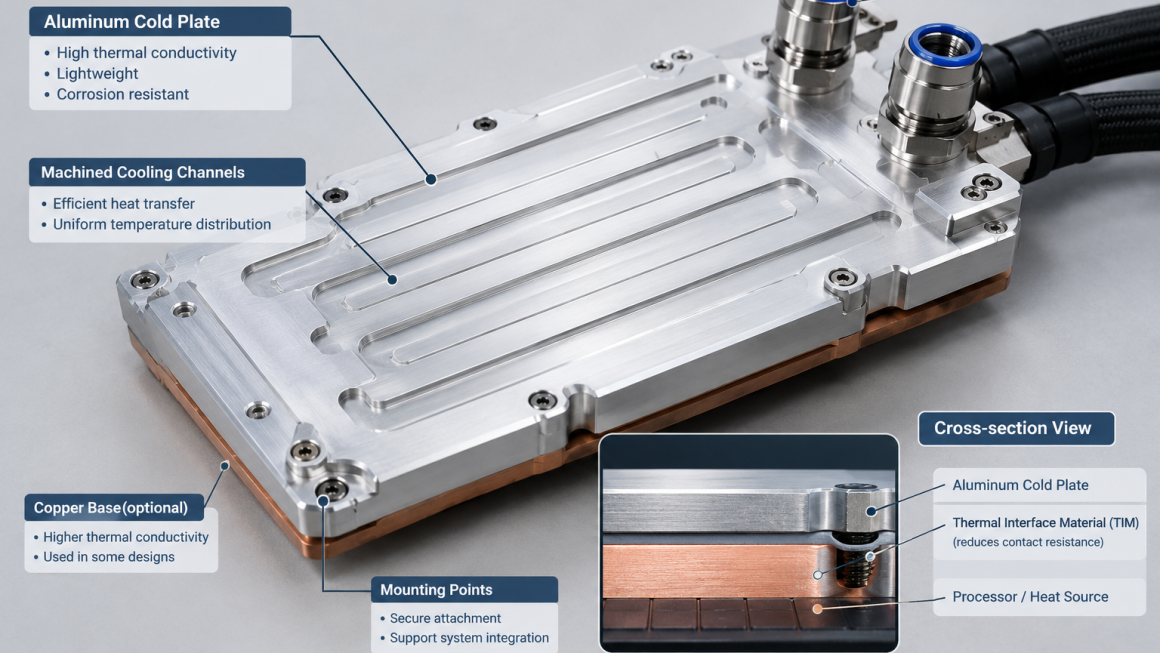
- Cold plates
- Mounting systems
- Fasteners
- Sealing surfaces
- Cable connections
- Aluminum extrusion profiles
- Connections between aluminum and other materials
Therefore, thermal expansion of aluminum in AI infrastructure should be considered during the design stage rather than treated as a secondary issue.
The key principle is simple:
Temperature Change → Dimensional Change → Interface Movement → Mechanical Stress
Understanding this relationship can help engineers develop more reliable AI cooling and structural systems.
What Is Aluminum Thermal Expansion?
Thermal expansion describes the change in a material’s dimensions as its temperature changes.
For a simple linear component, dimensional change can be approximated using:
ΔL = α × L × ΔT
where:
- ΔL = dimensional change
- α = coefficient of linear thermal expansion
- L = original length
- ΔT = temperature change
For many aluminum alloys, the coefficient of thermal expansion is approximately in the range of 23 × 10⁻⁶ /°C, although the actual value depends on alloy, temperature, and material condition.
This means that a sufficiently long aluminum structure can experience measurable dimensional movement even under relatively moderate temperature changes.
For example, a 1-meter aluminum component experiencing a 50°C temperature increase could expand by roughly:
23 × 10⁻⁶ × 1 × 50 ≈ 1.15 mm
For a simple structural member, this movement may be acceptable.
For a precision cooling interface, however, the same movement could become important.
Why Thermal Expansion Matters More in AI Infrastructure
AI infrastructure is increasingly compact and highly integrated.
A modern AI rack may combine:
GPU Servers + Cold Plates + Manifolds + Aluminum Frames + Copper Components + Cables + Fasteners + Seals
These components do not necessarily operate at the same temperature.
They may also have different coefficients of thermal expansion.
As a result, thermal movement can occur at multiple levels simultaneously.
For example:
GPU Temperature Changes
↓
Cold Plate Temperature Changes
↓
Aluminum Structure Expands
↓
Copper Components Expand Differently
↓
Fasteners and Interfaces Experience Relative Movement
This can create mechanical stress even when none of the individual components is experiencing an extreme temperature.
The challenge is therefore not simply aluminum expansion.
It is differential thermal expansion within the complete system.
Thermal Expansion of Aluminum in AI Server Racks
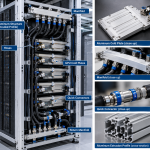
AI server racks often contain long vertical and horizontal aluminum profiles.
These profiles can support:
- Server trays
- GPU systems
- Power equipment
- Cooling manifolds
- Cable assemblies
- Doors and panels
- Auxiliary infrastructure
If the rack experiences a significant temperature change, these profiles can expand or contract.
The effect becomes more noticeable as the structural length increases.
A short bracket may experience only a very small dimensional change.
A 2-meter or 3-meter structural extrusion can experience substantially more movement.
Therefore, long aluminum profiles should be evaluated for thermal movement when dimensional alignment is important.
AI Server Thermal Deformation
Thermal deformation is not necessarily the same as structural failure.
A component can remain well below its strength limit while still moving enough to affect system performance.
For AI server infrastructure, thermal deformation may influence:
- Server alignment
- Rail positioning
- Door and panel fit
- Cooling connections
- Cable routing
- Mounting pressure
- Sealing interfaces
This is particularly important for precision systems.
A few tenths of a millimeter may be insignificant in one application but important in another.
Therefore, engineers should define acceptable thermal deformation based on the function of each component.
Thermal Expansion in Aluminum Cooling Structures
Liquid cooling introduces additional thermal considerations.
A simplified cooling structure may consist of:
Processor → TIM → Cold Plate → Coolant → Manifold → Heat Exchanger
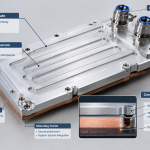
The cold plate itself may experience temperature gradients.
One section may be close to the high-power processor.
Another section may be closer to the coolant inlet or outlet.
This means the component may not simply expand uniformly.
Instead, it can experience non-uniform thermal deformation.
This can produce:
- Local bending
- Surface deformation
- Contact-pressure changes
- Thermal stress
- Interface movement
For high-power AI processors, this makes thermal-mechanical analysis particularly valuable.
Thermal Expansion and Cold Plate Interfaces
The interface between a processor and cold plate is one of the most sensitive areas in an AI cooling system.
The cooling structure must maintain appropriate thermal contact while accommodating temperature changes.
If the aluminum cold plate expands differently from the processor package or other interface materials, the contact conditions can change.
Potential consequences include:
- Uneven contact pressure
- Increased thermal resistance
- Localized hotspots
- Mechanical stress
- TIM deformation
Therefore, thermal expansion should be considered together with:
Contact Pressure + Surface Flatness + TIM Behavior + Mechanical Constraint
The objective is not to eliminate thermal movement.
It is to control it.
Differential Expansion Between Aluminum and Copper
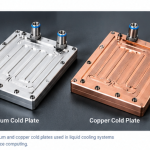
AI liquid cooling systems may contain both aluminum and copper.
Copper has a lower coefficient of thermal expansion than aluminum.
This difference can become important when the two materials are rigidly connected.
Consider a simplified assembly:
Aluminum Cooling Structure + Copper Thermal Component
When temperature increases, the aluminum component tends to expand more than the copper component for the same length and temperature change.
If the two materials are strongly constrained, the difference in expansion must be accommodated somewhere.
This can create:
- Mechanical stress
- Interface deformation
- Fastener loading
- Seal stress
- Fatigue under repeated thermal cycling
Material compatibility therefore includes not only corrosion and coolant compatibility but also thermal expansion compatibility.
Thermal Expansion and Fasteners
Fasteners are often overlooked in thermal-mechanical design.
An aluminum extrusion may be connected using:
- Steel bolts
- Stainless-steel fasteners
- Threaded inserts
- Brackets
- Rivets
- Other mechanical interfaces
These materials can expand at different rates.
During temperature changes, the relative movement can influence preload.
Too much thermal movement can potentially cause:
- Reduced clamping force
- Excessive clamping force
- Joint movement
- Local deformation
- Fatigue
- Loosening
Therefore, fastener selection and joint design should account for the operating temperature range.
Mounting Systems Need Controlled Movement
A common design mistake is to assume that a rigid structure is always better.
For thermally active systems, excessive constraint can actually increase thermal stress.
A more effective approach may be to allow controlled movement in selected directions.
Depending on the design, engineers may use:
- Floating mounts
- Sliding interfaces
- Expansion slots
- Flexible joints
- Compliant mounting elements
- Elongated holes
The principle is:
Constrain the structure where positioning is critical and allow movement where thermal expansion is expected.
This can reduce unnecessary mechanical stress.
Fixed Point and Floating Point Design
Long aluminum structures can benefit from a combination of fixed and floating mounting points.
A simplified concept is:
Fixed Point → Controls Position
Floating Points → Accommodate Thermal Movement
For example, a long aluminum extrusion may be fixed at one location while allowing controlled sliding at another location.
This prevents the entire structure from becoming over-constrained.
The exact implementation depends on:
- Structural loading
- Temperature range
- Required positioning accuracy
- Mounting hardware
- Profile geometry
This design principle is especially useful for long aluminum cooling and support structures.
Thermal Expansion and Cable Management
Cables and hoses can also be affected by thermal movement.
In AI liquid-cooled racks, coolant hoses may connect:
- Cold plates
- Manifolds
- Distribution units
- Rack-level cooling systems
If the aluminum structure moves while the hose remains fixed at another location, the hose can experience additional mechanical stress.
Similarly, rigid cable routing can transfer structural movement into connectors.
Therefore, cable and hose management should include appropriate flexibility.
Design considerations may include:
- Bend radius
- Slack
- Flexible sections
- Strain relief
- Movement allowance
- Connector positioning
Thermal expansion should therefore be considered not only in the aluminum structure itself but also in everything connected to it.
Sealing and Thermal Expansion
Seals are another critical interface.
Liquid cooling systems may contain seals around:
- Cold plates
- Manifolds
- Ports
- Connectors
- Covers
- Service interfaces
Thermal expansion can change the dimensions and contact pressure of these interfaces.
Repeated temperature cycles can also cause mechanical fatigue in sealing materials.
Therefore, sealing systems should be selected and designed according to:
- Operating temperature
- Pressure
- Coolant chemistry
- Thermal cycling
- Material compatibility
- Expected service life
A leak-free system requires both good sealing materials and appropriate thermal-mechanical design.
Thermal Gradients Are More Important Than Average Temperature
Engineers should not look only at average temperature.
A component may have a relatively moderate average temperature while experiencing a significant temperature difference across its surface.
For example:
Coolant Inlet → Low Temperature
Processor Region → High Temperature
Coolant Outlet → Intermediate Temperature
This creates a thermal gradient.
Different parts of the aluminum structure expand by different amounts.
The result can be bending or warping rather than simple uniform expansion.
For precision cold plates and heat spreaders, this distinction can be important.
Thermal Stress in Aluminum Structures
When aluminum is free to expand, thermal expansion generally produces limited mechanical stress.
The problem occurs when expansion is constrained.
A simplified conceptual relationship is:
Thermal Stress ∝ Elastic Modulus × Thermal Expansion × Temperature Change
The actual stress state depends on geometry, constraints, temperature distribution, material properties, and joint design.
This is why simply calculating dimensional expansion is not enough.
Engineers should also ask:
Where can the structure move?
and:
What prevents it from moving?
These questions help identify potential thermal-stress concentrations.
Repeated Thermal Cycling and Long-Term Reliability
AI infrastructure may experience repeated temperature changes.
For example:
Low Load → High Load → Low Load → High Load
can produce repeated heating and cooling.
Over thousands of cycles, repeated thermal movement can contribute to fatigue or degradation at interfaces.
Potentially affected components include:
- Fasteners
- Joints
- Seals
- TIMs
- Mounting brackets
- Welded connections
- Bonded interfaces
This is why long-term reliability should consider not only maximum temperature but also the number and magnitude of thermal cycles.
Aluminum Thermal Expansion and Surface Contact
Surface contact is particularly important for thermal components.
A heat spreader or cold plate requires a reliable thermal interface.
If thermal deformation causes the surface to become less flat, the contact area can change.
This can increase local thermal resistance.
For high-power AI processors, this may contribute to localized hotspots.
Therefore, thermal-mechanical design should consider:
Temperature Distribution → Deformation → Contact Pressure → Thermal Resistance
This is an example of why thermal and mechanical engineering cannot always be separated in AI infrastructure.
How Profile Geometry Can Reduce Thermal Deformation
The geometry of an aluminum extrusion can influence its thermal behavior.
Engineers can consider:
- Wall thickness
- Internal ribs
- Symmetrical geometry
- Support locations
- Expansion direction
- Cross-sectional stiffness
A symmetrical profile can sometimes provide more predictable thermal movement.
Strategically positioned ribs can increase stiffness.
Mounting points can be designed to accommodate expansion.
Therefore, profile design is not only a structural optimization problem.
It can also be a thermal-mechanical optimization problem.
Aluminum Extrusion for Thermally Stable AI Structures
Aluminum extrusion provides considerable flexibility for this type of design.
A profile can be engineered with:
- Reinforced sections
- Mounting channels
- Floating interfaces
- Cable paths
- Cooling interfaces
- Structural ribs
This allows engineers to control where thermal movement occurs.
For example, a profile may be designed to maintain stiffness in one direction while allowing controlled expansion in another.
This is much more effective than simply making the entire structure thicker.
Thermal Expansion and Surface Treatment
Surface treatment does not eliminate the thermal expansion of the aluminum substrate.
However, thermal cycling can still be relevant to the durability of coatings and anodized surfaces.
Repeated expansion and contraction may create mechanical stresses at interfaces between:
- Aluminum substrate
- Coating
- Sealant
- Attached components
Therefore, surface-treatment selection should consider the expected operating environment and thermal cycling.
For outdoor or industrial AI infrastructure, environmental exposure and thermal cycling should be evaluated together.
Thermal Expansion in Outdoor AI Infrastructure
Outdoor or edge AI infrastructure can experience a wider temperature range than climate-controlled data centers.
An aluminum structure may experience:
- Solar heating
- Cold nighttime temperatures
- Rain cooling
- Wind-driven temperature changes
This can create larger thermal cycles.
For outdoor equipment, thermal expansion should therefore be considered alongside:
- UV exposure
- Humidity
- Corrosion
- Wind loading
- Dust
- Condensation
The combination of environmental and thermal stresses can be more important than any individual factor.
Designing for Thermal Expansion: A Practical Workflow
Engineers can incorporate thermal expansion into the design process through several steps.
Step 1: Define the Operating Temperature Range
Identify minimum, maximum, and typical temperatures.
Step 2: Identify Temperature Gradients
Determine whether different parts of the structure operate at different temperatures.
Step 3: Calculate Expected Dimensional Movement
Use the coefficient of thermal expansion and component dimensions to estimate movement.
Step 4: Identify Fixed Interfaces
Determine which points cannot move.
Step 5: Identify Floating Interfaces
Provide controlled movement where appropriate.
Step 6: Evaluate Different Materials
Compare aluminum, copper, steel, polymers, seals, and other materials.
Step 7: Check Mechanical Stress
Evaluate thermal stress and deformation under realistic constraints.
Step 8: Validate the Interface
Check contact pressure, sealing, fastening, and alignment.
Step 9: Test Thermal Cycling
Verify performance under repeated temperature changes.
This workflow can identify potential thermal-mechanical problems before production.
Thermal-Mechanical Simulation
For complex AI infrastructure, simulation can help predict thermal deformation.
A coupled thermal-structural analysis can evaluate:
- Temperature distribution
- Thermal expansion
- Structural deformation
- Stress concentration
- Interface movement
- Fastener loading
- Cold plate deformation
A typical process is:
Thermal Model → Temperature Distribution → Structural Model → Thermal Deformation → Interface Analysis
This can be particularly valuable for:
- High-power cold plates
- Long aluminum cooling structures
- Precision mounting systems
- Aluminum-copper assemblies
- Large AI rack frames
Simulation can reduce the need for repeated physical prototypes while helping engineers identify critical areas.
Physical Validation Still Matters
Simulation should be supported by physical testing.
A prototype can be evaluated under controlled temperature cycles to measure:
- Dimensional movement
- Surface flatness
- Interface pressure
- Structural deformation
- Seal performance
- Fastener behavior
- Cooling performance
The most reliable development approach combines:
Calculation + Simulation + Prototype + Thermal Cycling Test
This provides a stronger basis for long-term reliability.
Design Strategies for Controlling Aluminum Thermal Expansion
Several practical strategies can be used.
Use Appropriate Expansion Allowances
Provide sufficient space for expected dimensional movement.
Avoid Over-Constraining Long Profiles
Allow movement where it does not compromise positioning.
Use Fixed and Floating Mounts
Control the location of the structure while accommodating thermal expansion.
Consider Material Combinations Carefully
Evaluate differences between aluminum, copper, steel, and polymer components.
Optimize Profile Geometry
Use structural geometry to control deformation.
Control Temperature Gradients
More uniform temperatures generally produce more predictable deformation.
Validate Thermal Interfaces
Ensure that dimensional movement does not compromise contact or sealing.
Thermal Expansion and Lifecycle Reliability
The impact of thermal expansion may not appear immediately after installation.
A system can perform normally during initial testing but experience gradual degradation after repeated thermal cycles.
Potential long-term effects include:
- Joint fatigue
- Seal degradation
- Fastener movement
- Contact-pressure changes
- Surface deformation
- Cable stress
- Cooling-performance variation
Therefore, lifecycle reliability analysis should include thermal cycling rather than evaluating only static temperature conditions.
The Importance of System-Level Design
Thermal expansion demonstrates why AI infrastructure components cannot always be designed independently.
A cooling plate may be thermally optimized but mechanically incompatible with the rack.
A structural frame may be strong but over-constrain a cooling manifold.
A mounting system may be mechanically robust but create excessive stress during temperature changes.
A cable assembly may work perfectly at room temperature but become overstressed during thermal cycling.
The complete architecture must therefore consider:
Thermal + Mechanical + Structural + Electrical + Fluidic Interfaces
This is the essence of system-level infrastructure engineering.
Aluminum Thermal Expansion: Key Engineering Questions
Before finalizing an aluminum AI infrastructure design, engineers should ask:
How much will the structure move?
Calculate expected dimensional changes over the operating temperature range.
Where will the movement occur?
Determine the preferred direction of thermal expansion.
What is fixed?
Identify critical positioning points.
What can move?
Design floating or sliding interfaces where appropriate.
Are different materials connected?
Evaluate differential thermal expansion.
Will contact pressure change?
Check thermal interfaces and fasteners.
Will seals remain reliable?
Evaluate temperature cycling and deformation.
Will cables and hoses experience additional stress?
Provide appropriate flexibility.
Will repeated cycling affect reliability?
Validate long-term thermal-mechanical behavior.
From Aluminum Material to Thermal-Mechanical Infrastructure
The value of aluminum in AI infrastructure goes beyond low weight and thermal conductivity.
When properly engineered, aluminum extrusion and machined aluminum components can form integrated structures that combine:
Structural Support + Thermal Management + Mounting + Cable Routing
But this integration also means that thermal expansion must be considered across the complete component.
The design process should therefore move from:
Material Selection
to:
Profile Design
to:
Thermal Analysis
to:
Mechanical Analysis
to:
Interface Design
to:
Thermal Cycling Validation
This approach can create more predictable and reliable infrastructure.
Thermal expansion of aluminum is a fundamental material behavior, but in high-density AI infrastructure it can become an important engineering design consideration.
As AI servers generate more heat and liquid cooling becomes increasingly common, aluminum components may experience significant temperature changes.
These changes can influence:
Dimensions + Interfaces + Mounting Systems + Cooling Structures + Seals + Fasteners + Cables
The objective is not to prevent aluminum from expanding.
That is not practical.
The objective is to control and accommodate thermal movement.
For AI server structures, this may involve optimized extrusion geometry, fixed and floating mounting points, expansion allowances, compatible materials, flexible connections, and coupled thermal-mechanical analysis.
For aluminum cooling structures, engineers should also evaluate temperature gradients, surface flatness, contact pressure, and long-term thermal cycling.
Ultimately, reliable AI infrastructure requires more than selecting an aluminum alloy with good thermal and mechanical properties.
It requires understanding how that material behaves inside the complete thermal, mechanical, and structural system.
The design philosophy can be summarized as:
Temperature Change → Predict Thermal Movement → Control Interfaces → Manage Stress → Validate Thermal Cycling → Improve Lifecycle Reliability
As AI infrastructure continues to become denser and more thermally demanding, thermal expansion will become an increasingly important part of aluminum structural and cooling design.
Good aluminum infrastructure is not designed to eliminate thermal movement—it is designed to make thermal movement predictable, controlled, and reliable.