
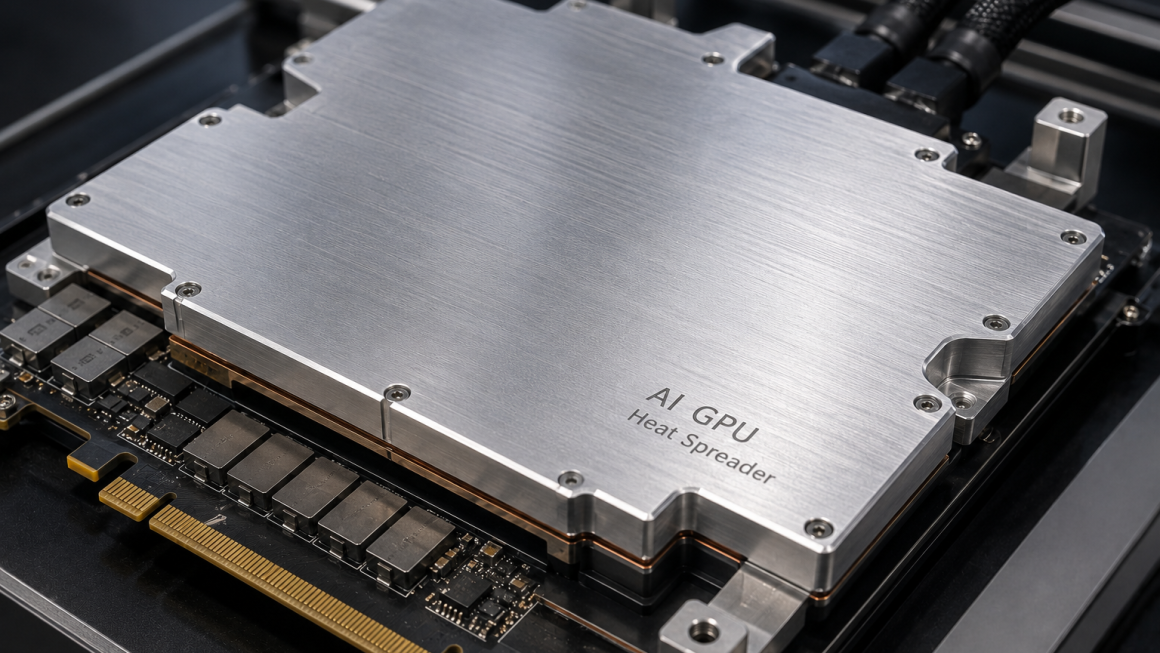
As artificial intelligence workloads continue to increase, AI processors are generating higher levels of heat within increasingly compact packages.
Modern GPUs, AI accelerators, CPUs, and other high-performance processors can operate at substantial power levels, creating challenging thermal conditions inside servers and data centers.
When heat is concentrated in a small semiconductor package, localized hotspots can develop rapidly.
This makes efficient heat spreading an important part of AI processor thermal management.
Aluminum heat spreaders can provide an effective way to distribute heat over a larger area before it reaches a heat sink, cold plate, vapor chamber, or other downstream cooling component.
However, the role of an aluminum heat spreader is often misunderstood.
A heat spreader is not simply a piece of metal placed on top of a processor.
Its performance depends on:
Material + Geometry + Contact Interface + Thermal Path + Manufacturing Accuracy
For high-power AI processors, these factors must be considered together.
Why AI Processors Need Heat Spreading
AI processors generate heat at extremely high power densities.
The heat may originate from a relatively small semiconductor die, while the downstream cooling system may have a significantly larger heat-transfer area.
This creates a thermal concentration problem.
A simplified thermal path can be represented as:
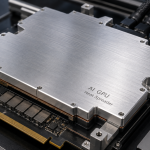
AI Processor → Thermal Interface → Heat Spreader → Cold Plate / Heat Sink → Cooling Medium
Without effective heat spreading, the heat entering the cooling system may remain highly concentrated.
This can create localized hotspots and uneven temperature distribution.
A heat spreader helps distribute the heat laterally across a larger surface area.
The objective is therefore not necessarily to remove all of the heat by itself.
Instead, it helps create a more uniform and manageable thermal path.
What Is an Aluminum Heat Spreader?
An aluminum heat spreader is a thermally conductive component designed to receive heat from a concentrated source and distribute that heat over a larger area.
Depending on the application, it may be positioned between:
- AI processor and cold plate
- Processor and heat sink
- Semiconductor package and cooling structure
- High-power electronic component and enclosure
- Thermal interface and larger cooling surface
The spreader can be manufactured as:
- Flat plates
- Machined blocks
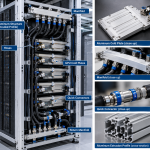
- Extruded profiles
- Integrated structural plates
- Customized thermal components
The geometry depends on the required thermal path and mechanical interface.
Aluminum as a Heat Spreader Material
Aluminum is attractive for AI infrastructure because it combines several useful properties.
These include:
- Relatively high thermal conductivity
- Low density
- Good machinability
- Excellent extrusion capability
- Corrosion resistance
- Good mechanical performance
- Recyclability
Compared with heavier metals, aluminum can provide useful thermal performance while reducing structural mass.
This can be particularly valuable in large server assemblies where thermal components must also be mechanically supported.
However, aluminum is not automatically the best material for every heat-spreading application.
Material selection should consider the complete thermal and mechanical system.
Thermal Conductivity Is Only One Part of the Design
Thermal conductivity is an important material property, but it does not determine the final heat-spreader performance by itself.
A high-conductivity material can still perform poorly if:
- The contact surface is uneven
- The thermal interface is poorly designed
- The heat-spreader thickness is inappropriate
- The heat-transfer area is insufficient
- Mechanical pressure is uneven
- The downstream cooling system is inadequate
The effective thermal path can therefore be more important than the material property alone.
A simplified thermal-resistance model is:
Rtotal = Rinterface + Rspreader + Rcooling
Reducing only the spreader’s internal resistance may not significantly improve system performance if the dominant resistance occurs at the interface or downstream cooling stage.
This is why heat-spreader development should be performed at the system level.
Aluminum Heat Spreader vs Heat Sink
A heat spreader and a heat sink perform different but complementary functions.
Heat Spreader
The primary function is to distribute heat over a larger area.
Heat Sink
The primary function is to transfer heat from the component into the surrounding air or another cooling medium.
A heat-spreader design may therefore look relatively simple.
Its purpose is to reduce local heat concentration before the heat reaches the main cooling structure.
For AI processors, the architecture may be:
GPU Die → Heat Spreader → Cold Plate → Coolant
or:
AI Processor → Heat Spreader → Heat Sink → Air
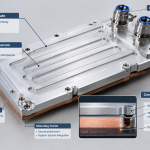
In liquid-cooled AI systems, the heat spreader can therefore form an important part of the interface between the processor and cold plate.
Heat Spreading and Local Hotspots
AI processors can produce highly concentrated heat loads.
This means that average temperature alone may not adequately describe thermal performance.
A processor could have an acceptable average temperature while still developing a localized hotspot.
Heat spreading helps reduce this concentration.
The basic principle is:
Small Heat Source → Larger Heat Distribution Area
The larger thermal footprint can improve the effectiveness of the downstream cooling structure.
For example, instead of transferring concentrated heat directly into a small cooling region, a heat spreader can distribute the heat across a larger contact area.
This can improve temperature uniformity and help reduce peak thermal gradients.
Heat Spreader Thickness Optimization
One common assumption is that a thicker heat spreader must always provide better thermal performance.
This is not necessarily true.
Increasing thickness can reduce in-plane thermal resistance, but it also increases:
- Material usage
- Component weight
- Manufacturing cost
- Package height
At some point, additional thickness may provide diminishing thermal benefits.
Therefore, heat-spreader thickness should be optimized according to:
- Heat-source dimensions
- Heat flux
- Thermal conductivity
- Cooling area
- Interface resistance
- Mechanical constraints
- Required temperature uniformity
The objective is to find an efficient thermal thickness rather than simply maximizing material volume.
The Importance of Thermal Interface Materials
The interface between the processor and heat spreader can become one of the most important parts of the thermal path.
Even when the aluminum spreader has good thermal conductivity, microscopic surface irregularities can create air gaps between mating surfaces.
Air has relatively poor thermal conductivity compared with metals.
Thermal interface materials (TIMs) can fill these microscopic gaps.
Depending on the application, the interface may use:
- Thermal grease
- Thermal pads
- Phase-change materials
- Other engineered thermal interface solutions
The selection and application of TIMs can have a significant effect on total thermal resistance.
Therefore, heat-spreader design should include the interface rather than treating the aluminum component as an isolated part.
Surface Flatness and Machining Accuracy
For high-power AI processors, surface quality can become critical.
The heat spreader needs to maintain appropriate contact with the processor and downstream cooling component.
Important manufacturing parameters may include:
- Flatness
- Surface roughness
- Thickness tolerance
- Parallelism
- Dimensional accuracy
These parameters can influence contact resistance.
For this reason, a heat spreader may begin as an aluminum extrusion or plate and then undergo precision CNC machining.
A typical manufacturing process can be:
Aluminum Material → Cutting → CNC Machining → Surface Treatment → Cleaning → Inspection
The exact process depends on the design and thermal requirements.
Extruded Aluminum Heat Spreaders
Aluminum extrusion can be particularly useful when the heat-spreading component requires a long or repeated geometry.
An extrusion can integrate:
- Thermal contact surfaces
- Structural ribs
- Mounting features
- Cooling channels
- Attachment interfaces
This can reduce the number of separate components.
For example, an aluminum extrusion could potentially function as both a thermal spreader and a structural mounting element.
This is particularly attractive for larger AI infrastructure assemblies where thermal and mechanical requirements overlap.
CNC-Machined Aluminum Heat Spreaders
CNC machining provides another manufacturing route.
Machined aluminum heat spreaders can be designed with precise:
- Contact surfaces
- Mounting holes
- Fastener locations
- Steps
- Recesses
- Alignment features
This can be valuable when the processor package or cold plate requires tight dimensional tolerances.
A hybrid manufacturing strategy can also be used:
Extrusion for the Main Geometry + CNC Machining for Precision Interfaces
This can provide a balance between manufacturing efficiency and dimensional accuracy.
6061 vs 6063 for Heat Spreaders
The choice between 6061 and 6063 aluminum should depend on the specific design.
6063 is attractive for applications requiring complex extrusion geometry and good thermal performance.
6061 can be attractive when higher mechanical strength and machining performance are important.
For example:
Complex Extruded Thermal Profile → 6063
High-Strength Machined Thermal Component → 6061
However, this is a simplified guideline rather than a universal rule.
The actual selection should consider:
- Thermal conductivity
- Mechanical requirements
- Geometry
- Manufacturing method
- Surface treatment
- Dimensional requirements
- Cost
- Production volume
For high-power AI applications, material selection should be performed together with thermal and structural analysis.
Aluminum Heat Spreaders in Liquid-Cooled AI Servers
Liquid cooling is becoming increasingly important as AI rack power density rises.
In a liquid-cooled architecture, the heat path may be:
AI Processor → TIM → Aluminum Heat Spreader → Cold Plate → Coolant
The heat spreader helps distribute heat before it reaches the cooling plate.
The cold plate then transfers heat into the circulating coolant.
This architecture separates two functions:
Heat Spreading
and
Heat Removal
This distinction is important.
The heat spreader improves the distribution of heat.
The cold plate and coolant system are responsible for removing the heat from the system.
A successful thermal design must optimize both stages.
Heat Spreader Design for High Heat Flux
As processor power increases, thermal design becomes increasingly sensitive to heat flux.
Heat flux describes the amount of heat transferred through a specific area.
A small high-power processor can therefore create a much more demanding thermal condition than a larger component with the same total power.
Heat-spreader design should consider:
- Heat-source size
- Heat-source location
- Peak heat flux
- Heat distribution
- Contact area
- Cooling interface geometry
The spreader must be designed to distribute heat efficiently without creating unnecessary thermal resistance.
This often requires simulation rather than relying solely on simple material comparisons.
Thermal Simulation and FEA
Computer-aided engineering can help engineers optimize heat-spreader geometry.
Thermal simulation can evaluate:
- Temperature distribution
- Hotspot location
- Thermal gradients
- Heat-spreading efficiency
- Interface resistance
- Heat-transfer paths
A typical optimization process is:
Initial Design → Thermal Simulation → Identify Hotspots → Modify Geometry → Simulate Again → Prototype → Test
This process can be combined with structural FEA when the heat spreader also performs a mechanical function.
The result is a more integrated design approach.
Mechanical Requirements Should Not Be Ignored
A heat spreader is a thermal component, but it can also be a mechanical component.
It may need to:
- Maintain contact pressure
- Support a cold plate
- Connect to a server structure
- Resist deformation
- Accommodate thermal expansion
Excessive deformation can reduce thermal contact quality.
This means mechanical stiffness and thermal performance can be interconnected.
For example, a very thin heat spreader may reduce weight but deform under mounting pressure.
This can increase interface resistance.
Therefore, thermal and mechanical requirements should be evaluated together.
Thermal Expansion in AI Processor Assemblies
Aluminum expands and contracts with temperature.
AI processors, copper components, cold plates, PCBs, and other materials may have different coefficients of thermal expansion.
Repeated temperature changes can therefore create mechanical stresses.
This can affect:
- TIM layers
- Fasteners
- Contact surfaces
- Soldered components
- Mechanical interfaces
A reliable heat-spreader design should account for thermal expansion throughout the expected operating range.
This is particularly important in systems that experience frequent power cycling.
Corrosion and Material Compatibility
When aluminum is integrated into a liquid-cooled AI system, material compatibility becomes an important consideration.
The cooling loop may contain multiple materials, such as:
- Aluminum
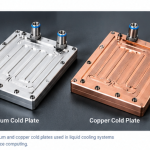
- Copper
- Stainless steel
- Brass
- Polymers
If incompatible materials are combined with an unsuitable coolant environment, galvanic corrosion may become a concern.
Therefore, heat-spreader and cooling-system development should consider:
- Coolant chemistry
- Material compatibility
- Surface treatment
- Electrical isolation
- Corrosion protection
Thermal performance should never be optimized independently from long-term reliability.
Weight Reduction Through Aluminum Heat Spreaders
One advantage of aluminum is its relatively low density.
This can be valuable in large AI server assemblies.
A lower-mass thermal component can simplify:
- Server assembly
- Rack integration
- Transportation
- Structural support
- Maintenance
However, the objective should not simply be minimum weight.
The goal is:
Maximum Thermal Performance per Unit Weight
This can be achieved through optimized geometry, material distribution, and integration with other infrastructure components.
Integrating Thermal and Structural Functions
One of the most interesting opportunities in AI infrastructure is multifunctional aluminum design.
A heat-spreading component could potentially incorporate:
Thermal Spreading + Structural Support + Mounting + Cable Management
This reduces the need for independent components.
For example, an aluminum profile may support a cooling structure while also providing attachment points for cables or server hardware.
Such integration can reduce component count and simplify assembly.
However, integrated designs require careful analysis because thermal, mechanical, electrical, and manufacturing requirements may interact.
Manufacturing Considerations
The best heat-spreader design must also be manufacturable at the required production volume.
Potential manufacturing routes include:
Extrusion
Suitable for continuous and complex profiles.
CNC Machining
Suitable for precision geometries and interfaces.
Die Casting
Potentially useful for certain high-volume complex components.
Forging
Suitable for applications requiring specific mechanical properties.
Hybrid Manufacturing
Combining extrusion with machining can provide both efficient material production and precision interfaces.
The optimal process depends on:
- Geometry
- Tolerances
- Production volume
- Material requirements
- Thermal performance
- Cost
Quality Control for Aluminum Heat Spreaders
Thermal components require more than visual inspection.
Important quality parameters may include:
- Dimensional accuracy
- Flatness
- Surface roughness
- Thickness
- Material composition
- Thermal conductivity
- Machining quality
- Surface treatment
- Cleanliness
For liquid-cooled systems, additional attention may be required for:
- Channel integrity
- Sealing surfaces
- Pressure resistance
- Leak testing
Quality control should reflect the actual failure modes of the component.
Aluminum Heat Spreaders and Future AI Architectures
As AI processors continue to increase in power density, thermal interfaces will become increasingly important.
Future AI server architectures may require tighter integration between:
- Processor packages
- Heat spreaders
- Cold plates
- Liquid cooling
- Structural frames
- Power systems
This creates an opportunity for aluminum components that are designed not as isolated thermal parts but as integrated infrastructure elements.
The boundary between:
Thermal Component
and
Structural Component
may become increasingly blurred.
How to Select an Aluminum Heat Spreader
When evaluating an aluminum heat spreader for an AI processor, engineers should consider at least the following factors.
1. Heat Load
How much power must be transferred?
2. Heat Flux
How concentrated is the heat source?
3. Contact Area
How large is the processor-to-spreader interface?
4. Thermal Conductivity
Does the selected aluminum provide sufficient thermal performance?
5. Thickness
Is the spreader thickness optimized for the heat-spreading requirement?
6. Surface Flatness
Can the required contact resistance be achieved?
7. Mechanical Strength
Can the component withstand mounting and operating loads?
8. Thermal Expansion
How will the spreader interact with surrounding materials?
9. Manufacturing
Should the component be extruded, machined, cast, or manufactured using a hybrid process?
10. Lifecycle Reliability
Can the component maintain performance throughout the expected operating life?
From Heat Spreader to Integrated Thermal Infrastructure
The future of AI thermal management is moving toward increasingly integrated architectures.
A conventional approach might use:
Processor + Separate Heat Spreader + Separate Mount + Separate Cooling Structure
An integrated approach can potentially combine several functions:
Processor Interface + Heat Spreading + Cooling Interface + Structural Mounting
This can reduce system complexity while improving packaging efficiency.
Aluminum extrusion and CNC machining provide useful manufacturing platforms for developing such components.
The key is to design the thermal component around the complete system rather than treating it as an isolated metal plate.
As AI processors continue to generate higher heat loads, effective heat spreading is becoming increasingly important for high-performance computing infrastructure.
Aluminum heat spreaders can provide a useful combination of thermal conductivity, low density, manufacturability, and structural capability.
Their role is to distribute concentrated processor heat across a larger area and create a more efficient thermal path toward the primary cooling system.
However, heat-spreader performance depends on much more than aluminum thermal conductivity.
The complete design must consider:
Material → Geometry → Surface Flatness → Thermal Interface → Mechanical Loading → Cooling Architecture → Manufacturing → Reliability
For some applications, 6063 aluminum may be attractive for complex extruded thermal profiles, while 6061 may be preferred for higher-strength machined components.
In liquid-cooled AI servers, aluminum heat spreaders can also form an important interface between high-power processors and cold plates.
The next generation of AI thermal infrastructure will increasingly require components that perform multiple functions simultaneously.
Thermal Spreading + Structural Integration + Precision Manufacturing
This is where engineered aluminum solutions can provide value beyond conventional heat sinks and standard aluminum components.
For high-power AI processors, the goal is not simply to find a material with good thermal conductivity.
The goal is to engineer a complete thermal path that moves heat quickly, uniformly, reliably, and efficiently from the processor to the cooling system.
High-Power Processor → Efficient Heat Spreading → Optimized Cooling Interface → Reliable AI Infrastructure