
Pushing Beyond Traditional Cooling
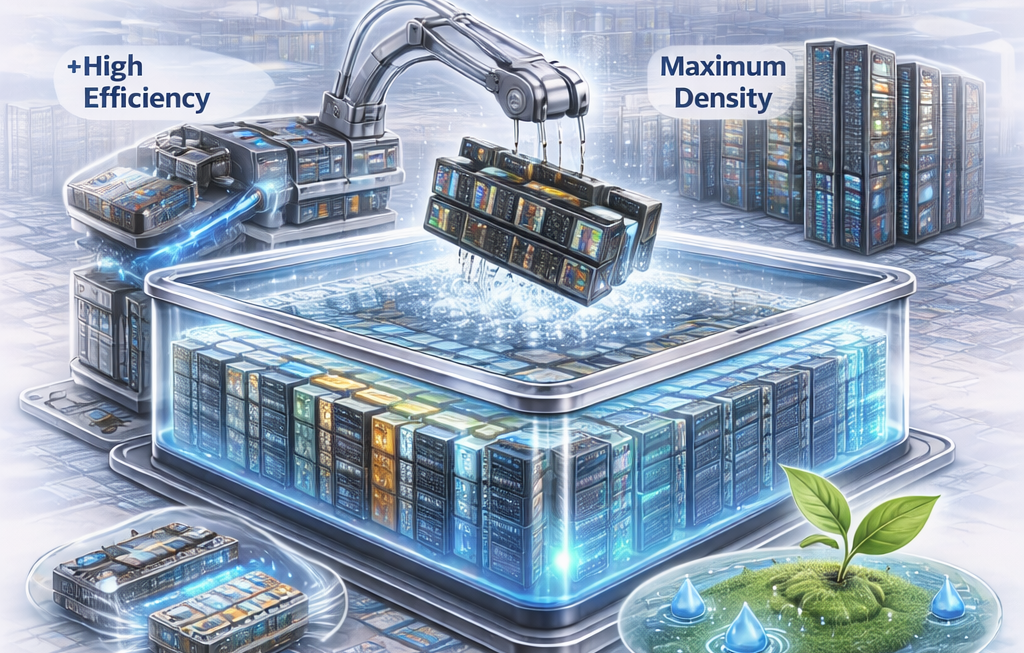
As AI workloads continue to grow in complexity and power density, traditional air and even direct-to-chip liquid cooling face fundamental limits. Immersion cooling has emerged as a game-changing technology, allowing entire servers or components to be submerged in dielectric fluids for highly efficient heat management.
This approach promises:
- Higher thermal efficiency
- Compact system design
- Reduced operational costs
- Scalability for next-generation AI hardware
1. What Is Immersion Cooling?
Immersion cooling involves submerging components directly in a non-conductive dielectric fluid. Key points:
- Components (GPUs, CPUs, memory modules) are fully immersed
- Heat is transferred directly to the fluid without the need for air
- Fluids can be single-phase (liquid remains liquid) or two-phase (boiling/condensation cycles)
Benefits over traditional cooling:
- Elimination of airflow constraints
- Uniform temperature distribution
- Simplified thermal interfaces
2. Advantages of Immersion Cooling for AI
Extreme Heat Dissipation
- Ideal for high-density GPUs and AI accelerators (>1000W per chip)
- Supports continuous operation without throttling
Energy Efficiency
- Reduces reliance on fans and HVAC
- Lower Power Usage Effectiveness (PUE) in data centers
Compact & Flexible Design
- Components can be densely packed without hotspots
- Rack-level or container-level deployment possible
Reduced Maintenance
- Fluid provides protection against dust and oxidation
- Components have longer operational life
3. Types of Immersion Cooling
Single-Phase
- Fluid absorbs heat and is circulated to a heat exchanger
- Simple, reliable, and cost-effective
- Common in hyperscale AI deployments
Two-Phase
- Fluid boils at low temperature, removing heat via phase change
- Extremely high heat flux removal
- Requires careful fluid selection and system design
- Emerging technology for ultra-high-performance AI clusters
4. Material and Fluid Considerations
Immersion cooling success depends on careful material-fluid compatibility:
- Dielectric fluids must be non-conductive and thermally stable
- Component materials (metals, plastics, coatings) must resist corrosion or swelling
- Advanced fluids may include engineered additives to improve heat transfer or prevent degradation
Emerging trends:
- Graphene-enhanced surfaces to improve heat conduction
- Advanced coatings for long-term reliability
- Hybrid dielectric fluids for optimized thermal properties
5. System-Level Integration
Immersion cooling is more than just a fluid bath—it requires holistic system engineering:
- Fluid circulation design (flow rate, distribution, thermal uniformity)
- Rack or container-level thermal management
- Monitoring and control systems for fluid temperature, pressure, and flow
- Maintenance strategies and leak prevention
Key insight: Immersion cooling is a platform-level solution, not just a component upgrade.
6. Challenges and Considerations
While promising, immersion cooling introduces new challenges:
- Higher initial capital expenditure
- Fluid handling and containment requirements
- Material compatibility over long-term operation
- Complexity of integration with existing infrastructure
Future innovations are focusing on:
- Lower-cost dielectric fluids
- Modular immersion enclosures
- Advanced monitoring and predictive maintenance systems
7. Why Immersion Cooling Is the Future for AI Hardware
With AI models scaling rapidly:
- Thermal density will continue to increase
- Air cooling and traditional liquid cooling will struggle
- Immersion cooling offers scalable, efficient, and reliable thermal management
For data centers and AI clusters, immersion cooling:
- Enables larger model training in smaller footprints
- Reduces operational costs and energy consumption
- Provides a long-term path for next-generation AI hardware deployment
Immersion cooling represents the next evolution of thermal management for AI hardware.
Its adoption will be driven by:
- Advances in dielectric fluids and materials
- Modular, scalable system design
- Operational efficiency and cost savings
In the near future, immersive solutions may become the standard for high-density AI systems, unlocking new levels of performance and reliability.