
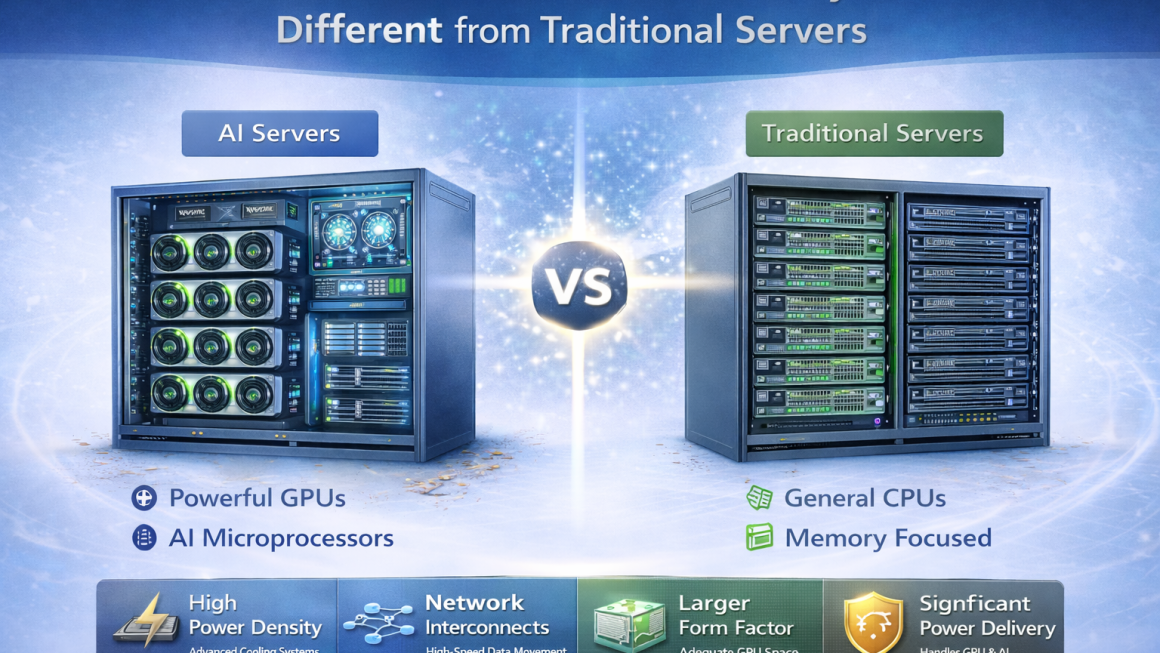
Artificial Intelligence (AI) workloads, including machine learning (ML) and deep learning (DL), have unique computational and data requirements that differ significantly from traditional IT workloads. Consequently, AI servers are designed with structural optimizations to handle these specific demands efficiently, enabling faster training, inference, and data processing.
Key Structural Differences
1. Processing Units
- Traditional Servers: Rely mainly on central processing units (CPUs) optimized for general-purpose computing.
- AI Servers: Incorporate high-performance GPUs, TPUs, FPGAs, or AI accelerators to handle massively parallel computations required for neural networks and large-scale ML models.
2. Memory Architecture
- Traditional Servers: Typically use standard RAM configurations suitable for transactional and database operations.
- AI Servers: Feature high-bandwidth memory (HBM), large GPU memory pools, and specialized caching to support large tensor operations and high-speed data throughput.
3. Storage Systems
- Traditional Servers: Rely on HDDs or SSDs optimized for capacity and general I/O.
- AI Servers: Use NVMe SSDs or tiered storage with high IOPS to feed GPUs quickly during training, minimizing bottlenecks.
4. Interconnects and Networking
- Traditional Servers: Standard Ethernet or Infiniband networks handle typical server-to-server communication.
- AI Servers: Require high-speed interconnects, such as NVLink, PCIe Gen5, or custom AI fabric, to facilitate rapid data transfer between GPUs and minimize latency in multi-GPU configurations.
5. Cooling and Power Design
- Traditional Servers: Standard air-cooling systems suffice for general workloads.
- AI Servers: Incorporate advanced liquid cooling or high-efficiency airflow designs to handle the higher heat density from GPUs and AI accelerators.
6. Scalability and Modular Design
- Traditional Servers: Optimized for rack density and linear scaling of CPU cores and memory.
- AI Servers: Feature modular GPU trays, expandable NVMe storage, and scalable networking to support multi-node clusters for distributed AI workloads.
Specialized Components in AI Servers
- GPU/TPU Arrays – Parallel compute units for training deep neural networks
- High-Bandwidth Memory (HBM) – Reduces memory bottlenecks for tensor processing
- NVMe Storage Pools – Fast access to large datasets
- High-Speed Interconnects – Low-latency GPU-to-GPU communication
- Enhanced Cooling Systems – Liquid cooling or hybrid airflow for thermal management
Use Case Implications
- Training Large AI Models: AI servers provide the necessary computational density to train models with billions of parameters.
- Inference Acceleration: Optimized memory and interconnects reduce latency for real-time AI applications.
- Data-Intensive Analytics: High-speed storage and GPU acceleration enable faster insights from massive datasets.
Structural Advantages Over Traditional Servers
| Feature | AI Servers | Traditional Servers |
|---|---|---|
| Compute | Multi-GPU/TPU for parallelism | CPU-centric |
| Memory | High-bandwidth, GPU-optimized | Standard DDR RAM |
| Storage | NVMe high-speed | SATA/SAS SSD or HDD |
| Networking | Low-latency GPU interconnect | Ethernet/Infiniband |
| Cooling | Advanced liquid/airflow | Standard air-cooling |
| Scalability | Multi-node clusters | Rack-scale CPU scaling |
Challenges in AI Server Design
- Power Consumption: AI accelerators require more energy than traditional CPUs.
- Heat Management: Dense GPUs create hotspots requiring advanced cooling.
- Cost: High-end GPUs, HBM, and NVMe storage increase CAPEX.
- Software Compatibility: Requires AI frameworks optimized for multi-GPU environments.
Future Trends
- Heterogeneous Computing: Integration of CPUs, GPUs, FPGAs, and AI chips in a single server.
- Liquid Immersion Cooling: To manage high-density AI racks efficiently.
- AI-Optimized Networking: Ultra-low-latency fabrics for exascale AI clusters.
- Energy-Efficient AI Accelerators: Balancing performance with sustainability.
AI servers differ structurally from traditional servers by prioritizing parallel processing, high-speed memory, optimized interconnects, and advanced cooling. These design choices are critical to meeting the demands of modern AI workloads, from deep learning model training to real-time inference.
Organizations adopting AI at scale need to consider these structural differences to maximize performance, efficiency, and scalability.