
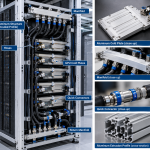
As AI data centers move toward higher rack densities, liquid cooling, heavier computing equipment, and increasingly integrated infrastructure, material selection is becoming an important part of physical infrastructure design.
Aluminum is widely considered for AI data center applications because it combines relatively low density, useful thermal conductivity, corrosion resistance, machinability, and excellent opportunities for extrusion and fabrication.
However, not all aluminum alloys provide the same performance.
Two alloys frequently considered for engineered aluminum components are 6061 and 6063 aluminum.
So, which is better for AI infrastructure?
The answer depends on the application.
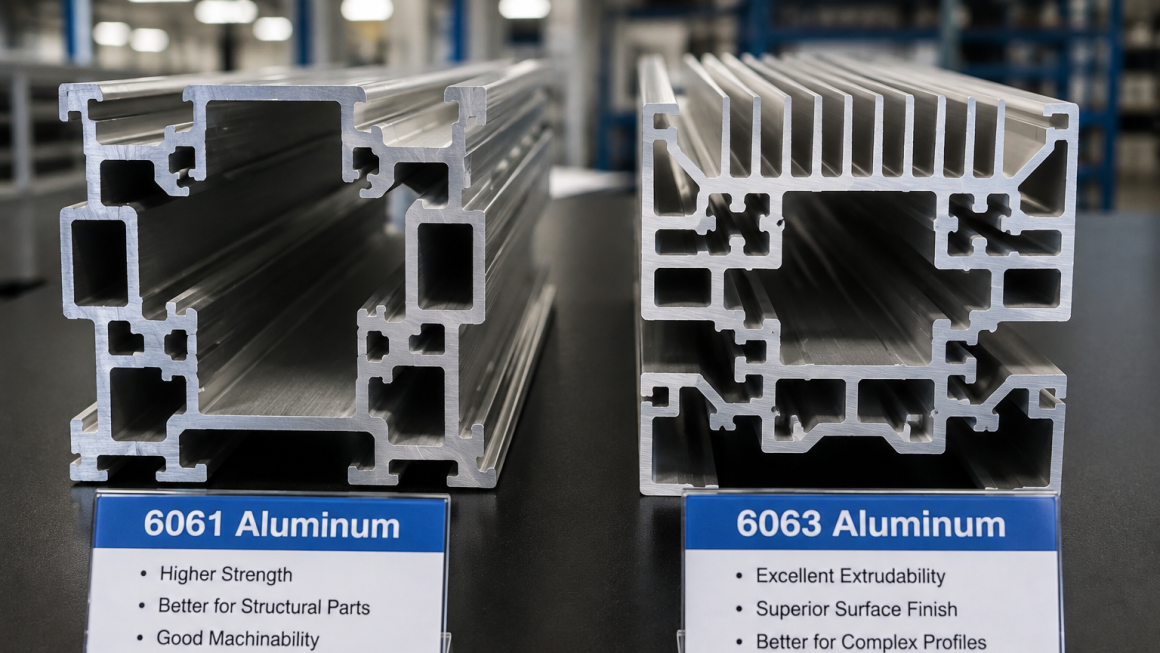
6061 aluminum is generally favored when higher mechanical strength and structural performance are important, while 6063 aluminum is particularly attractive for complex extruded profiles, surface finish, and applications where extrusion performance is a priority.
For AI data centers, the correct alloy should therefore be selected according to the function of the component rather than simply choosing the alloy with the highest strength or thermal conductivity.
6061 vs 6063 Aluminum: Quick Comparison
At a high level, the two alloys can be compared as follows:
| Property | 6061 Aluminum | 6063 Aluminum |
|---|---|---|
| Primary advantage | Strength and structural performance | Extrusion performance and surface finish |
| Extrusion complexity | Good | Excellent |
| Mechanical strength | Generally higher | Generally lower |
| Thermal conductivity | Good | Generally higher |
| Machinability | Good | Good |
| Surface finish | Good | Excellent |
| Corrosion resistance | Good | Good to excellent |
| Complex profiles | Suitable | Particularly suitable |
| Structural frames | Excellent candidate | Suitable for lighter-duty designs |
| Heat sinks | Suitable | Excellent candidate |
| Typical AI application | Structural components, brackets, heavy-duty frames | Extrusions, heat sinks, channels, lightweight structures |
The actual performance depends on the temper, geometry, processing condition, and specific design.
Therefore, alloy designation alone should never be used as the only material-selection criterion.
What Is 6061 Aluminum?
6061 is a widely used precipitation-hardenable aluminum alloy in the 6000 series.
Its combination of strength, corrosion resistance, machinability, and weldability makes it suitable for many structural and engineering applications.
For AI infrastructure, 6061 can be considered for components where mechanical performance is a major requirement.
Potential applications include:
- AI server rack structural components
- Heavy-duty aluminum frames
- Mounting brackets
- Equipment support structures
- CNC-machined components
- Structural beams
- Reinforced rack members
- Cooling-system support components
- Precision mechanical interfaces
One of the main advantages of 6061 is its relatively high strength compared with 6063.
This can be important when an aluminum structure needs to support substantial equipment loads.
What Is 6063 Aluminum?
6063 is also a 6000-series aluminum alloy, but it is particularly well known for its extrusion characteristics and surface finish.
It is frequently used to manufacture architectural and industrial aluminum profiles where complex cross-sectional geometries are required.
For AI infrastructure, this makes 6063 particularly interesting for:
- Aluminum extrusion profiles
- Heat sinks
- Cooling channels
- Cable-management structures
- Lightweight rack components
- Mounting channels
- Decorative or exposed structural profiles
- Thermal-management components
The alloy is generally easier to extrude into complex geometries than stronger structural alloys.
This can provide more freedom when engineers want to integrate multiple functions into a single profile.
6061 vs 6063: Which Is Stronger?
For most comparable tempers, 6061 generally provides higher mechanical strength than 6063.
This is one of the most important differences between the two alloys.
When designing an AI server rack or structural frame, engineers need to consider:
- Static equipment load
- Concentrated loads
- Bending
- Deflection
- Fastening forces
- Vibration
- Transportation loads
- Long-term dimensional stability
If a structural component experiences substantial mechanical stress, 6061 may therefore provide a better starting point.
However, material strength should not be considered independently from profile geometry.
A well-designed 6063 extrusion with optimized ribs, wall thickness, and cross-sectional geometry can provide useful structural performance while maintaining lower material usage.
In other words:
Alloy strength + profile geometry = actual structural performance
This is why aluminum extrusion design is just as important as alloy selection.
6061 vs 6063: Thermal Performance
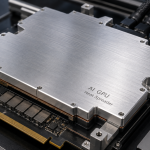
Thermal performance is particularly important in AI infrastructure because high-performance GPUs and accelerators generate substantial heat.
Both 6061 and 6063 offer useful thermal conductivity compared with many conventional structural metals.
However, 6063 generally offers somewhat higher thermal conductivity than 6061.
This makes 6063 attractive for applications where heat transfer is an important design objective.
Potential applications include:
- Heat sinks
- Heat spreaders
- Cooling channels
- Thermal frames
- Extruded cooling structures
- Thermal-management housings
But there is an important engineering principle to remember:
Higher thermal conductivity does not automatically mean better cooling performance.
The final thermal performance depends on the entire system.
For example:
GPU → Thermal Interface → Cold Plate → Coolant → Manifold → Heat Exchanger
The geometry of the component, contact resistance, coolant flow, surface area, wall thickness, and interface design can all have a significant influence on thermal performance.
Therefore, 6063 should not automatically be selected for every AI cooling component simply because it has higher thermal conductivity.
6061 vs 6063 for Aluminum Extrusion
This is where the difference between the two alloys becomes particularly relevant.
6063 is widely regarded as an excellent extrusion alloy.
It can support relatively complex profile geometries and generally provides good surface quality after extrusion and finishing.
This makes it attractive when an AI infrastructure component needs:
- Internal cavities
- Thin walls
- Multiple channels
- T-slots
- Mounting grooves
- Cooling pathways
- Integrated cable channels
- Complex structural ribs
6061 can also be extruded, but it is generally more demanding than 6063 when producing highly complex extrusion profiles.
Therefore, if the primary requirement is:
“Create a complex multifunctional aluminum extrusion.”
6063 may be the more attractive starting point.
If the requirement is:
“Create a high-strength structural component.”
6061 may be more appropriate.
Complex Aluminum Profiles for AI Infrastructure
AI infrastructure is creating new opportunities for multifunctional aluminum profiles.
A conventional aluminum profile may perform only one function.
A next-generation AI infrastructure profile could potentially combine:
Structural Support + Cable Routing + Cooling Interface + Equipment Mounting
For example, a single extruded profile could contain several internal cavities.
One section may provide structural reinforcement.
Another section may provide cable routing.
Additional features may provide mounting interfaces for cooling components.
This type of multifunctional design can reduce the number of separate components required in an AI rack.
Because 6063 is particularly suitable for complex extrusion geometries, it can be an attractive material for this type of application.
6061 vs 6063 for CNC Machining
CNC machining is another important consideration.
AI infrastructure often requires precision-machined components rather than simple extruded profiles.
Examples include:
- Cooling manifolds
- Mounting brackets
- Server interfaces
- Connector plates
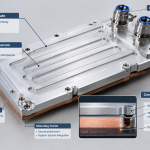
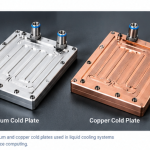
- Cold plates
- Structural joints
- Precision mounting components
6061 is widely used for CNC-machined aluminum components because it provides a useful combination of strength, machinability, and dimensional stability.
This makes it attractive when a component needs both:
High Mechanical Performance + Precision Machining
6063 can also be machined effectively, particularly for components that begin as extruded profiles.
A common manufacturing strategy is therefore:
6063 Extrusion → Cutting → CNC Machining → Surface Treatment
For higher-strength structural components, another possible approach is:
6061 Extrusion or Plate → CNC Machining → Surface Treatment
The best manufacturing route depends on geometry, production volume, tolerances, and final performance requirements.
Surface Finish: 6061 vs 6063
Surface appearance may not seem like a critical engineering issue for AI infrastructure, but it can become important when aluminum components are exposed or integrated into premium data center systems.
6063 is particularly well known for producing attractive extrusion surfaces.
It is therefore widely used where anodizing and other finishing processes are important.
Potential applications include:
- Visible rack structures
- Equipment frames
- Architectural data center components
- Exposed aluminum profiles
- Heat sinks
- Cable management structures
6061 can also receive a range of surface treatments, including anodizing.
However, if the project places a strong emphasis on extrusion appearance and complex profile quality, 6063 may offer advantages.
Corrosion Resistance
Both 6061 and 6063 provide good corrosion resistance compared with many conventional structural metals.
For AI data centers, this can be useful because infrastructure may need to operate reliably for many years.
However, corrosion performance depends on much more than the alloy designation.
Engineers should also consider:
- Coolant chemistry
- Humidity
- Surface treatment
- Contact with other metals
- Galvanic corrosion
- Contamination
- Environmental exposure
- Sealing
This becomes especially important in liquid-cooled AI infrastructure.
For example, aluminum may be placed near copper components, stainless-steel fittings, or other metals.
In such systems, material compatibility and coolant chemistry should be evaluated as part of the complete cooling architecture.
6061 vs 6063 for Liquid Cooling Systems
Liquid cooling is one of the most important areas where alloy selection becomes application-specific.
An AI liquid cooling system can contain:
- Cold plates
- Manifolds
- Cooling channels
- Pipes
- Quick-disconnect couplings
- Heat exchangers
- Mounting brackets
- Structural supports
Not every component requires the same material characteristics.
For example, a structural bracket supporting a coolant manifold may prioritize strength.
A heat sink or extruded cooling channel may prioritize thermal conductivity and extrusion complexity.
A CNC-machined manifold may require a combination of machinability, pressure resistance, dimensional stability, and coolant compatibility.
Therefore, it is entirely possible for the same AI infrastructure system to use both 6061 and 6063 aluminum.
This is an important point.
The question should not always be:
“Should we use 6061 or 6063?”
The better question is:
“Where should 6061 and 6063 each be used within the system?”
Where 6061 Aluminum May Be Better for AI Infrastructure
6061 is generally a strong candidate when mechanical performance is the dominant requirement.
Typical applications may include:
Heavy-Duty Rack Structures
When large equipment loads must be supported, 6061 can provide useful structural strength.
Structural Brackets
Mounting components that experience significant mechanical forces may benefit from the higher strength of 6061.
CNC-Machined Components
6061 is commonly selected for precision-machined engineering components.
Mechanical Interfaces
Components connecting cooling systems, server structures, and other infrastructure may require higher mechanical performance.
Reinforced Frames
Where structural stiffness and load-bearing capability are important, 6061 can be a strong candidate.
Where 6063 Aluminum May Be Better for AI Infrastructure
6063 becomes particularly attractive when extrusion geometry, thermal performance, or surface quality is important.
Typical applications may include:
Complex Aluminum Extrusions
6063 is well suited to profiles with multiple channels, cavities, ribs, and mounting features.
Heat Sinks
Its thermal characteristics and extrusion capability make it attractive for many heat-dissipation applications.
Cooling Channels
Extruded aluminum cooling structures can take advantage of complex profile geometry.
Cable Management
Long continuous profiles with integrated cable channels can be manufactured efficiently.
Lightweight Structural Profiles
For applications where loads are moderate and profile complexity is high, 6063 can provide an effective solution.
Can 6061 and 6063 Be Used Together?
Yes.
In fact, combining different aluminum alloys can be a practical strategy for complex AI infrastructure.
Consider an AI rack architecture consisting of:
Primary Structural Frame → 6061
Complex Extruded Channels → 6063
Heat Sink → 6063
Precision Mounting Brackets → 6061
CNC-Manufactured Mechanical Interfaces → 6061
This approach allows each material to perform the function for which it is best suited.
The result can be more efficient than forcing the entire system to use a single aluminum alloy.
This is an example of system-level material selection.
The Role of Aluminum Profile Geometry
It is important not to overemphasize alloy selection.
In many AI infrastructure applications, profile geometry can have an enormous impact on performance.
For example, increasing structural ribs or optimizing the position of material can significantly improve stiffness without simply increasing overall weight.
Similarly, cooling channels can be positioned to increase heat-transfer efficiency.
Mounting slots can be integrated directly into the profile.
Cable channels can be incorporated into unused internal space.
Therefore, the engineering process should ideally follow:
Application Requirements → Load & Thermal Analysis → Profile Geometry → Alloy Selection → Manufacturing Process
rather than:
Choose Alloy → Design Around It
The first approach generally provides greater design flexibility.
6061 vs 6063: A Practical Selection Guide
For AI infrastructure projects, the following simplified decision framework can be useful.
Choose 6061 when:
- Structural strength is a major requirement
- The component experiences significant mechanical loading
- CNC machining is important
- Heavy-duty brackets are required
- Structural interfaces need higher strength
- Dimensional stability is important
Consider 6063 when:
- Complex extrusion geometry is required
- Surface finish is important
- Thermal performance is important
- Long continuous profiles are needed
- Integrated channels are required
- Heat sinks or cooling structures are being developed
- Lightweight multifunctional profiles are preferred
Consider using both when:
- The AI infrastructure contains multiple functional layers
- Structural and thermal requirements are different
- Some components require high strength while others require complex extrusion
- The system is being optimized at the architecture level
6061 vs 6063: Cost Considerations
Material price should not be the only consideration when comparing 6061 and 6063.
The total manufacturing cost can include:
Raw Material + Extrusion + Tooling + CNC Machining + Surface Treatment + Assembly + Inspection + Logistics
A slightly more expensive alloy may actually produce a lower total system cost if its manufacturing characteristics reduce machining or assembly requirements.
For example, a complex 6063 extrusion may replace several machined or assembled components.
Similarly, a 6061 component may be worth the additional material or manufacturing cost if it eliminates the need for additional structural reinforcement.
This is why AI infrastructure projects should evaluate total cost of ownership and manufacturing cost, rather than material price alone.
Why Material Selection Should Start at the System Level
AI data centers are highly integrated environments.
A structural aluminum profile may interact with:
- Server chassis
- GPU hardware
- Cooling systems
- Coolant
- Copper components
- Stainless-steel components
- Electrical systems
- Cable management
- Mounting hardware
Changing one material can influence other parts of the system.
For example, changing an aluminum alloy may affect extrusion geometry.
Changing geometry may affect structural stiffness.
Changing wall thickness may affect thermal performance.
Changing cooling channels may affect pressure drop.
Changing surface treatment may affect electrical or corrosion behavior.
This interconnected relationship is why material selection should be performed at the system level.
Beyond 6061 vs 6063: Engineering the Complete Aluminum Solution
For AI infrastructure, the most valuable question is rarely simply which aluminum alloy has better properties.
The more important question is:
How can the material, geometry, manufacturing process, thermal system, and structural architecture work together?
A complete aluminum infrastructure solution may involve:
Alloy Selection
↓
Extrusion Profile Design
↓
Structural Optimization
↓
Thermal Integration
↓
CNC Machining
↓
Surface Treatment
↓
Assembly
↓
Thermal & Mechanical Validation
This approach can turn a conventional aluminum profile into an engineered infrastructure component.
There is no universal winner in the 6061 vs 6063 aluminum comparison.
6061 is generally more attractive when higher mechanical strength, structural performance, and precision machining are priorities.
6063 is particularly attractive when complex extrusion geometry, thermal performance, and surface finish are important.
For AI data center infrastructure, both alloys can play important roles.
A high-density AI rack may use 6061 for structural members while using 6063 for complex extruded cooling channels, heat sinks, cable-routing profiles, or lightweight multifunctional components.
The most effective approach is therefore to select the alloy according to the function of each component.
6061 for strength.
6063 for extrusion flexibility and thermal applications.
Both for system-level AI infrastructure design.
As AI computing continues to increase rack power density and drive wider adoption of liquid cooling, aluminum alloy selection will become increasingly connected with structural engineering, thermal management, and manufacturing strategy.
For AI infrastructure developers, the future is not simply about choosing a stronger or more thermally conductive aluminum alloy.
It is about designing the right aluminum material, geometry, and manufacturing process for the right function within the complete AI infrastructure system.
Material Selection → Profile Design → Thermal Management → Structural Integration → AI Infrastructure