



Why Cold Plate Materials Matter
In liquid cooling systems—especially Direct-to-Chip (D2C) architectures—the cold plate is the critical interface between the chip and the cooling fluid.
While system design and fluid flow are important, the material of the cold plate directly determines:
- Heat transfer efficiency
- System reliability
- Long-term corrosion resistance
- Overall cooling performance
👉 In high-density AI infrastructure, material choice is not secondary—it is decisive.
1. What Does a Cold Plate Do?


A cold plate sits directly on top of the GPU/CPU, transferring heat into circulating liquid via internal channels.
Core functions:
- Rapid heat absorption from the chip
- Efficient heat transfer to coolant
- Uniform temperature distribution
- Mechanical stability and sealing
2. Key Material Requirements for Cold Plates
To perform effectively, cold plate materials must meet several criteria:
Thermal Conductivity
- High conductivity ensures fast heat transfer
- Reduces thermal resistance between chip and coolant
Corrosion Resistance
- Continuous exposure to liquid requires chemical stability
- Especially important for water-based systems
Mechanical Strength
- Must withstand pressure, flow, and long-term operation
Manufacturability
- Compatibility with CNC machining, brazing, or additive manufacturing
- Ability to form microchannels for enhanced heat exchange
3. Common Cold Plate Materials
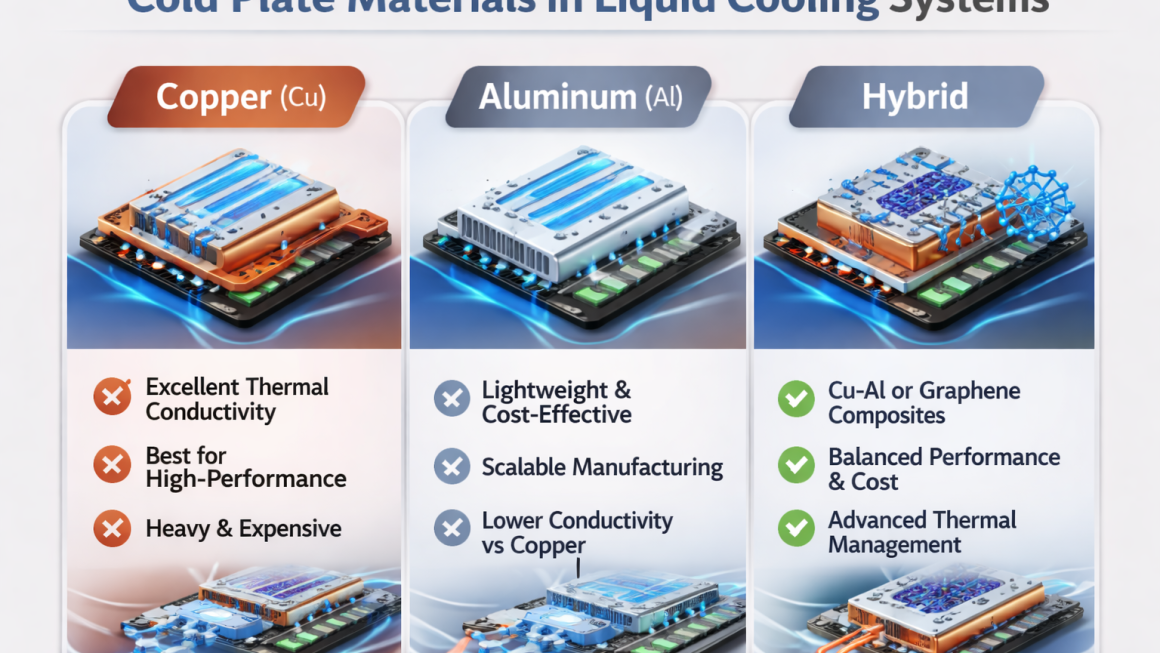
Copper (Cu): High Performance Standard


Advantages:
- Excellent thermal conductivity (~400 W/m·K)
- Ideal for high heat flux applications
- Widely used in HPC and AI systems
Limitations:
- Heavy and expensive
- Susceptible to corrosion without proper treatment
👉 Best for: Maximum performance AI and HPC cooling
Aluminum (Al): Lightweight and Scalable


Advantages:
- Lightweight and cost-effective
- Good thermal conductivity (~200–230 W/m·K)
- Easier manufacturing and scalability
Limitations:
- Lower conductivity than copper
- Requires surface treatment for corrosion resistance
👉 Best for: Scalable AI infrastructure and cost-sensitive deployments
Hybrid Materials (Cu + Al, Advanced Composites)


Approach:
- Copper base for heat transfer
- Aluminum structure for weight and cost optimization
- Integration with advanced materials (graphene, coatings)
Advantages:
- Balanced performance and cost
- Improved thermal spreading
- Enhanced system efficiency
👉 Best for: Next-generation AI cooling systems
4. The Role of Advanced Materials (Your Strategic Entry Point)
Cold plate performance can be significantly enhanced through material innovation:
Graphene & Carbon-Based Enhancements
- Improve in-plane heat spreading
- Reduce hotspots at chip interface
Thermal Interface Materials (TIMs)
- Minimize contact resistance between chip and cold plate
- Critical for D2C systems
Surface Coatings
- Anti-corrosion layers
- Improved wettability and thermal transfer
👉 This is exactly where materials suppliers can move upstream into system value.
5. Choosing the Right Material: Application-Based Strategy
| Application | Recommended Material |
|---|---|
| Hyperscale AI / HPC | Copper or Hybrid |
| Medium-density AI | Aluminum |
| Cost-sensitive deployments | Aluminum |
| Advanced systems | Hybrid + graphene/TIM |
Material Choice Defines Cooling Performance
In liquid cooling systems, the cold plate is not just a component—it is the thermal bridge that determines system efficiency.
As AI infrastructure evolves:
- Copper ensures performance
- Aluminum enables scalability
- Hybrid and advanced materials unlock future potential
👉 The winners in this space are not just system integrators—but those who control the material layer of thermal performance.