
Why Direct-to-Chip Cooling Matters
As AI workloads scale, GPU and CPU heat output has become a major performance bottleneck. Traditional air cooling struggles with high-density racks, leading to throttling and increased energy costs.
Direct-to-Chip (D2C) liquid cooling addresses this by delivering cooling fluid directly to the processor, rather than relying on airflow through heat sinks. This approach is becoming essential for high-performance AI infrastructure and HPC systems.
1. How Direct-to-Chip Liquid Cooling Works
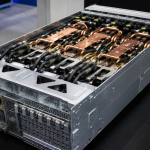
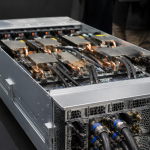
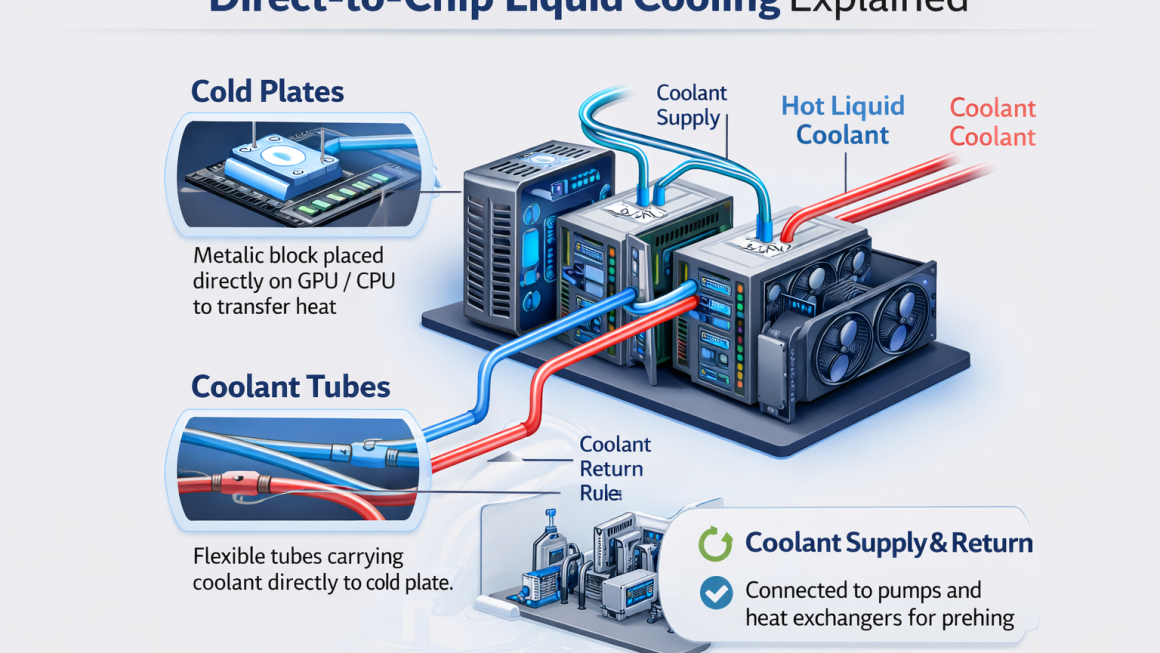
- Cold Plate Attachment: Each GPU/CPU is mounted with a cold plate that has channels for liquid flow.
- Liquid Flow: Water or dielectric fluid circulates through the cold plate, absorbing heat from the chip.
- Heat Removal: The heated liquid is then carried to a heat exchanger or radiator, where it is cooled before recirculation.
Result: More efficient heat transfer directly at the source, reducing hotspots and maintaining consistent performance.
2. Key Advantages of Direct-to-Chip Cooling
| Advantage | Explanation |
|---|---|
| High Efficiency | Direct contact removes heat faster than air or rear-door cooling. |
| Supports High Density | Rack power densities of 50–100kW+ become manageable. |
| Lower Energy Consumption | Fans are smaller or fewer; PUE is improved. |
| Stable Performance | Reduces thermal throttling for AI/GPU workloads. |
| Compact Design | Enables denser server layouts and better space utilization. |
3. Challenges and Considerations
- System Complexity: Requires plumbing, pumps, and leak management.
- CAPEX: Higher upfront cost than air cooling.
- Maintenance: Coolant quality must be monitored to prevent corrosion or microbial growth.
- Integration: Not all legacy servers are easily retrofitted.
Despite these challenges, D2C liquid cooling is increasingly used in hyperscale AI and HPC data centers where efficiency and density are critical.
4. Materials Matter: TIMs, Graphene, and Aluminum
Efficiency depends not just on liquid flow, but also on thermal interfaces. Key material considerations:
- Thermal Interface Materials (TIMs): Minimize thermal resistance between chip and cold plate.
- Graphene/Carbon-Based Spreaders: Improve lateral heat conduction, distributing heat evenly.
- Optimized Aluminum Structures: Facilitate mounting and heat transfer, integrating with liquid channels.
Impact: Higher heat flux removal, longer chip life, and reduced operational costs.
5. Why Direct-to-Chip is the Future for AI Infrastructure
- Air cooling is reaching its limits for modern AI racks.
- D2C liquid cooling enables reliable, high-performance, and energy-efficient AI clusters.
- Coupled with advanced materials and hybrid solutions, it allows data centers to scale compute power without overheating constraints.