
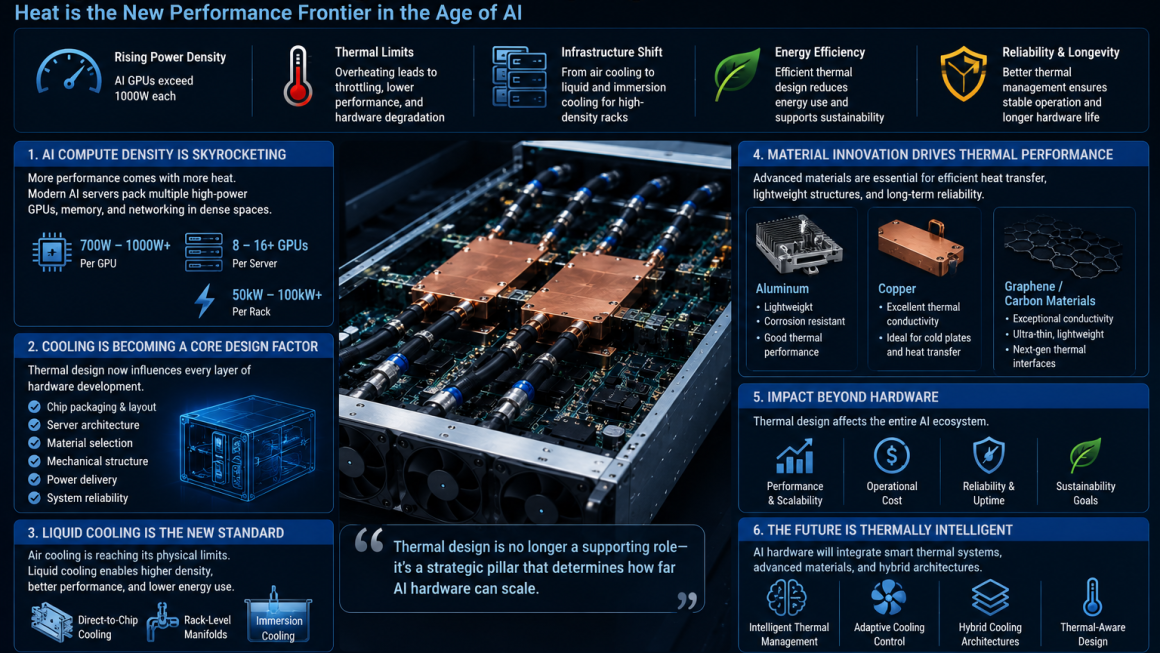
AI Hardware Is Entering a Thermal Era
For years, AI hardware development focused primarily on:
- Faster processors
- Larger GPU clusters
- Higher memory bandwidth
- Advanced semiconductor architectures
But today, a new engineering reality is emerging:
👉 Thermal design is becoming one of the most important forces shaping the future of AI hardware.
Modern AI systems now operate at:
- Extreme power densities
- Continuous heavy workloads
- Multi-GPU configurations
- Rack-scale compute clusters
As a result, heat management is no longer a secondary engineering task.
It is now influencing:
- Server architecture
- Material selection
- Mechanical design
- Infrastructure scalability
- Energy efficiency
- System reliability
1. AI Compute Density Is Rising Rapidly
Modern AI accelerators consume dramatically more power than traditional computing hardware.
Today’s AI GPUs may exceed:
- 700W
- 1000W+ per processor
Large AI servers can contain:
- 8 GPUs
- 16 GPUs
- Massive high-bandwidth memory systems
- Dense networking hardware
This creates:
- Extreme thermal concentration
- High rack-level heat density
- Continuous thermal stress
👉 Compute scaling is now directly tied to thermal management capability.
2. Thermal Limits Are Becoming Performance Limits
In modern AI systems, overheating can cause:
- Thermal throttling
- Reduced compute efficiency
- Lower GPU utilization
- Hardware degradation
This means:
- Raw compute power alone is no longer enough
Without efficient thermal design:
- AI hardware cannot operate at full performance for sustained workloads.
👉 Cooling capability is becoming a key determinant of usable AI performance.
3. AI Servers Are Being Physically Redesigned Around Cooling
Traditional servers were designed primarily around:
- Airflow pathways
- Standardized motherboard layouts
- Conventional rack dimensions
Modern AI servers increasingly revolve around:
- Liquid cooling integration
- Thermal zoning
- Coolant routing systems
- Structural heat management
Examples include:
- Direct-to-chip cooling
- Cold plate integration
- Rack-level manifolds
- Immersion cooling systems
👉 Thermal architecture is now reshaping physical server design itself.
4. Liquid Cooling Is Changing AI Infrastructure
Air cooling is reaching physical limitations in high-density AI environments.
As rack power approaches:
- 50kW
- 80kW
- 100kW+
liquid cooling is becoming increasingly necessary.
This shift is transforming:
- Server structures
- Rack engineering
- Facility design
- Maintenance workflows
Modern AI infrastructure now requires:
- Coolant distribution networks
- Leak prevention systems
- Fluid-compatible materials
- Thermal monitoring systems
👉 Cooling has evolved into a core infrastructure layer.
5. Thermal Design Is Driving Material Innovation
High thermal density creates demand for advanced materials.
Modern AI thermal systems require:
- High thermal conductivity
- Lightweight structural performance
- Corrosion resistance
- Long-term reliability
Aluminum
Used for:
- Heat spreaders
- Server structures
- Cooling enclosures
Advantages:
- Lightweight
- Good thermal performance
- Scalable manufacturing
Copper
Used for:
- Cold plates
- Thermal interfaces
- High-performance heat transfer
Advantages:
- Excellent thermal conductivity
Challenges:
- Heavy
- Expensive
Graphene and Carbon-Based Materials
Emerging for:
- Thermal interface materials
- Heat spreaders
- Advanced thermal coatings
Advantages:
- Exceptional heat transfer capability
- Lightweight integration potential
👉 AI hardware evolution is increasingly becoming a materials engineering challenge.
6. Thermal Design Is Changing Mechanical Engineering
Thermal systems affect nearly every structural aspect of AI hardware.
Challenges include:
- Thermal expansion
- Weight distribution
- Cold plate mounting pressure
- Vibration management
- Fluid routing integration
Heavy cooling systems also increase:
- Rack loading
- Structural stress
- Deployment complexity
👉 Mechanical and thermal engineering are becoming deeply interconnected.
7. Energy Efficiency Is Now a Thermal Problem
Cooling consumes a major portion of data center energy.
Poor thermal design increases:
- Fan power usage
- Cooling infrastructure demand
- Facility operating costs
Efficient thermal systems help:
- Reduce energy consumption
- Improve PUE (Power Usage Effectiveness)
- Support sustainability goals
👉 Thermal optimization is becoming both an engineering and economic priority.
8. Edge AI Is Creating New Thermal Challenges
Edge AI systems operate under very different conditions than hyperscale data centers.
Constraints include:
- Compact form factors
- Limited airflow
- Remote deployment locations
- Harsh environmental conditions
This drives demand for:
- Passive cooling systems
- Lightweight thermal structures
- Compact liquid cooling
- Advanced thermal materials
👉 Edge AI is accelerating innovation in thermal-mechanical integration.
9. Thermal Infrastructure Is Becoming Strategic
Historically, cooling was considered supporting infrastructure.
Today, thermal systems directly affect:
- AI scalability
- Hardware reliability
- Infrastructure economics
- Compute efficiency
Future competitive advantage will increasingly depend on:
- Thermal architecture
- Cooling efficiency
- Material innovation
- Structural integration
👉 Thermal design is becoming one of the most strategic engineering disciplines in AI infrastructure.
10. The Future: AI Hardware Will Be Thermally Driven
Future AI systems will likely integrate:
- Intelligent thermal management
- Smart cooling control systems
- Advanced material coatings
- Hybrid cooling architectures
- Thermal-aware infrastructure optimization
Thermal engineering will increasingly shape:
- Chip packaging
- Rack architecture
- Data center design
- Edge AI systems
- Infrastructure scalability
👉 The future of AI hardware development will be heavily influenced by how efficiently systems manage heat.
Conclusion: Thermal Design Is Redefining AI Hardware Engineering
The AI industry is entering a new phase where thermal management is no longer secondary.
It is now directly shaping:
- Hardware architecture
- Material selection
- Infrastructure scalability
- Energy efficiency
- System reliability
As AI workloads continue growing, successful hardware systems will increasingly depend on:
- Advanced cooling technologies
- Lightweight structural engineering
- High-performance thermal materials
- Integrated thermal-mechanical design
👉 In the next generation of AI infrastructure, thermal design will be one of the defining forces behind hardware innovation.