
AI Is No Longer Reserved for Hyperscale Data Centers
When artificial intelligence first began transforming industries, the focus was largely on massive computing facilities operated by hyperscale cloud providers.
Training large language models and advanced AI systems required:
- Thousands of GPUs
- Large-scale power infrastructure
- Advanced cooling systems
- Multi-billion-dollar investments
However, a new trend is emerging across the AI industry.
Organizations are increasingly deploying small-scale AI infrastructure closer to users, data sources, and business operations.
Today, AI workloads are being installed in:
- Factories
- Hospitals
- Retail stores
- Office buildings
- Telecom facilities
- Research laboratories
- Smart city networks
This shift is driving rapid growth in compact, scalable, and distributed AI infrastructure.
👉 AI is becoming decentralized, and small-scale infrastructure is at the center of that transformation.
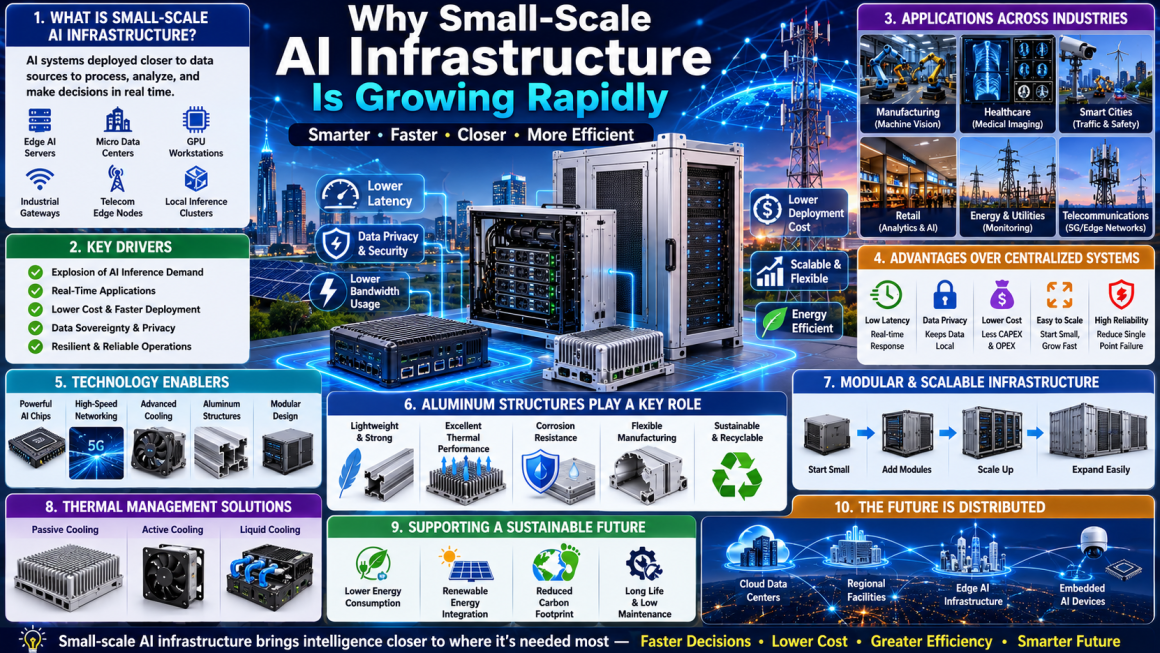
1. What Is Small-Scale AI Infrastructure?
Small-scale AI infrastructure refers to computing environments that support AI workloads without requiring large hyperscale facilities.
Examples include:
- Edge AI servers
- GPU workstations
- Micro data centers
- AI-enabled industrial gateways
- Telecom edge nodes
- Local inference clusters
These systems are typically designed to:
- Process data locally
- Reduce latency
- Improve reliability
- Support specific applications
Unlike hyperscale environments, small-scale AI infrastructure prioritizes flexibility and accessibility.
2. The Rise of AI Inference Is Driving Growth
One of the biggest reasons for this trend is the shift from AI training to AI inference.
Training large models requires enormous computing resources.
Inference, however, occurs when deployed models perform real-world tasks such as:
- Image recognition
- Predictive maintenance
- Natural language processing
- Quality inspection
- Intelligent monitoring
Inference workloads often benefit from being located near the source of data.
Benefits include:
- Faster response times
- Reduced network traffic
- Improved privacy
👉 As AI inference expands, demand for localized computing grows.
3. Edge AI Is Expanding Across Industries
The growth of Edge AI is creating strong demand for smaller infrastructure platforms.
Applications include:
Manufacturing
Factories use AI for:
- Machine vision
- Process optimization
- Predictive maintenance
Healthcare
Hospitals deploy AI for:
- Medical imaging
- Diagnostics
- Patient monitoring
Telecommunications
Operators use AI for:
- Network optimization
- Traffic management
- Edge computing services
Smart Cities
Applications include:
- Traffic monitoring
- Public safety
- Environmental sensing
👉 Many of these applications require local computing rather than centralized processing.
4. Lower Deployment Costs Are Accelerating Adoption
Building hyperscale facilities requires substantial investment.
Small-scale AI infrastructure offers a more accessible entry point.
Advantages include:
- Lower capital expenditure
- Faster deployment
- Reduced facility requirements
- Easier scalability
Organizations can start with modest deployments and expand as workloads increase.
This flexibility is particularly attractive for:
- Enterprises
- Research institutions
- Regional service providers
- Industrial operators
5. Smaller AI Systems Are Becoming More Powerful
Hardware advancements are making compact AI platforms increasingly capable.
Modern systems can integrate:
- High-performance GPUs
- AI accelerators
- Advanced CPUs
- High-speed networking
As semiconductor technology improves, more computing power can fit into smaller footprints.
This enables:
- Edge AI servers
- Compact GPU clusters
- AI-enabled industrial equipment
👉 Performance is increasing while physical size decreases.
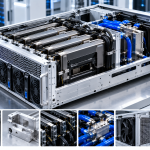
6. Thermal Management Is Enabling Compact Deployments
As computing density rises, thermal management becomes increasingly important.
Small-scale AI infrastructure must handle significant heat loads within limited space.
Common cooling approaches include:
Passive Cooling
Using:
- Aluminum heat sinks
- Thermal enclosures
- Heat spreaders
Active Cooling
Using:
- Fans
- Directed airflow systems
Liquid Cooling
Increasingly adopted for:
- High-density AI servers
- Compact GPU systems
- Edge data centers
Thermal engineering is becoming a critical factor in infrastructure design.
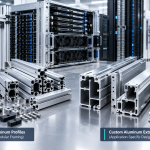
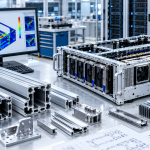
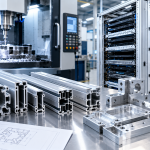
7. Aluminum Structures Support Scalable Deployment
Material selection plays an important role in small-scale infrastructure.
Aluminum is widely used because it provides:
Lightweight Construction
Benefits include:
- Easier transportation
- Faster installation
- Reduced structural requirements
Thermal Performance
Aluminum helps support:
- Passive cooling
- Heat spreading
- Thermal integration
Manufacturing Flexibility
Suitable for:
- Server chassis
- Edge enclosures
- Modular rack systems
👉 Aluminum supports both structural and thermal requirements.
8. AI Infrastructure Is Becoming More Modular
Organizations increasingly prefer modular deployment models.
Benefits include:
- Rapid installation
- Simplified maintenance
- Flexible expansion
- Lower operational complexity
Examples include:
- Modular AI cabinets
- Prefabricated micro data centers
- Edge computing containers
- Compact GPU racks
Modular infrastructure allows organizations to scale AI resources incrementally.
9. Sustainability Is Influencing Deployment Strategies
Large centralized facilities consume significant resources.
Small-scale AI infrastructure can improve efficiency by:
- Reducing data transmission requirements
- Supporting localized processing
- Optimizing energy use
Future deployments may increasingly integrate:
- Battery storage
- Renewable energy
- Smart energy management systems
Sustainability considerations are becoming part of infrastructure planning.
10. The Future of AI Will Be Distributed
The future computing landscape is unlikely to rely solely on hyperscale facilities.
Instead, it will consist of multiple interconnected layers:
Hyperscale Data Centers
Supporting model training and large-scale cloud services.
Regional AI Facilities
Providing localized computing resources.
Edge AI Infrastructure
Delivering low-latency processing.
Embedded AI Devices
Enabling intelligent products and autonomous systems.
This distributed architecture supports:
- Scalability
- Resilience
- Performance
- Efficiency
👉 Small-scale AI infrastructure is becoming a critical component of the broader AI ecosystem.
Conclusion
The rapid growth of small-scale AI infrastructure reflects a broader shift toward distributed computing.
Organizations increasingly require AI systems that are:
- Closer to users
- Faster to deploy
- Easier to scale
- More energy efficient
Advances in:
- AI hardware
- Thermal management
- Aluminum structural systems
- Modular design
- Edge computing
are making this transformation possible.
As AI adoption continues expanding across industries, small-scale infrastructure will play an increasingly important role in enabling intelligent, responsive, and scalable computing environments.
👉 The future of AI is not only bigger—it is also smaller, more distributed, and closer to where decisions are made.