
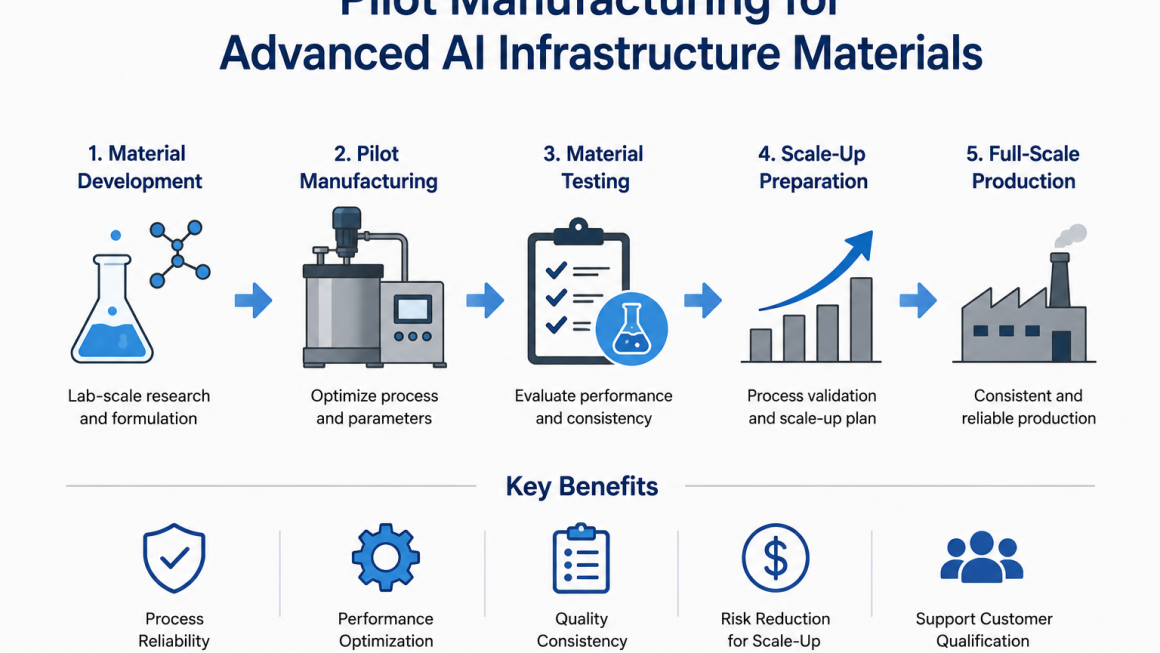
Artificial intelligence (AI) infrastructure is evolving rapidly, driving demand for advanced materials that can support higher computing density, improved thermal management, lightweight structural design, and long-term operational reliability. As new material technologies emerge, moving from laboratory research to industrial production requires a structured development process that balances technical performance, manufacturing feasibility, and quality consistency.
Pilot manufacturing serves as an important stage within this process. Positioned between laboratory-scale research and full-scale commercial production, pilot manufacturing enables developers to evaluate production methods, optimize processing parameters, and generate engineering data before larger-scale manufacturing decisions are made.
For advanced materials intended for AI infrastructure—including thermal interface materials, conductive composites, structural reinforcement materials, carbon-based materials, and functional coatings—pilot manufacturing provides an opportunity to assess manufacturing stability while supporting product development and customer evaluation.
This article discusses the role of pilot manufacturing in advanced AI infrastructure materials and outlines several considerations that may influence successful scale-up.
The Growing Demand for Advanced AI Infrastructure Materials
The rapid expansion of AI applications has increased the performance requirements for computing hardware.
Modern AI infrastructure includes:
- AI data centers
- GPU server clusters
- Edge AI devices
- High-performance computing (HPC) systems
- Network and communication equipment
- Power distribution systems
These systems often require materials that can support one or more of the following objectives:
- Efficient thermal management
- Reduced component weight
- Mechanical reinforcement
- Electrical insulation or conductivity
- Dimensional stability
- Compatibility with automated manufacturing
As computing systems become more integrated and power densities continue to increase, material development has become an important aspect of overall system design.
What Is Pilot Manufacturing?
Pilot manufacturing refers to the production of materials or components using manufacturing equipment and processes that more closely resemble industrial production than laboratory experiments, while remaining below full commercial production scale.
The primary purpose is not mass production but process verification.
Typical objectives include:
- Evaluating process repeatability
- Optimizing manufacturing parameters
- Assessing production consistency
- Supporting engineering validation
- Producing samples for qualification testing
- Identifying potential scale-up challenges
Pilot manufacturing may also provide valuable information for future production planning and quality control strategies.
Why Pilot Manufacturing Matters
Many advanced materials demonstrate promising laboratory performance but require additional development before they can be produced consistently at larger volumes.
Differences between laboratory preparation and industrial manufacturing may include:
- Equipment configuration
- Batch size
- Material handling
- Environmental control
- Mixing or dispersion methods
- Curing or heat treatment conditions
Pilot production helps identify how these factors influence final material properties.
Rather than assuming laboratory performance can be directly transferred to industrial production, pilot manufacturing provides an opportunity to evaluate process robustness under more representative manufacturing conditions.
Materials Commonly Evaluated Through Pilot Manufacturing
Several categories of advanced materials relevant to AI infrastructure may benefit from pilot-scale evaluation.
Thermal Management Materials
Examples include:
- Thermal interface materials (TIMs)
- Heat spreader materials
- Thermally conductive composites
- Gap fillers
- Thermal encapsulation materials
Pilot manufacturing can support evaluation of:
- Dispersion consistency
- Thermal conductivity variation
- Processability
- Manufacturing repeatability
Carbon-Based Functional Materials
Carbon materials continue to attract attention for advanced electronic applications.
Examples include:
- Graphene-enhanced materials
- Carbon nanotube (CNT) composites
- Graphite-based thermal materials
- Conductive carbon formulations
Pilot production may assist in assessing:
- Material uniformity
- Dispersion quality
- Mechanical stability
- Manufacturing compatibility
Structural Composite Materials
Lightweight structural materials are increasingly considered for AI hardware enclosures and supporting structures.
Examples include:
- Carbon fiber composites
- Resin systems
- Reinforced polymer materials
- Hybrid composite structures
Pilot-scale production allows manufacturers to study processing windows and evaluate manufacturing consistency before larger-scale deployment.
Functional Coatings
Advanced coatings may provide:
- Corrosion resistance
- Electrical insulation
- Thermal management
- Surface protection
Pilot manufacturing enables coating developers to optimize application methods and evaluate production repeatability.
Process Development During Pilot Manufacturing
Pilot manufacturing often focuses on refining the production process rather than maximizing output.
Areas that may be evaluated include:
Raw Material Preparation
Consistent raw material quality contributes to process stability.
Parameters may include:
- Particle size
- Moisture content
- Purity
- Storage conditions
Mixing and Dispersion
Many advanced materials contain functional fillers that require uniform dispersion.
Examples include:
- Graphene
- Carbon nanotubes
- Ceramic particles
- Conductive additives
Pilot production can help determine suitable mixing parameters while monitoring batch-to-batch consistency.
Forming and Processing
Depending on the material, manufacturing methods may include:
- Coating
- Lamination
- Extrusion
- Compression molding
- Additive manufacturing
- Casting
Pilot equipment allows engineers to evaluate production conditions under more representative manufacturing environments.
Quality Evaluation
Material characterization during pilot production may involve:
- Dimensional measurements
- Thermal conductivity
- Electrical properties
- Mechanical performance
- Density
- Surface quality
The specific evaluation methods depend on material type and intended application.
Supporting Customer Qualification
For many industrial applications, customers require engineering samples before considering larger procurement decisions.
Pilot manufacturing may provide materials for:
- Internal engineering evaluations
- Prototype development
- Compatibility testing
- Application-specific verification
- Process integration studies
Because application environments differ across industries, pilot samples often support collaborative evaluation between material suppliers and customers.
Scale-Up Considerations
Transitioning from pilot manufacturing to commercial production involves multiple engineering considerations.
Examples include:
Process Stability
Manufacturing parameters should remain controllable across larger production volumes.
Equipment Selection
Commercial production equipment may differ significantly from pilot equipment.
Scale-up often requires process adjustment rather than simple capacity expansion.
Quality Management
Consistent production typically relies on:
- Standard operating procedures
- Process monitoring
- Inspection methods
- Documentation systems
Supply Chain Readiness
Reliable sourcing of raw materials becomes increasingly important as production volumes increase.
Future Trends
Several industry trends are influencing pilot manufacturing for advanced AI materials.
Digital Process Monitoring
Sensors and data collection systems are increasingly used to monitor production parameters during pilot operations.
AI-Assisted Manufacturing Optimization
Machine learning tools are being explored for process analysis, parameter optimization, and predictive quality control.
Multi-Functional Material Systems
Future AI infrastructure materials may combine several functions within a single material, such as:
- Thermal management
- Mechanical reinforcement
- Electromagnetic shielding
- Electrical conductivity
Pilot manufacturing provides an environment for evaluating these more complex material systems before larger-scale implementation.
Sustainability Considerations
Manufacturers are also examining approaches to improve resource efficiency, reduce material waste, and optimize production processes as part of broader sustainability objectives.
As AI infrastructure continues to evolve, advanced materials are expected to play an increasingly important role in supporting higher computing performance, improved thermal management, and more efficient system integration. Successfully transitioning these materials from laboratory research to industrial production requires careful engineering and process development.
Pilot manufacturing provides an intermediate stage where production methods, material consistency, and manufacturing feasibility can be evaluated under conditions that more closely resemble industrial production. While pilot-scale production does not eliminate all scale-up challenges, it offers valuable technical information that can support engineering decisions and product development.
For organizations developing advanced materials for AI infrastructure, pilot manufacturing represents a practical step in understanding how laboratory innovations may be translated into manufacturing processes that are repeatable, measurable, and aligned with application requirements.