
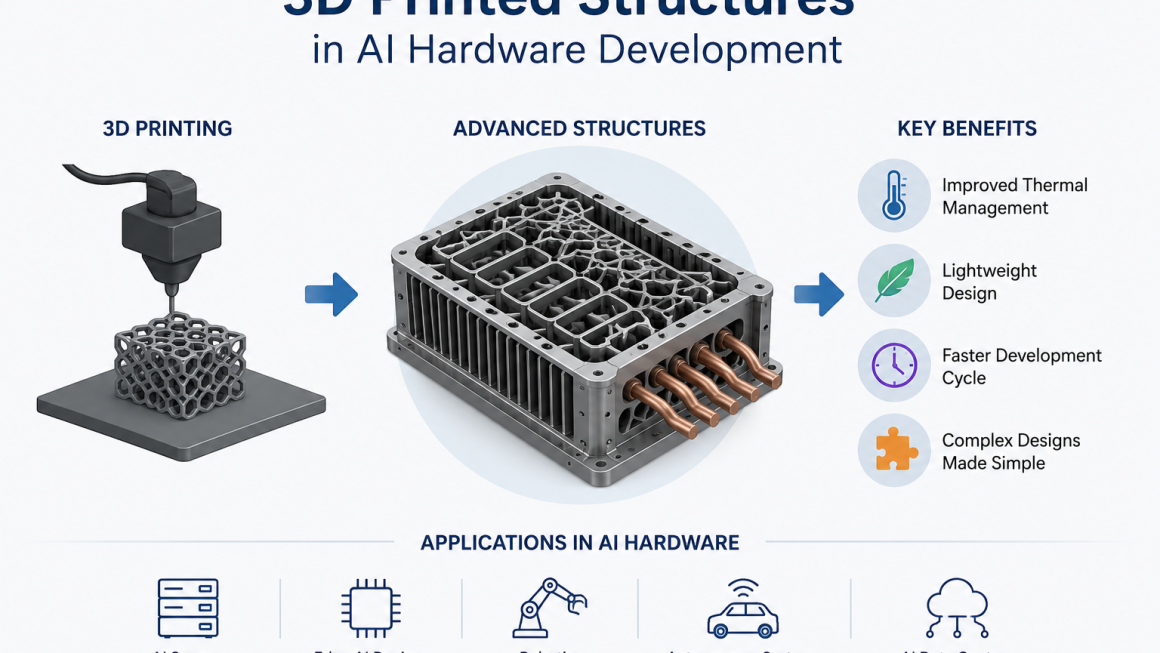
Artificial Intelligence (AI) is transforming industries at an unprecedented pace. From large language models and autonomous vehicles to industrial automation and edge computing, AI workloads continue to demand higher computational performance. As processors become more powerful, hardware developers face increasing challenges related to thermal management, weight reduction, structural complexity, and manufacturing efficiency.
Traditionally, AI hardware systems have relied on machined aluminum components, injection-molded plastics, and standardized mechanical assemblies. While these methods remain effective, they often limit design flexibility and slow down product development cycles.
This is where 3D printed structures are beginning to reshape AI hardware development.
Additive manufacturing enables engineers to create complex geometries that are difficult or impossible to produce using conventional manufacturing techniques. By integrating structural, thermal, and functional requirements into a single design, 3D printing offers new opportunities for developing next-generation AI servers, edge computing devices, robotic systems, and advanced electronics.
As AI infrastructure continues to expand globally, 3D printed structures are becoming an increasingly important tool for improving performance, accelerating prototyping, and reducing manufacturing constraints.
Why AI Hardware Requires New Structural Solutions
Modern AI hardware generates enormous amounts of heat while operating under demanding computational loads.
Typical AI systems include:
- AI servers
- GPU clusters
- Edge AI devices
- Autonomous robot controllers
- Industrial AI processors
- AI-enabled communication equipment
These systems face several common challenges:
Thermal Management
High-performance GPUs and AI accelerators may consume hundreds of watts per chip.
As power density increases, cooling becomes a critical factor influencing:
- System reliability
- Processing performance
- Component lifespan
- Energy efficiency
Structural Complexity
AI hardware often integrates:
- Heat sinks
- Cooling channels
- Sensors
- Power modules
- Communication interfaces
Traditional manufacturing frequently requires multiple components and assembly steps.
Weight Reduction
For applications such as:
- Autonomous drones
- Mobile robots
- Edge AI devices
- Aerospace AI systems
Reducing weight can directly improve operational efficiency.
Faster Development Cycles
AI hardware evolves rapidly.
Companies need to move from concept to prototype and from prototype to production much faster than traditional hardware development timelines allow.
How 3D Printing Changes AI Hardware Design
Unlike subtractive manufacturing, where material is removed from a solid block, additive manufacturing builds structures layer by layer.
This approach provides unprecedented design freedom.
Complex Internal Geometries
Engineers can create:
- Internal cooling channels
- Lattice structures
- Hollow reinforcement zones
- Topology-optimized components
These designs are often impossible to machine economically.
Part Consolidation
Multiple components can be combined into a single printed structure.
Benefits include:
- Fewer assembly steps
- Reduced failure points
- Lower inventory requirements
- Improved reliability
For AI hardware manufacturers, reducing assembly complexity can significantly shorten production timelines.
Rapid Iteration
Design modifications can be implemented digitally without creating expensive tooling.
This allows:
- Faster testing
- Quicker design validation
- Accelerated product development
Applications of 3D Printed Structures in AI Hardware
AI Server Cooling Systems
Cooling remains one of the largest challenges in AI infrastructure.
3D printing allows the production of:
- Customized heat sinks
- Liquid cooling manifolds
- Airflow optimization structures
- Cold plate components
Complex cooling geometries can improve heat transfer while reducing material usage.
As data centers continue deploying larger AI clusters, advanced cooling structures are becoming increasingly valuable.
Edge AI Devices
Edge computing places AI processing closer to data sources.
Examples include:
- Smart cameras
- Industrial sensors
- Autonomous vehicles
- Medical diagnostic equipment
These devices often require:
- Compact designs
- Lightweight structures
- Efficient heat dissipation
3D printed enclosures can integrate:
- Structural support
- Thermal pathways
- Cable routing
- Sensor mounting features
into a single component.
Robotics and Autonomous Systems
AI-powered robots rely heavily on lightweight structures.
3D printed designs enable:
- Weight reduction
- Improved stiffness-to-weight ratios
- Customized component layouts
Applications include:
- Warehouse robots
- Service robots
- Inspection drones
- Agricultural automation
Topology-optimized structures can reduce mass while maintaining mechanical strength.
AI Development Platforms
Research institutions and AI startups frequently require prototype hardware.
3D printing supports:
- Fast enclosure production
- Custom mounting brackets
- Experimental cooling systems
- Rapid design changes
This flexibility reduces both development costs and project risk.
Materials Used in 3D Printed AI Hardware
Material selection plays a critical role in performance.
Engineering Polymers
Common materials include:
- Nylon (PA)
- Polycarbonate (PC)
- ABS
- PEEK
- PEI (ULTEM)
Advantages:
- Lightweight
- Electrical insulation
- Good dimensional stability
Applications:
- Housings
- Structural frames
- Cable management systems
Metal Additive Manufacturing
Metal 3D printing is increasingly used for advanced AI hardware.
Materials include:
- Aluminum alloys
- Stainless steel
- Titanium alloys
- Copper alloys
Benefits:
- High strength
- Superior thermal conductivity
- Structural durability
Applications:
- Heat sinks
- Cooling manifolds
- Mounting structures
- Thermal interfaces
Carbon Fiber Reinforced Materials
Carbon fiber composites are becoming increasingly attractive for AI-related hardware.
Advantages include:
- High stiffness
- Low weight
- Excellent dimensional stability
Suitable for:
- Robotic systems
- AI drones
- Precision electronics
Graphene and Advanced Carbon Materials
Emerging research is exploring the integration of:
- Graphene
- Carbon nanotubes (CNTs)
- Hybrid carbon composites
into additive manufacturing materials.
Potential benefits include:
- Improved thermal conductivity
- Enhanced mechanical strength
- Electromagnetic shielding performance
- Reduced weight
Although still in early commercialization stages, these materials could significantly influence future AI hardware designs.
Thermal Management: The Most Promising Opportunity
Among all applications, thermal management may represent the most significant opportunity for 3D printed structures in AI systems.
AI processors continue to increase in power consumption.
Many next-generation accelerators exceed:
- 500W
- 700W
- Even 1000W per package
Traditional cooling methods face limitations in handling these thermal loads efficiently.
3D printed cooling solutions enable:
Conformal Cooling Channels
Cooling pathways can follow heat-generating surfaces precisely.
This improves:
- Heat extraction efficiency
- Temperature uniformity
- System stability
Lightweight Heat Exchangers
Advanced lattice geometries can increase surface area while minimizing weight.
Integrated Cooling Components
Designers can combine:
- Structural support
- Fluid distribution
- Thermal management
into a single printed component.
This reduces both complexity and manufacturing costs.
Challenges Facing Adoption
Despite the advantages, several challenges remain.
Production Scale
For very high-volume products, traditional manufacturing may still offer lower unit costs.
Material Qualification
AI hardware often requires strict standards regarding:
- Mechanical reliability
- Thermal performance
- Long-term durability
Material validation remains an important step.
Surface Finish Requirements
Certain applications require post-processing to achieve:
- Tight tolerances
- Smooth surfaces
- Enhanced thermal contact
Cost Considerations
Metal additive manufacturing remains more expensive than conventional machining for some applications.
However, cost comparisons should consider:
- Reduced assembly
- Faster development
- Improved performance
- Lower inventory requirements
Future Trends
Several technology trends suggest continued growth of additive manufacturing within AI hardware development.
AI-Designed Structures
AI itself is increasingly being used to optimize mechanical structures.
Generative design software can automatically create:
- Lightweight geometries
- Optimized airflow pathways
- Improved thermal structures
Many of these designs can only be manufactured through 3D printing.
Multi-Material Printing
Future systems may combine:
- Structural materials
- Thermal materials
- Conductive materials
within a single component.
Advanced Thermal Materials
Research continues into:
- Graphene-enhanced composites
- CNT-reinforced polymers
- High-conductivity printable materials
These developments could significantly improve AI hardware cooling performance.
Digital Manufacturing Ecosystems
As manufacturing becomes increasingly digital, additive manufacturing supports:
- Distributed production
- Faster customization
- Reduced supply chain complexity
This aligns well with the rapid evolution of AI hardware markets.
The rapid growth of artificial intelligence is driving demand for more efficient, reliable, and innovative hardware platforms. Traditional manufacturing methods remain important, but they increasingly struggle to accommodate the structural complexity, thermal challenges, and accelerated development cycles required by modern AI systems.
3D printed structures provide a powerful alternative by enabling complex geometries, lightweight designs, integrated functionality, and rapid prototyping. From AI servers and edge computing devices to robotics and autonomous systems, additive manufacturing is helping engineers rethink how hardware is designed and produced.
As material technologies continue advancing—including carbon fiber composites, graphene-enhanced materials, and next-generation thermal management solutions—the role of 3D printing in AI hardware development is expected to expand further.
For companies seeking to improve cooling performance, reduce weight, accelerate product development, and create highly optimized structures, 3D printed solutions are becoming an essential part of the future AI hardware ecosystem.