



Smart Sensing Is Becoming the Foundation of Modern Infrastructure
The world is becoming increasingly connected through sensors.
Today, smart sensing technologies are deployed across:
- Smart cities
- Industrial automation systems
- Transportation networks
- Energy infrastructure
- Telecommunications systems
- Environmental monitoring platforms
These sensors continuously collect data that supports:
- Artificial intelligence
- Predictive maintenance
- Real-time decision-making
- Infrastructure optimization
As sensing networks expand, attention is shifting beyond electronics and software.
A critical but often overlooked component is the structural platform that supports sensing systems.
👉 Aluminum structures are becoming an essential part of modern smart sensing infrastructure.
1. What Is Smart Sensing Infrastructure?
Smart sensing infrastructure refers to the physical and digital systems that collect, process, and transmit real-world data.
Typical sensing systems include:
- Cameras
- LiDAR units
- Environmental sensors
- Vibration sensors
- Temperature sensors
- Air quality monitoring devices
- Energy monitoring equipment
These systems are often deployed in challenging environments where structural reliability is essential.
Applications include:
- Roadside monitoring stations
- Utility networks
- Industrial facilities
- Renewable energy installations
- Edge AI platforms
👉 Sensors require robust structural support to operate reliably over long periods.
2. Why Structural Materials Matter
While sensors themselves are becoming smaller and more advanced, the infrastructure supporting them must address numerous engineering challenges.
These include:
- Mechanical stability
- Environmental exposure
- Thermal management
- Corrosion resistance
- Ease of installation
Poor structural design can affect:
- Sensor accuracy
- Equipment lifespan
- Maintenance costs
- System reliability
As a result, material selection is becoming increasingly important.
3. Why Aluminum Is Widely Used
Aluminum has become one of the preferred materials for smart sensing infrastructure.
Its popularity comes from a combination of mechanical, thermal, and environmental advantages.
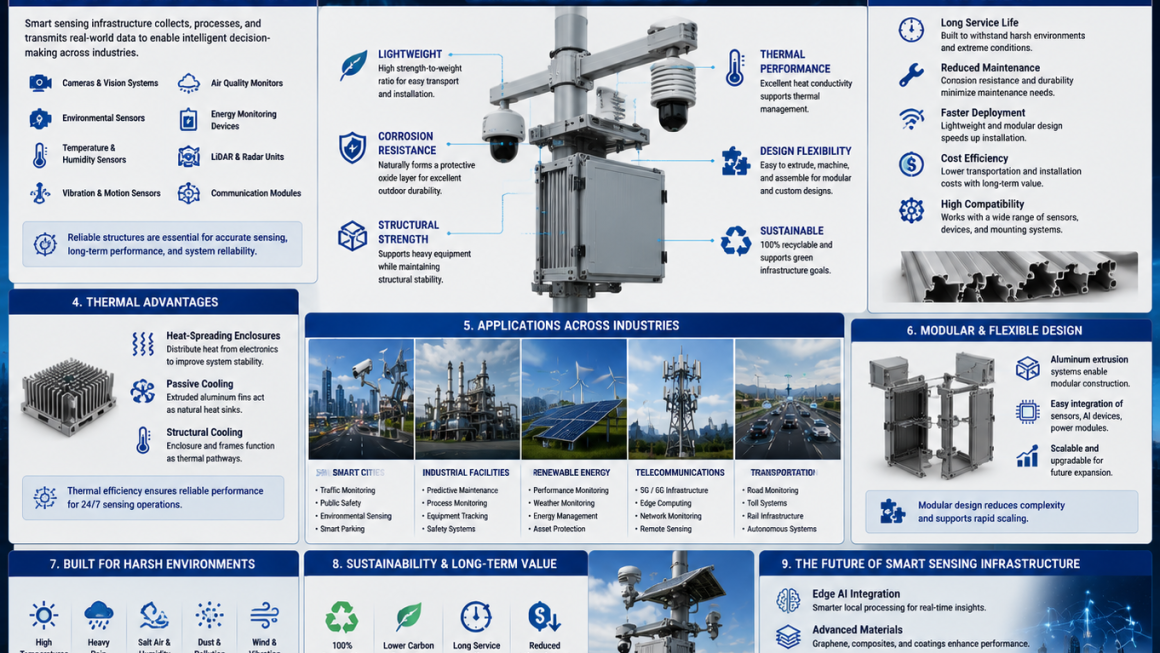
Lightweight Construction
Many sensing systems are installed in locations where weight matters.
Examples include:
- Utility poles
- Telecom towers
- Building facades
- Solar installations
Aluminum significantly reduces structural weight compared with steel while maintaining sufficient strength.
Benefits include:
- Easier transportation
- Faster installation
- Reduced support requirements
👉 Lightweight design lowers deployment costs.
Corrosion Resistance
Outdoor sensing systems may operate for years under exposure to:
- Rain
- Humidity
- Salt air
- Industrial pollutants
Aluminum naturally forms a protective oxide layer that helps resist corrosion.
This improves:
- Service life
- Reliability
- Maintenance intervals
Structural Strength
Modern aluminum alloys provide excellent strength-to-weight ratios.
This allows structures to support:
- Cameras
- Communication equipment
- Edge AI processors
- Power systems
without excessive weight penalties.
4. Supporting Edge AI and Intelligent Monitoring
Smart sensing systems increasingly incorporate local intelligence.
Many modern installations now include:
- AI processors
- Edge computing devices
- Video analytics hardware
- Machine learning accelerators
These components require:
- Stable mounting structures
- Environmental protection
- Thermal management support
Aluminum structures provide a versatile platform for integrating both sensing and computing equipment.
👉 Smart sensing and Edge AI are becoming closely connected.
5. Thermal Benefits of Aluminum Structures
Many sensing systems operate continuously.
This creates thermal challenges for:
- Processors
- Communication modules
- Power electronics
Aluminum contributes to thermal management through its good thermal conductivity.
Applications include:
Heat-Spreading Enclosures
The enclosure itself can help distribute heat away from sensitive electronics.
Passive Cooling Systems
Aluminum fins and extrusions can function as heat sinks.
Structural Cooling
Integrated aluminum frames can serve as thermal pathways.
👉 Structural and thermal functions are increasingly being combined.
6. Applications Across Multiple Industries
Aluminum structures support smart sensing deployments across a wide range of sectors.
Smart Cities
Applications include:
- Traffic monitoring
- Parking systems
- Environmental sensing
- Public safety networks
Lightweight aluminum poles and enclosures simplify large-scale deployment.
Industrial Facilities
Factories increasingly deploy sensing systems for:
- Predictive maintenance
- Equipment monitoring
- Process optimization
Corrosion-resistant aluminum structures perform well in industrial environments.
Renewable Energy
Solar and wind installations use sensors to monitor:
- Equipment performance
- Environmental conditions
- Energy generation
Aluminum structures help reduce installation weight while maintaining durability.
Telecommunications
5G and future network deployments rely heavily on distributed sensing and monitoring systems.
Aluminum supports:
- Antenna mounts
- Edge computing cabinets
- Sensor housings
throughout telecom infrastructure.
7. Modular Design Is Becoming More Important
As sensing networks grow, operators increasingly seek modular solutions.
Benefits include:
- Faster deployment
- Easier upgrades
- Simplified maintenance
- Improved scalability
Aluminum extrusion systems are particularly well suited for modular construction.
These systems allow:
- Flexible mounting configurations
- Standardized components
- Future expansion capability
👉 Modularity supports large-scale infrastructure growth.
8. Sustainability Considerations
Infrastructure developers are placing greater emphasis on sustainability.
Aluminum offers several environmental advantages.
Recyclability
Aluminum can be recycled repeatedly without significant degradation.
Long Service Life
Durable structures reduce replacement requirements.
Lower Transportation Impact
Lightweight components reduce transportation energy consumption.
These factors support sustainability goals across infrastructure projects.
9. Future Trends in Smart Sensing Infrastructure
The next generation of sensing infrastructure will likely include:
Integrated Edge AI
Local processing will reduce latency and bandwidth demands.
Advanced Thermal Materials
Graphene and carbon-based thermal technologies may complement aluminum structures.
Smart Structural Systems
Future structures may incorporate sensors that monitor:
- Vibration
- Temperature
- Structural health
Hybrid Material Architectures
Combining:
- Aluminum
- Composites
- Advanced coatings
- Thermal materials
to improve performance.
👉 Infrastructure itself is becoming increasingly intelligent.
Smart sensing infrastructure is becoming a critical foundation of digital transformation.
From smart cities and industrial facilities to renewable energy and telecommunications networks, sensing systems require reliable structural platforms capable of supporting:
- Sensors
- Edge AI devices
- Communications equipment
- Power systems
Aluminum has emerged as one of the most important materials for these applications due to its:
- Lightweight design
- Corrosion resistance
- Structural strength
- Thermal performance
- Sustainability advantages
As sensing networks continue expanding, aluminum structures will play an increasingly important role in enabling scalable, reliable, and intelligent infrastructure.
👉 The future of smart sensing is not only about better sensors—it is also about smarter materials and better structural engineering.