

Remote AI Creates New Thermal Challenges
Artificial intelligence is increasingly moving beyond traditional data centers and into remote environments.
Today, AI devices are deployed in:
- Industrial facilities
- Renewable energy sites
- Telecommunications networks
- Smart transportation systems
- Agricultural monitoring stations
- Environmental sensing platforms
Many of these locations face unique constraints:
- Limited maintenance access
- Harsh environmental conditions
- Restricted power availability
- Dust and moisture exposure
As a result, traditional fan-based cooling is often undesirable or impractical.
This has led to growing interest in passive thermal structures that can manage heat without consuming additional power.
👉 For many remote AI deployments, passive cooling is becoming a key enabler of long-term reliability.
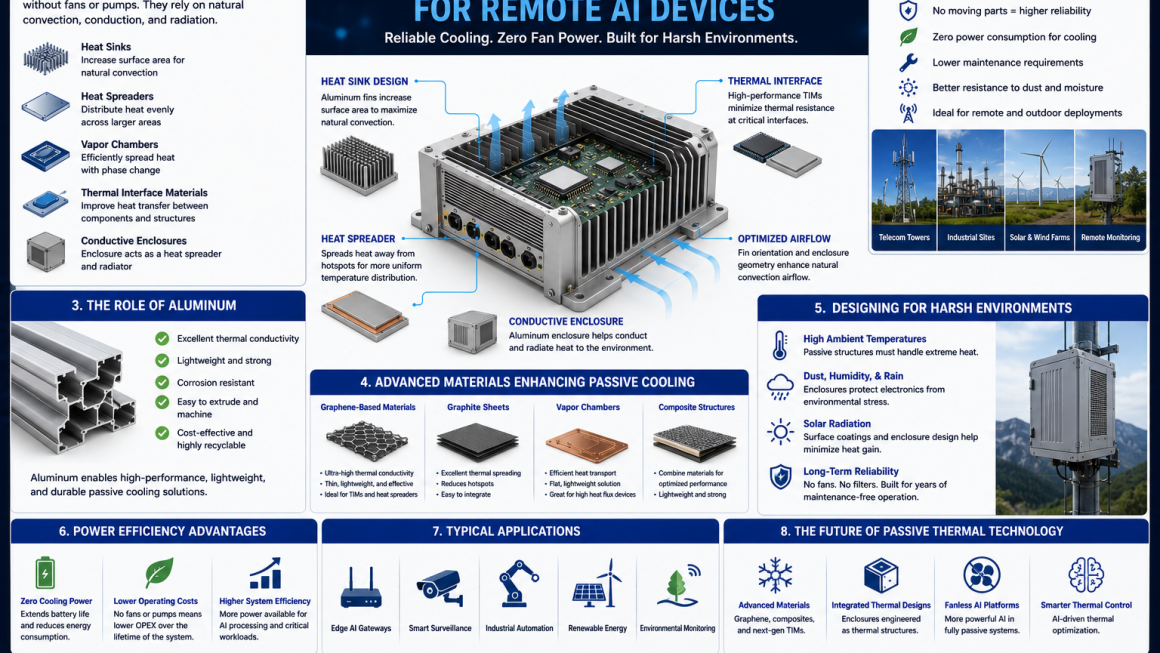
1. What Are Passive Thermal Structures?
Passive thermal structures are cooling solutions that dissipate heat without using powered mechanical devices such as:
- Fans
- Pumps
- Compressors
Instead, they rely on:
- Thermal conduction
- Natural convection
- Heat spreading
- Radiation
Common passive thermal components include:
- Heat sinks
- Heat spreaders
- Vapor chambers
- Thermal interface materials (TIMs)
- Conductive enclosures
These structures transfer heat away from critical electronic components and into the surrounding environment.
👉 Passive cooling works continuously without requiring additional energy input.
2. Why Remote AI Devices Favor Passive Cooling
Remote deployments often prioritize reliability over maximum computing density.
Every additional moving component introduces potential failure points.
Fan failures may lead to:
- Overheating
- Reduced performance
- Unexpected downtime
For systems located in:
- Telecom towers
- Utility substations
- Offshore facilities
- Remote industrial sites
maintenance visits can be expensive and infrequent.
Passive thermal structures help eliminate many of these risks.
Benefits include:
- Reduced maintenance requirements
- Lower power consumption
- Increased operational lifespan
- Improved environmental resistance
👉 Reliability is often the primary design goal for remote AI systems.
3. Heat Density Continues to Increase
Although edge devices are generally smaller than data center servers, their thermal demands continue growing.
Modern remote AI systems may contain:
- Edge GPUs
- AI accelerators
- Vision processing units
- High-performance CPUs
Applications such as:
- Machine vision
- Predictive maintenance
- Autonomous systems
- Real-time analytics
can generate significant thermal loads.
This means passive cooling systems must become increasingly sophisticated.
4. The Role of Aluminum in Passive Thermal Design
Aluminum remains one of the most widely used materials in passive cooling structures.
Its popularity stems from a combination of:
- Good thermal conductivity
- Low weight
- Corrosion resistance
- Cost efficiency
Heat Sink Applications
Aluminum heat sinks help:
- Increase cooling surface area
- Improve natural convection
- Reduce device temperatures
They are commonly found in:
- Edge AI gateways
- Industrial computers
- Outdoor communication equipment
Structural Heat Dissipation
In many modern designs, enclosure structures themselves contribute to cooling.
Aluminum housings can function as:
- Heat spreaders
- Thermal pathways
- Passive radiators
This integration reduces component count while improving thermal efficiency.
👉 Structural cooling is becoming increasingly important in remote AI systems.
5. Heat Spreaders and Thermal Distribution
Hotspots are one of the biggest challenges in compact AI hardware.
Localized heat concentration can reduce:
- Processor performance
- Component lifespan
- System reliability
Heat spreaders help distribute thermal energy over larger areas.
Common materials include:
- Aluminum
- Copper
- Graphite sheets
- Graphene-enhanced films
By spreading heat more evenly, passive structures improve overall cooling effectiveness.
6. Advanced Materials Are Expanding Passive Cooling Capabilities
As AI processors become more powerful, traditional cooling materials are being supplemented by advanced solutions.
Graphene-Based Thermal Materials
Graphene offers exceptionally high thermal conductivity.
Potential applications include:
- Thermal interface layers
- Heat spreading films
- Advanced coatings
Benefits include:
- Lightweight design
- Thin form factors
- Improved thermal transfer
Graphite Thermal Sheets
Widely used in compact electronics, graphite sheets help:
- Distribute heat rapidly
- Reduce thermal hotspots
- Improve passive cooling performance
Composite Thermal Structures
Future systems may combine:
- Aluminum
- Graphene
- Carbon composites
- Advanced polymers
to optimize thermal performance while minimizing weight.
👉 Materials science is becoming a major driver of passive cooling innovation.
7. Designing for Outdoor Environments
Remote AI systems often operate in challenging environments.
Design considerations include:
High Ambient Temperatures
Passive cooling must remain effective during summer heat conditions.
Dust Exposure
Fanless systems help reduce contamination risks.
Humidity and Rain
Corrosion-resistant materials become essential.
Solar Radiation
Outdoor enclosures may require additional thermal protection to minimize solar heat gain.
These factors influence both thermal and structural design decisions.
8. Power Efficiency Advantages
Every watt consumed by cooling systems reduces overall energy efficiency.
This is particularly important for:
- Solar-powered systems
- Battery-supported deployments
- Remote monitoring stations
Passive cooling consumes no operational power.
Benefits include:
- Lower energy consumption
- Extended battery runtime
- Reduced operating costs
👉 Passive thermal structures directly support energy-efficient AI infrastructure.
9. Future Trends in Passive Thermal Engineering
As Edge AI continues to grow, passive cooling technologies will become increasingly sophisticated.
Emerging trends include:
Graphene-Enhanced Heat Spreaders
Providing higher thermal performance in compact spaces.
Intelligent Thermal Materials
Materials capable of adapting to changing operating conditions.
Lightweight Aluminum-Composites
Combining structural strength with enhanced heat dissipation.
Integrated Thermal Enclosures
Where the entire enclosure functions as a cooling system.
Fanless AI Platforms
Designed specifically for long-life remote deployments.
👉 The future of remote AI hardware will increasingly depend on advanced passive thermal engineering.
Remote AI devices face unique challenges related to reliability, maintenance, energy efficiency, and environmental exposure.
Passive thermal structures provide an attractive solution by offering:
- High reliability
- Zero cooling power consumption
- Reduced maintenance requirements
- Long operational lifespans
Materials such as aluminum, graphite, graphene, and advanced composites are helping expand the capabilities of passive cooling systems.
As AI continues moving toward distributed and remote deployments, passive thermal structures will play an increasingly important role in enabling efficient, reliable, and scalable edge computing infrastructure.
👉 In many remote AI applications, thermal engineering is becoming just as important as computing performance itself.