
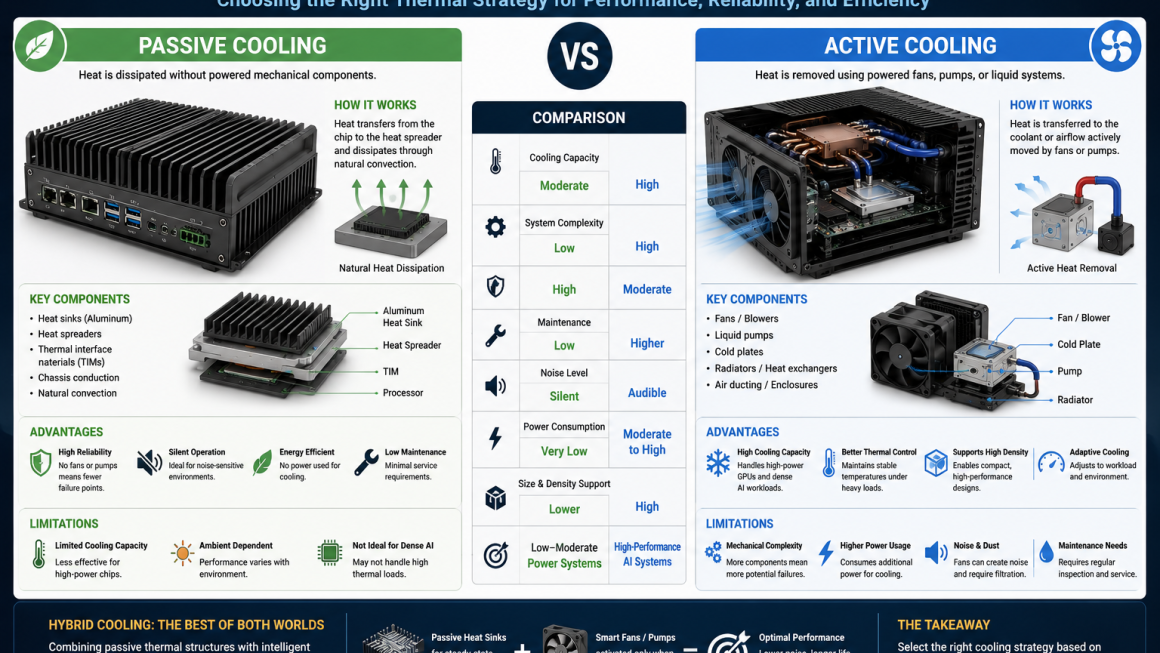
Cooling Is Becoming a Critical Challenge for Edge AI
As AI computing expands beyond hyperscale data centers, Edge AI infrastructure is rapidly growing across:
- Smart factories
- Autonomous systems
- Telecom networks
- Retail environments
- Healthcare devices
- Smart city platforms
Unlike centralized AI clusters, edge systems often operate in:
- Limited physical space
- Harsh environmental conditions
- Remote locations
- Restricted airflow environments
This creates a major engineering challenge:
👉 How can edge AI systems maintain reliable thermal performance within compact and constrained environments?
The answer increasingly depends on choosing the right cooling architecture:
- Passive cooling
- Active cooling
- Or hybrid thermal systems
1. What Is Passive Cooling?
Passive cooling removes heat without powered mechanical components such as fans or pumps.
Instead, it relies on:
- Heat sinks
- Heat spreaders
- Natural convection
- Thermal conduction
- Structural heat dissipation
Common passive cooling components include:
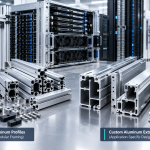
- Aluminum heat sinks
- Vapor chambers
- Thermal interface materials (TIMs)
- Conductive chassis structures
👉 Passive systems prioritize simplicity and reliability.
2. Advantages of Passive Cooling in Edge AI
High Reliability
Without moving parts:
- Failure risk is reduced
- Maintenance requirements are minimized
This is especially valuable in:
- Remote edge deployments
- Industrial automation systems
- Outdoor infrastructure
Low Noise Operation
Passive systems operate silently, making them suitable for:
- Medical environments
- Offices
- Retail systems
- Consumer-facing AI devices
Lower Maintenance
No fans or pumps means:
- Reduced dust accumulation
- Fewer mechanical failures
- Longer operational lifespan
Energy Efficiency
Passive cooling consumes little or no additional power.
👉 This improves overall system efficiency and sustainability.
3. Limitations of Passive Cooling
As AI compute density increases, passive cooling faces physical limitations.
Challenges include:
- Limited heat dissipation capability
- Reduced performance at high thermal loads
- Dependence on ambient airflow conditions
High-performance edge AI accelerators may generate:
- Thermal loads beyond passive cooling capability
👉 Passive cooling works best for:
- Low-power AI systems
- Moderate thermal density applications
4. What Is Active Cooling?
Active cooling uses powered thermal management systems such as:
- Fans
- Blowers
- Liquid cooling pumps
- Refrigeration systems
These systems actively move:
- Air
- Liquid coolant
- Heat energy
👉 Active cooling enables significantly higher thermal performance.
5. Advantages of Active Cooling in Edge AI
Higher Cooling Capacity
Active systems can support:
- High-power GPUs
- Dense AI accelerators
- Continuous heavy workloads
Better Thermal Control
Active systems provide:
- Stable temperature regulation
- Dynamic thermal adjustment
- Improved hotspot management
Support for Compact High-Density Systems
Because heat removal is more efficient:
- Systems can be smaller and denser
This is increasingly important for:
- Edge AI servers
- Telecom AI nodes
- Autonomous compute platforms
👉 Active cooling enables high-performance edge computing.
6. Limitations of Active Cooling
Active cooling also introduces challenges.
Mechanical Complexity
Fans and pumps add:
- Failure points
- Maintenance requirements
- Reliability concerns
Power Consumption
Cooling hardware itself consumes energy.
This affects:
- System efficiency
- Battery-powered edge devices
- Operational cost
Noise and Dust Issues
Fan-based systems may:
- Generate noise
- Accumulate dust
- Require filtration systems
Liquid Cooling Complexity
Advanced active systems require:
- Fluid management
- Leak prevention
- Material compatibility engineering
👉 Active cooling improves performance but increases system complexity.
7. Materials Play a Critical Role in Both Approaches
Cooling performance depends heavily on materials engineering.
Aluminum
Widely used for:
- Passive heat sinks
- Structural heat spreaders
- Lightweight cooling enclosures
Advantages:
- Lightweight
- Corrosion resistant
- Good thermal conductivity
Copper
Used for:
- High-performance thermal interfaces
- Vapor chambers
- Cold plates
Advantages:
- Excellent heat conductivity
Limitations:
- Heavy
- Expensive
Graphene and Carbon Materials
Emerging for:
- Thermal interface materials
- Thin heat spreaders
- Advanced thermal coatings
Advantages:
- Exceptional thermal conductivity
- Compact thermal integration
👉 Advanced materials are helping improve both passive and active cooling architectures.
8. Hybrid Cooling Architectures Are Emerging
Many future edge AI systems will combine:
- Passive cooling structures
- Intelligent active cooling support
Examples include:
- Passive aluminum chassis with low-speed fans
- Vapor chamber systems with adaptive airflow
- Liquid-assisted passive thermal systems
This hybrid approach helps balance:
- Performance
- Reliability
- Noise reduction
- Energy efficiency
👉 Hybrid cooling is becoming increasingly important in edge AI infrastructure.
9. Choosing the Right Cooling Architecture
The ideal cooling strategy depends on:
- AI workload intensity
- Environmental conditions
- Deployment location
- Maintenance accessibility
- Power availability
Passive Cooling Is Best For:
- Low-power edge AI devices
- Silent operation environments
- Remote infrastructure
- Long-life systems with minimal maintenance
Active Cooling Is Best For:
- High-density AI workloads
- GPU-based edge systems
- Compact compute nodes
- Performance-critical infrastructure
👉 Future edge AI systems will increasingly require customized thermal strategies.
10. The Future of Edge AI Cooling
As edge AI continues expanding:
- Compute density will increase
- Thermal loads will rise
- System miniaturization will continue
Future cooling innovation will focus on:
- Advanced thermal materials
- Lightweight cooling structures
- Smart adaptive thermal systems
- Compact liquid cooling solutions
- Integrated thermal-mechanical design
👉 Cooling is becoming one of the defining engineering challenges of next-generation edge AI infrastructure.
Cooling Architecture Will Shape the Future of Edge AI
Edge AI infrastructure requires balancing:
- Performance
- Reliability
- Size constraints
- Energy efficiency
- Thermal management
Passive cooling offers:
- Simplicity
- Reliability
- Low maintenance
Active cooling enables:
- Higher compute density
- Greater thermal performance
- More scalable AI capability
👉 The future of edge AI will increasingly depend on intelligent combinations of:
- Thermal engineering
- Advanced materials
- Structural optimization
- Hybrid cooling architectures