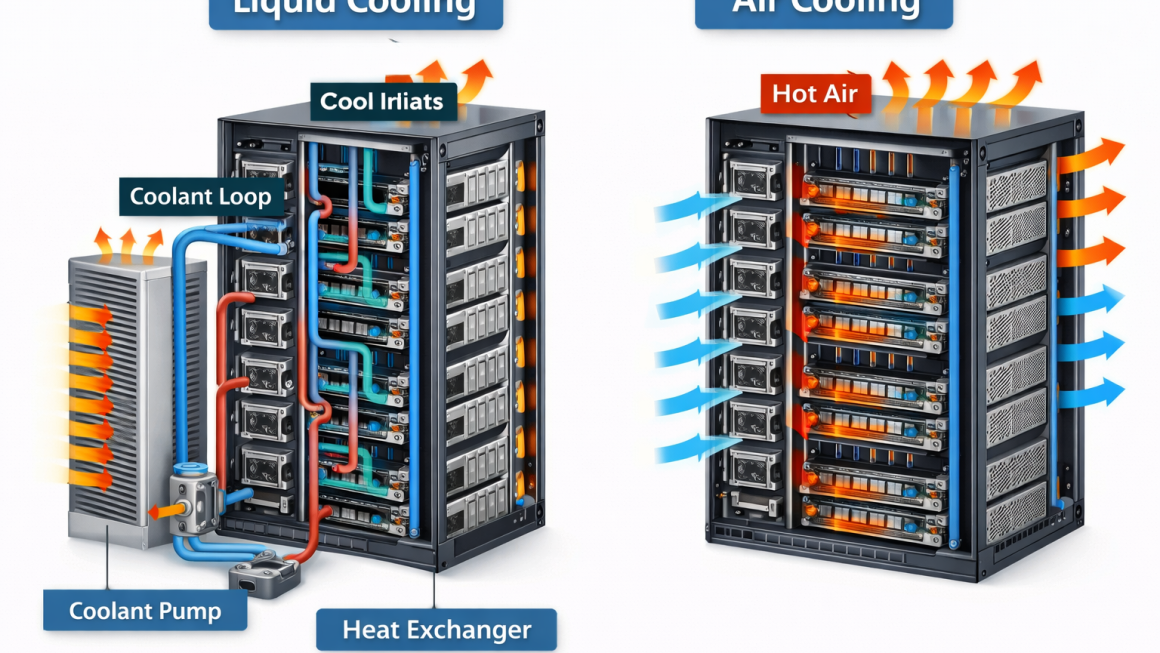
From Airflow Limits to Thermal Reality in High-Density Compute
When Air Is No Longer Enough
For decades, air cooling has been the default solution in data centers.
It is:
- Simple
- Cost-effective
- Easy to maintain
However, the rapid evolution of AI workloads is pushing hardware beyond the limits of traditional cooling approaches.
Modern AI systems now operate with:
- Extremely high power densities
- Continuous workloads (24/7)
- Compact, high-density configurations
This shift raises a critical question:
At what point does air cooling stop being sufficient?
Increasingly, the answer is clear:
👉 Liquid cooling is no longer optional—it is becoming essential.
The Thermal Challenge of AI Hardware
AI acceleration hardware—especially GPUs and AI-specific processors—has fundamentally changed thermal profiles.
1. Rising Power Density
Modern compute modules can exceed:
- 500W per GPU
- Multiple kilowatts per server
This results in:
- Concentrated heat sources
- High local heat flux
Air, as a cooling medium, struggles to remove this heat efficiently.
2. Continuous Operation
Unlike traditional workloads, AI systems:
- Run continuously
- Rarely return to idle states
This creates:
- Persistent thermal load
- Reduced recovery time for materials
3. Increasing System Density
To maximize performance per rack, systems are becoming:
- More compact
- More densely packed
This reduces:
- Airflow pathways
- Cooling effectiveness
The Physical Limits of Air Cooling
Air cooling relies on:
- Moving large volumes of air
- Creating temperature differences
- Maintaining airflow across components
However, it faces inherent limitations.
Low Heat Capacity
Air has relatively low:
- Thermal conductivity
- Heat capacity
This means:
- Large airflow is required
- Cooling efficiency drops at higher densities
Airflow Constraints
In dense systems:
- Air paths become restricted
- Hot spots form easily
- Cooling becomes uneven
Energy Inefficiency
High-performance air cooling requires:
- Powerful fans
- Increased energy consumption
In some cases, cooling overhead becomes a significant portion of total energy use.
Why Liquid Cooling Changes the Equation
Liquid cooling introduces a fundamentally different approach.
Instead of relying on airflow, it uses fluids to:
- Absorb heat directly
- Transport heat efficiently
- Maintain stable temperatures
Higher Thermal Efficiency
Liquids have:
- Much higher heat capacity than air
- Better thermal conductivity
This allows:
- More efficient heat removal
- Reduced temperature gradients
Direct Heat Transfer
Liquid cooling systems can:
- Bring coolant closer to the heat source
- Reduce thermal resistance
Examples include:
- Cold plates attached to GPUs
- Direct-to-chip cooling systems
Improved Thermal Stability
By removing heat more effectively, liquid cooling helps:
- Reduce temperature fluctuations
- Stabilize system operation
This is critical for:
- Long-term reliability
- Minimizing material fatigue
Impact on Materials and System Design
The shift to liquid cooling is not just about cooling technology—it reshapes material and structural design.
1. Thermal Interface Requirements
Liquid cooling increases expectations for:
- TIM performance
- Surface flatness
- Contact quality
Small inefficiencies at interfaces become more visible.
2. Structural Integration
Cooling systems must integrate with:
- Aluminum cold plates
- Mounting structures
- Sealing systems
This introduces new design challenges:
- Pressure management
- Mechanical stress
- Long-term sealing reliability
3. Corrosion and Material Compatibility
Liquid systems introduce:
- Risk of corrosion
- Chemical interaction between materials
Material selection becomes critical:
- Aluminum alloys
- Coatings
- Fluid compatibility
4. System-Level Complexity
Compared to air cooling, liquid systems require:
- Pumps
- Fluid routing
- Leak prevention strategies
This adds complexity—but also enables higher performance ceilings.
Trade-Offs and Considerations
Liquid cooling is not a universal solution. It introduces its own challenges.
Advantages
- Higher cooling capacity
- Better thermal stability
- Enables higher compute density
Challenges
- Increased system complexity
- Higher initial cost
- Maintenance requirements
- Risk management (e.g., leaks)
When Does Liquid Cooling Become Necessary?
There is no single threshold, but common indicators include:
- Power densities exceeding air cooling capability
- Persistent thermal hotspots
- Inefficient airflow in dense configurations
- Rising cooling energy consumption
In many modern AI deployments, these conditions are already present.
Aluminum4AI Perspective: Supporting the Transition
At aluminum4ai.com, liquid cooling is viewed as part of a broader shift:
👉 From airflow-based systems to thermal transport systems
Focus Areas
- Thermal interface optimization
- Aluminum component integration (e.g., cold plates)
- Structural considerations under thermal and mechanical stress
Supporting R&D
Rather than offering complete cooling systems, the focus is on:
- Understanding material behavior
- Supporting early-stage design decisions
- Exploring integration strategies
Future Trends in AI Data Center Cooling
1. Direct-to-Chip Cooling
- Increasing adoption in high-performance systems
- Reduced thermal resistance
2. Immersion Cooling
- Entire systems submerged in dielectric fluids
- Further improvements in heat removal
3. Hybrid Cooling Architectures
- Combining air and liquid cooling
- Balancing performance and complexity
4. Material Innovation
- Improved TIMs
- Advanced coatings
- Enhanced corrosion resistance
Cooling Defines the Future of Compute
As AI workloads continue to scale, cooling is no longer a supporting system—it is a defining constraint.
Air cooling, while still valuable, is approaching its practical limits in high-density environments.
Liquid cooling is not just an upgrade—it is an enabling technology.
It allows:
- Higher performance
- Greater density
- Improved long-term stability
For aluminum4ai.com, this reinforces a key idea:
👉 The future of AI hardware will be shaped not only by chips—but by how effectively we manage heat through materials, interfaces, and system design.